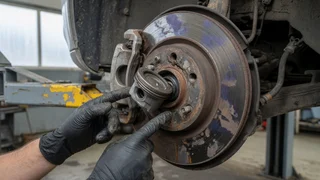
Recognize Brake Caliper Failure Symptoms
The short answer
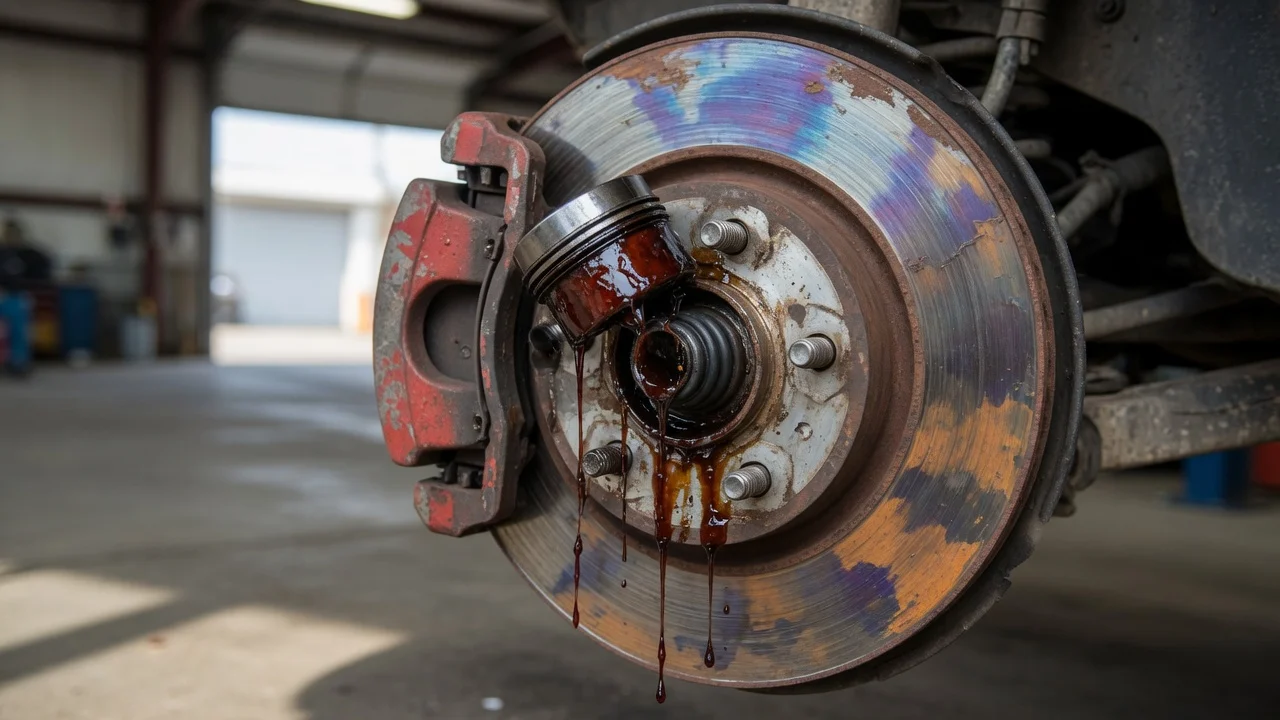
A failing brake caliper usually shows itself in one of two ways: it sticks, or it leaks. A sticking caliper keeps the pads pressed against the rotor or fails to apply them evenly. A leaking caliper loses brake fluid past its piston seal. The most common signs are the vehicle pulling to one side, a burning smell or one wheel running noticeably hotter than the others, uneven brake pad wear, brake fluid on the inside of a wheel or tire, a soft or sinking brake pedal, and a falling brake fluid level.
None of these signs proves on its own that the caliper is the problem. Brake hoses, the master cylinder, pads, rotors, tires, wheel alignment, wheel bearings and the parking brake can all produce similar symptoms. The useful approach is to treat each symptom as an observation, then use simple checks to narrow down where it comes from.
Terms used in this guide
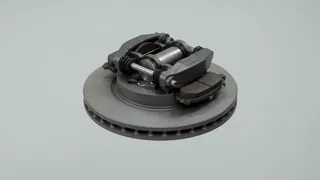
Brake caliper: the clamp-like assembly at each disc-braked wheel that squeezes the brake pads against the rotor when you press the pedal. Piston: the part inside the caliper that hydraulic pressure pushes outward to apply the pads. A rubber seal around it keeps fluid in and helps pull it back slightly when you release the pedal. Slide pins (also called guide pins): on floating calipers, these let the caliper body move so both pads clamp evenly. Fixed calipers have pistons on both sides and do not slide. Rotor (brake disc): the metal disc the pads clamp against. ABS (anti-lock braking system): the system that modulates brake pressure to prevent wheel lock-up. It is a separate system from the caliper, although both sit in the same hydraulic circuit. EPB (electric parking brake): on vehicles that have one, an electric motor is often mounted on the rear calipers to apply the parking brake. Whether your vehicle uses this design depends on the model, year and trim.
Common symptoms and what they can point to
Observation | Possible caliper-related cause | Other possible causes; Pulls to one side when braking | A caliper on one side not applying fully (seized piston or slide pins), or fluid-contaminated pads on one side | Uneven tire pressure, worn or mismatched tires, alignment or suspension problems, a restricted brake hose; Pulls to one side while driving without braking | A caliper dragging on the side the vehicle pulls toward | Alignment, tire condition, a dragging parking brake; Burning smell, smoke, or one wheel much hotter after a drive | A dragging caliper from a stuck piston or seized slide pins | A collapsed brake hose holding pressure, a parking brake not fully releasing, a failing wheel bearing; Vehicle feels sluggish, coasts poorly, or fuel use rises | Dragging caliper | Dragging parking brake, tire pressure, other drivetrain issues; Inner and outer pads on one wheel worn very differently | Seized slide pins or a sticking piston | Worn or damaged caliper bracket, incorrect pad fitment; One axle side wearing pads much faster than the other | Sticking caliper on the faster-wearing side | Hose restriction, wheel bearing play; Brake fluid on the inner wheel, tire sidewall or around the caliper | Leaking piston seal, damaged bleeder screw, loose fitting | Leaking brake hose or line near the wheel; Soft, spongy or slowly sinking pedal | Fluid leaking from a caliper | Air in the system, a leaking line or hose, internal master cylinder failure; Brake fluid level dropping or low-fluid warning light | External caliper leak | Leak elsewhere in the system; normal pad wear also lowers the level gradually; Clunking or rattling over bumps or when braking | Loose caliper mounting bolts, worn slide pins or missing pad hardware | Suspension or steering components; Grinding or squealing | Pads worn down unevenly because of a sticking caliper | Simply worn pads, debris, a damaged rotor
When to stop driving
Some symptoms point to a loss of braking ability rather than wear or noise. Treat the vehicle as unsafe to drive and arrange for it to be moved without driving it if you notice a pedal that sinks toward the floor, visible brake fluid leaking at a wheel, a brake warning light together with a low fluid level, smoke from a wheel, or a strong pull that makes the vehicle hard to keep straight under braking.
Checks that help separate the causes
The checks below are listed roughly from least to most involved. Each one supports some explanations and rules out others, but none is a substitute for an inspection against the service information for your specific vehicle. Any work on brakes should only be done with the vehicle properly supported, and if you are not confident doing it, a qualified technician should carry it out.
1) Check the brake fluid level and look for leaks
Look at the fluid reservoir level against its markings, then look at the inner side of each wheel, the tire sidewall and the caliper body for wet fluid or residue. Fluid at one wheel strongly suggests a leak at that corner, but you still need to see whether it comes from the caliper itself, the bleeder screw, the hose connection or the hose. A low reservoir with no visible external leak points toward other explanations, including normal pad wear or an internal master cylinder fault, and does not by itself implicate a caliper.
2) Compare wheel temperatures after a drive
After a normal drive with light braking, compare the wheels on the same axle. Do not touch the rotors or calipers; they can be hot enough to cause burns. An infrared thermometer, if available, gives a safer comparison. One wheel that is clearly hotter than its partner on the same axle suggests that brake is dragging. It does not tell you why: a stuck caliper, a hose holding pressure, or a parking brake that is not releasing can all do this.
3) Spin each wheel by hand
With the vehicle safely raised and supported, and with the parking brake released where it acts on that wheel, rotate each wheel by hand. Some light pad contact is normal; a wheel that is much harder to turn than its counterpart on the same axle supports a dragging brake. Noise, roughness or play in the wheel instead suggests the wheel bearing may be involved, which can mimic some brake symptoms.
4) Inspect pad wear
Removing the wheel lets you compare pad thickness. If the inner and outer pads on the same caliper are worn very differently, the caliper is likely not sliding or retracting evenly, which points to seized slide pins or a sticking piston. If both pads on one side are worn far more than both pads on the other side, a dragging caliper on that side is one explanation, but a hose restriction remains possible. Pad thickness limits vary by vehicle and pad design and should be checked in the applicable documentation.
5) Check slide pin movement
On floating calipers, the caliper body should move on its slide pins without binding. Pins that are stiff, corroded or dry support a sliding problem rather than a piston problem, and they can often be serviced separately. This check does not apply to fixed calipers.
6) Distinguish trapped hydraulic pressure from a mechanical bind
If a wheel is dragging, a technician can briefly relieve hydraulic pressure at that caliper, typically by opening the bleeder screw, and see whether the wheel then turns freely. If it frees up, pressure was being held in the line, which points upstream toward a brake hose that has collapsed internally or another hydraulic component, rather than toward the caliper alone. If the wheel stays tight with pressure released, the cause is more likely mechanical: a seized piston, seized slide pins, pads binding in the bracket, or the parking brake mechanism. Opening the hydraulic system lets air in, so it must be bled correctly afterwards using the procedure and fluid specified for the vehicle.
7) Rule out non-brake causes of pulling
If the vehicle pulls but the brakes show no signs of dragging, leaking or uneven wear, check tire pressures and tire condition first, then consider alignment and suspension. A pull that happens only under braking leans toward a brake cause; a pull that is constant whether or not you brake leans toward tires, alignment or a dragging brake.
Warning lights and fault codes
A conventional hydraulic caliper has no sensor and does not set a fault code on its own. A brake warning light is more often linked to low fluid level, the parking brake switch or the pad wear sensor, depending on the vehicle. On vehicles with an electric parking brake, the EPB module can store fault codes related to the motor on the rear caliper, its wiring or its operation, and the ABS module may store codes for wheel speed or hydraulic faults.
A stored code describes a condition the control module detected, not which part has failed. For example, an EPB code could result from a seized caliper mechanism, a motor fault, a wiring or connector problem, or low battery voltage during operation, depending on the system. Look up the exact code definition and its test criteria for your vehicle's make, model and year, including the conditions under which it sets, before replacing any part. Some EPB calipers also require a scan tool procedure to retract the piston for service.
What this guide cannot tell you
Exact pad thickness limits, rotor specifications, fastener torques, brake fluid type, bleeding procedures and EPB service steps differ by vehicle and were not covered here. The same applies to which fault codes exist and what they mean. Use the service documentation for your specific vehicle, or a qualified technician, for those details and for confirming any diagnosis before parts are replaced.