Diagnose a Bad Brake Caliper: Symptoms, Checks and When to Stop Driving
The short answer
A failing brake caliper most often shows up as the vehicle pulling to one side, one wheel running noticeably hotter than the others, a burning smell after driving, uneven or rapid pad wear on one wheel, brake fluid leaking near a wheel, or a soft or sinking brake pedal. Several of these signs can also come from other parts, including brake hoses, pads, rotors, wheel bearings, tires or the parking brake. Treat any single symptom as a reason to inspect, not as proof that the caliper itself has failed.
This guide covers conventional hydraulic disc brake calipers on passenger vehicles. Some vehicles use rear calipers with an integrated electronic parking brake motor, and their behavior, warnings and service procedures differ by make, model and model year. No vehicle-specific specifications were supplied for this article, so always confirm details such as inspection limits, torque values and service steps in the service information for your exact vehicle.
What a brake caliper does
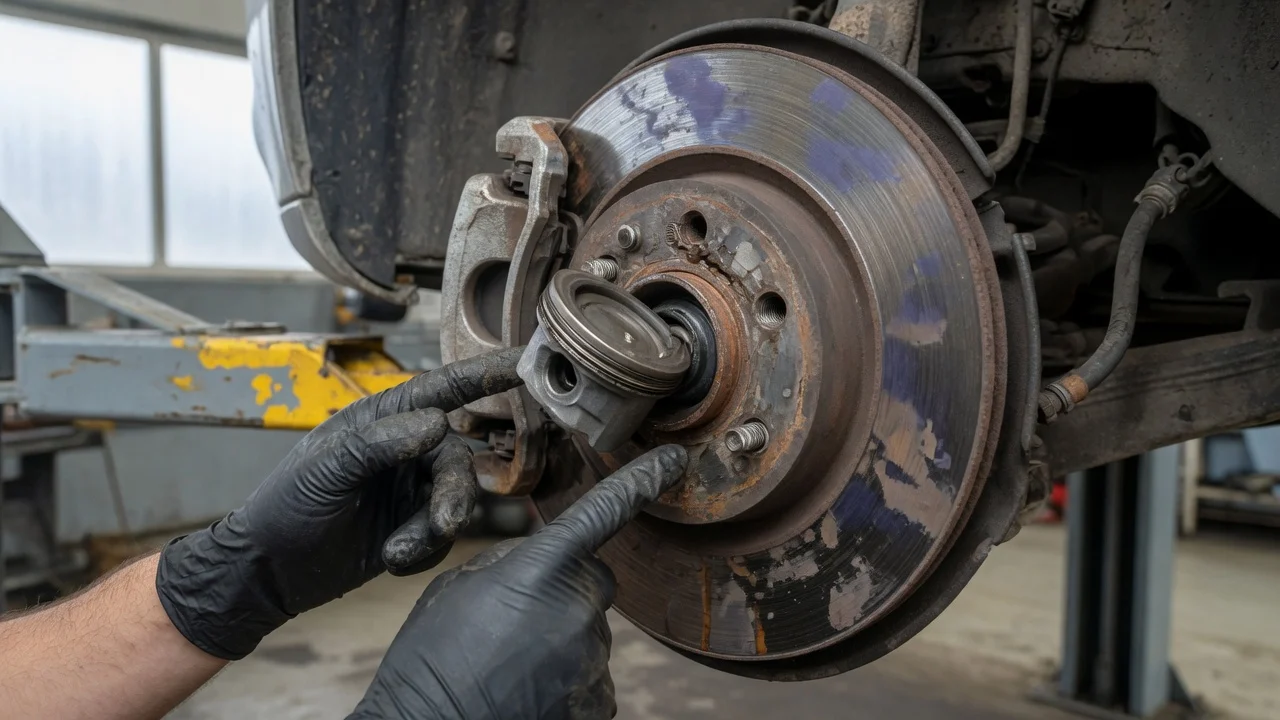
The caliper is the clamp that sits over the brake rotor. When you press the pedal, hydraulic pressure pushes one or more pistons inside the caliper, forcing the brake pads against the rotor. On many vehicles the caliper floats on slide pins (guide pins) so it can center itself and apply both pads evenly. Rubber boots and seals keep dirt and moisture out and fluid in. Most caliper problems come down to one of three things: a piston that sticks, slide pins that seize, or a seal that leaks.
Common symptoms of a bad caliper
Pulling to one side while braking, or sometimes while cruising, if one caliper is dragging or not applying fully. One wheel noticeably hotter than the others after a drive, often with a burning or hot-metal smell. Uneven pad wear: one pad worn much more than its partner on the same wheel, or one wheel's pads worn far more than the opposite side. Brake fluid wetness or residue on the inside of a wheel, the caliper body or the tire sidewall. A soft, spongy or slowly sinking brake pedal, or a falling fluid level in the reservoir. The vehicle feeling sluggish, as if the brakes are lightly applied, sometimes with reduced fuel economy. Clunking, rattling or knocking from a wheel area, which can point to loose or worn caliper hardware. Smoke from a wheel after driving, in severe cases of dragging.
What else could cause the same symptoms
Before blaming the caliper, consider the parts that commonly produce similar signs. Matching the symptom to the most likely cause helps you decide what to inspect first.
Symptom | Caliper-related cause | Other plausible causes; Pull to one side when braking | Stuck or slow piston, seized slide pins | Collapsed or restricted brake hose, contaminated pads, uneven tire pressure, alignment or suspension wear; One hot wheel or burning smell | Dragging piston or seized slide pins | Restricted hose holding pressure, stuck parking brake, failing wheel bearing; Uneven pad wear on one wheel | Seized slide pins or sticking piston | Worn or incorrectly installed pad hardware, warped or damaged pad; Fluid near a wheel | Leaking piston seal or bleeder screw | Leaking brake hose or line fitting, wheel cylinder on drum brakes; Soft or sinking pedal | Leaking caliper seal | Air in the system, leaking line or hose, master cylinder fault; Clunk or rattle | Loose caliper bolts, worn bushings or missing clips | Suspension or steering wear, loose heat shield
Checks you can make and what the results suggest
The checks below are observational. Work only on a level surface with the vehicle secured, use proper jack stands rather than a jack alone, and do not touch brake parts after driving because they can be hot enough to burn skin.
Compare wheel temperatures after a normal drive. Without touching, hold your hand near each wheel, or use a non-contact infrared thermometer if you have one. One wheel clearly hotter than its partner on the same axle suggests that brake is dragging, from the caliper, the hose or, on the rear, the parking brake. Spin each wheel by hand with the vehicle safely raised and in neutral where appropriate. Light, even pad contact is normal; a wheel that is hard to turn compared with its partner points to dragging. If it frees up after the brake is released and the hose is checked, the hose may be holding pressure rather than the caliper. Inspect pad thickness on both pads of each wheel. Even wear across both pads but one side worn faster than the other suggests a hydraulic or piston issue. One pad on the same wheel worn much more than the other often indicates seized slide pins. Look for fluid. Wetness around the piston boot or bleeder screw points to the caliper; wetness at a hose or line fitting points elsewhere. Check the reservoir level against its marks. Inspect the boots and slide pins. Torn or swollen boots let in moisture and dirt, which commonly lead to corrosion and sticking. Slide pins should move freely in their bores when the caliper is removed for service. Check the parking brake. If a rear wheel drags, confirm the parking brake fully releases. On vehicles with an electronic parking brake, service procedures can require a scan tool or a specific release sequence, so follow the manufacturer's instructions. Check tire pressures and look for uneven tire wear before attributing a pull to the brakes.
Warning lights and fault codes
A conventional hydraulic caliper has no sensor of its own, so it usually does not set a fault code directly. A brake warning light can indicate low fluid, a parking brake issue or another brake system fault, and a pad wear warning, where fitted, reports worn pads rather than a failed caliper. On vehicles with electronic parking brake calipers, stored codes can relate to the actuator motor, wiring or the caliper assembly. In every case, treat a code or warning as a starting point for inspection rather than confirmation that a specific part has failed, and check the code definition for your exact vehicle.
When to stop driving and get professional help
The brake pedal sinks toward the floor, feels much softer than usual, or the vehicle takes noticeably longer to stop. You see brake fluid leaking or the reservoir level keeps dropping. The red brake warning light stays on while driving. A wheel is smoking, or there is a strong burning smell along with a hard pull. The vehicle pulls sharply when braking, or you hear grinding that suggests pads are worn to the backing plate. You are not confident in diagnosing or repairing brakes, or your vehicle has an electronic parking brake that needs special procedures.
In these situations, avoid further driving where possible and arrange towing or an on-site inspection. Brake hydraulic work also requires correct bleeding afterward to remove air from the system, which affects pedal feel and stopping performance.
Repair or replace?
Seized slide pins can often be cleaned, lubricated with an appropriate brake grease and fitted with new boots, without replacing the caliper. A leaking piston seal or a corroded, sticking piston is usually resolved by rebuilding or replacing the caliper; many owners and shops choose replacement because remanufactured and new units are widely available. As an editorial recommendation, when a caliper has dragged, inspect the pads and rotor on that wheel as well, since heat and uneven wear may mean they also need attention. Cost, parts availability and whether calipers are commonly replaced in pairs vary by vehicle and supplier, and no pricing or vehicle-specific data was supplied for this guide.
Key takeaways
Pulling, a single hot wheel, uneven pad wear, fluid leaks and a soft pedal are the clearest signs of a caliper problem, but hoses, the parking brake, wheel bearings and tires can produce similar symptoms. Use simple comparisons between wheels to narrow the cause, treat warning lights and codes as clues rather than verdicts, and stop driving if the pedal, fluid level or braking performance changes.