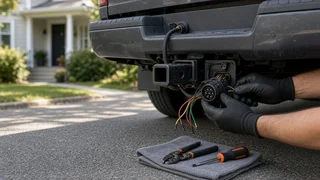
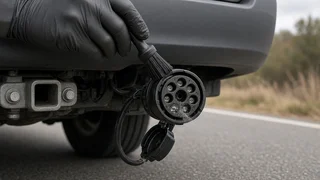
Boat Trailer Wiring Connector
A boat trailer wiring connector is the electrical bridge between the tow vehicle and the trailer, carrying stop, turn, tail, and sometimes reverse-light signals from the dash controls to the rear lamps. Because boat trailers routinely enter launch ramps, the connector must endure water, road spray, and corrosion far beyond what a dry utility trailer sees. Understanding its pinout, grounding behavior, and sealing methods helps you diagnose a dim or dead trailer light before it becomes a safety issue at the ramp or on the highway.
Essential answer
The essential answer is that a boat trailer wiring connector is a multi-pin plug and socket assembly that joins the tow vehicle’s lighting circuits to the trailer’s lamp wiring. In North America the most common styles are the flat four-pin for basic lighting and the round seven-pin when auxiliary power, reverse lights, or electric brakes are present, though boat trailers often use specialized sealed versions. The connector’s job is not simply to pass current; it must maintain clean, low-resistance contacts through water, vibration, and frequent connect/disconnect cycles.
The connector’s condition directly affects trailer-light behavior because any corrosion or looseness introduces resistance at the junction. With a 12-volt system, even a small voltage drop at a corroded pin can make a turn signal glow faintly or fail entirely. On a boat trailer, the environment adds an electrolyte in the form of lake or salt water, so the ground path matters as much as the hot feeds. A separated or green-corroded pin may not be a complete open circuit; it may still carry enough current to confuse a simple test light.