BMW Engine Oil Pressure Warning: What It Means and What to Check

The short answer
A red oil pressure warning on a BMW means the engine's lubrication system has reported pressure below the safe threshold. Treat it as an instruction to stop. Pull over as soon as it is safe, switch the engine off, and do not keep driving while the red warning is active. Running an engine without adequate oil pressure can damage bearings, the crankshaft and the valvetrain within a short time, and a repair after that kind of damage usually costs far more than a tow.
First confirm which warning you actually have. Many BMWs show a separate yellow or amber oil warning for low oil level, which is less urgent than a red pressure warning. Symbols, message wording and colour coding vary by model year, generation and market, so check the owner's manual or the vehicle's on-board manual for your car's exact meaning.
Red pressure warning vs yellow oil level warning
Warning | What it generally indicates | Urgency; Red oil can symbol or an oil pressure message | Oil pressure is too low for safe operation | Stop safely and switch off the engine; do not continue driving; Yellow or amber oil symbol or an oil level message | Oil level is low, or the level sensor or measurement needs attention | Check the level soon and top up with the specified oil; a red pressure warning that follows means stop; Oil level sensor or measurement fault message | The car cannot read the oil level reliably | Verify the level by another method if your car allows it, and have the sensor checked
The table summarises a general BMW convention, not a specification for every model. Some cars combine level and pressure information in the same display. The on-board message text, where present, is the most reliable guide for your specific vehicle.
What to do immediately
1) Move to a safe place and switch the engine off. Don't idle while you wait. 2) Note when the warning appeared: at start-up, at idle when hot, under braking or cornering, or at steady speed. This helps the diagnosis. 3) Note whether the warning was steady or flickering, and whether any other warnings or noises came with it, such as ticking, knocking or rattling. 4) Let the car stand on level ground, then check the oil level as described below. 5) Don't restart and drive if the red warning returns, or if the engine made unusual mechanical noises. Arrange recovery instead.
Check the oil level first
Low oil level is the simplest explanation to rule out. How you check it depends on the car. Older BMWs and some engines have a conventional dipstick. Many newer models have no dipstick and rely on an electronic oil level sensor, read through the instrument cluster or iDrive menu.
On cars with electronic measurement, the reading usually needs specific conditions, such as the car standing on level ground and the engine at a set temperature or running for a period. The exact procedure differs between models, so follow the owner's manual. This guide does not state those conditions for any particular model.
If the level is clearly low: top up with oil that meets the specification in your manual, then look for the cause of the loss, which could be a leak or oil consumption. If the level is restored and the red warning stays off, the low level was a likely contributor. Have the car inspected anyway, because the engine ran short of oil. If the level is correct: low level is ruled out as the cause. The warning points to a pressure-generating or sensing problem, and the car should not be driven until it is diagnosed. If the level is overfilled: overfilling can also cause problems, including oil aeration. Have the excess drained rather than driving on. If you cannot get a reading: treat the oil level as unknown and don't assume it is safe.
Possible causes and how to tell them apart
An oil pressure warning has two broad explanations. Either the pressure really is low, or the sensing system is reporting a false low. Distinguishing between them usually needs workshop equipment, but some observations point one way or the other.
Low oil level: the most common and easiest cause to confirm. The warning may first appear under hard cornering, braking or acceleration, when oil moves away from the pump pickup. Wrong oil grade or degraded oil: oil that is too thin for the specification, heavily diluted, or overdue for change may not hold pressure, especially at hot idle. Check the service history and the oil specification on the last invoice. Leaks: visible oil under the car, on the engine, or a burning smell suggests external loss. Gasket and seal leaks around the oil filter housing and similar joints are commonly reported on some BMW engines, but whether this applies depends on the engine family. Faulty oil pressure sensor or switch, or wiring: a warning that flickers erratically, appears with a correct level and no abnormal noise, or comes with sensor-related fault codes may point here. This can only be confirmed by measuring actual pressure. Oil pump or pump control problems: a failing pump, or a fault in pump control on engines that regulate oil pressure electronically, can cause genuinely low pressure. Not every BMW engine uses a controlled pump; this depends on the engine. Restricted oil supply: a blocked pickup screen, a clogged or wrong oil filter, or sludge can starve the pump. This is more likely after long service intervals or poor maintenance. Internal engine wear: worn crankshaft or connecting rod bearings let oil escape and lower pressure, often most noticeably when hot and at idle. Knocking or rumbling noises are a serious sign. Stop using the engine and get a professional diagnosis.
Using fault codes sensibly
Reading the stored fault codes with a BMW-capable diagnostic tool is a useful next step, but a code is evidence to investigate, not proof that a part has failed. A code for the oil pressure sensor, for example, can be set by a damaged connector, a wiring fault, or genuinely low pressure that the sensor reported correctly. Replacing a sensor on the strength of a code alone can leave a real lubrication problem undiagnosed.
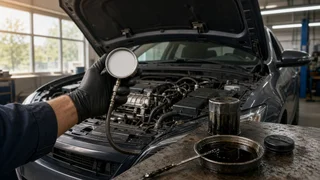
The decisive test is a mechanical oil pressure test. A workshop fits a calibrated gauge in place of the sensor and measures actual pressure at idle and higher engine speeds, hot and cold. It then compares the results with the manufacturer's specification for that engine. If the measured pressure is within specification, the sensing side is the likely fault. If it is low, the cause lies in the oil supply, the pump or the engine itself. Specific pressure values vary by engine and are not given here; a workshop should use the figures for your engine code.
When to stop driving and seek professional diagnosis
The red oil pressure warning is on or returns after restarting. The oil level is correct but the pressure warning appeared. The engine makes knocking, ticking, rattling or grinding noises. There is a significant leak, smoke, or a burning oil smell. The warning appears together with overheating or other engine warnings. You cannot verify the oil level.
In any of these cases, recovery to a workshop is safer than driving there. If the warning was brief, the level was low and has been corrected, and the warning has not returned, the car may be drivable with caution, but it still needs an inspection to find out why the oil was low and whether the engine was affected.
What this guide cannot tell you
No model-specific data was available for this article. It does not give oil pressure specifications, oil capacities, approved oil grades, sensor locations, known failure patterns for particular engines, or repair costs. For those details, use the owner's manual, BMW service information for your vehicle identification number, or a qualified BMW technician. Recalls and service campaigns related to oil pressure or oil level sensing may exist for some models and markets; a BMW dealer can check this for your car.