BMW Battery Drain Warning: What It Means and What to Check Next
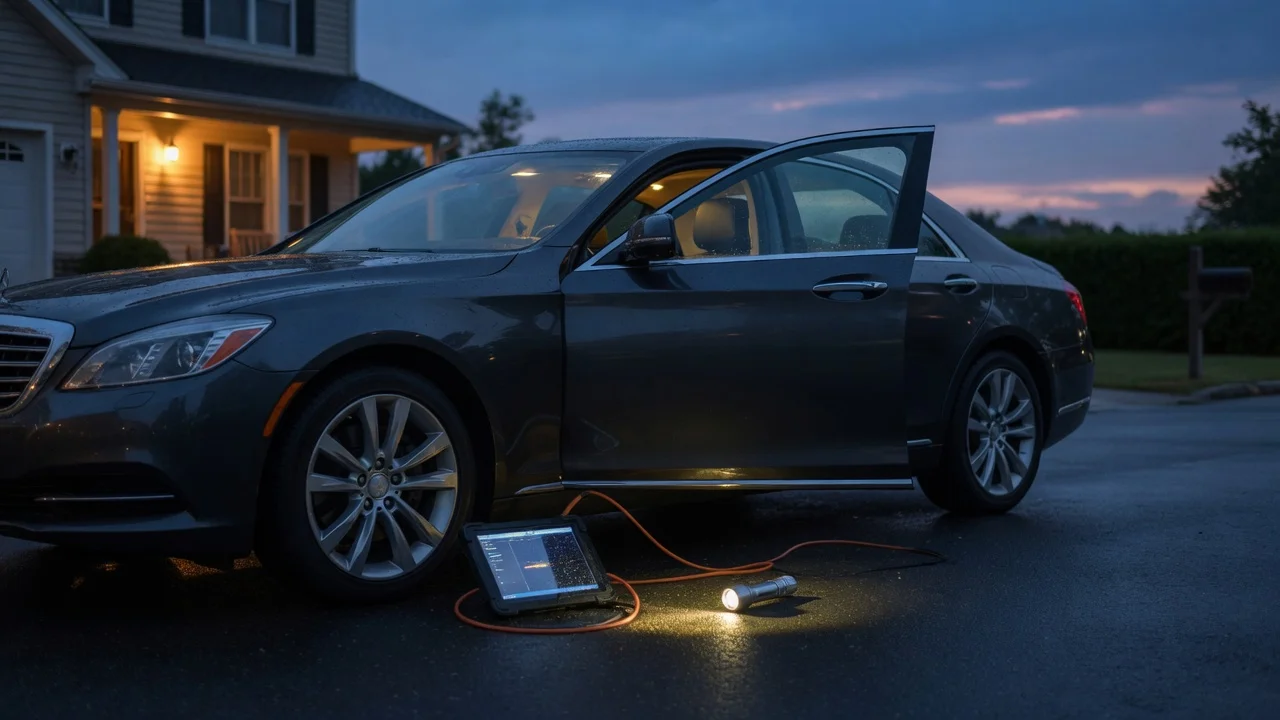
A battery drain warning on a BMW means the car's power management system has detected that the 12-volt battery lost more charge than expected, usually while the vehicle was parked or switched off. It points to a charge or consumption problem, not to a confirmed failed part. The cause may be as simple as frequent short trips or as involved as an electronic module that does not shut down properly. The exact message wording, the systems that monitor the battery and the right diagnostic steps vary by model, model year, generation and powertrain, so treat what follows as general guidance to confirm against your own vehicle's documentation.
What the warning is telling you
Many BMW models monitor the 12-volt battery with an electronic battery sensor, often called an intelligent battery sensor (IBS), mounted on the battery's negative terminal. It tracks current flow and state of charge. When the system finds that charge fell faster than normal during a rest period, or that the battery could not be kept adequately charged, it can show a Check Control message about increased battery discharge. Depending on the vehicle and software version, the message may read as a battery discharge, high battery drain or low battery warning.
The warning reports what the system measured. It does not identify what consumed the energy. That makes it a starting point for investigation rather than a diagnosis.
Qualifications that change the answer
Model and generation: battery monitoring, message wording and power management behavior differ across BMW generations and iDrive versions. Powertrain: plug-in hybrids and fully electric BMWs still use a 12-volt battery for low-voltage systems, but its charging arrangement differs from a combustion model's. Diagnostic steps for a conventional car may not apply directly. Battery replacement history: on many BMW models, a replacement battery has to be registered with the vehicle so the charging system can adapt to it. A battery that was replaced without registration, or replaced with a different type or capacity than specified, can affect charging and warnings. Market and equipment: fitted options, such as telematics or comfort features, and market-specific software can affect how much the car draws while parked.
Plausible causes
The causes below are general categories. Without diagnostic data from the specific vehicle, the actual cause can't be confirmed.
Insufficient charging from driving patterns: repeated short trips, long idle periods or heavy use of electrical loads with the engine off may never return the battery to full charge. An aging or weakened battery: a battery that has lost capacity discharges faster under normal parked loads and may trigger the warning even when nothing else is faulty. A module that stays awake: if a control unit does not enter its sleep state after the car is locked, it can keep drawing current. This is often described as parasitic drain. Left-on or intermittent loads: interior lights, the boot or glovebox light, a door or tailgate not fully latched, or accessories plugged into power outlets. Aftermarket equipment: dash cameras, trackers, alarms or audio components wired to permanent power can add continuous draw. Battery registration or specification mismatch: an unregistered or incorrect replacement battery may be charged inappropriately. Charging system faults: problems with the alternator, wiring, connections or, on electrified models, the components that charge the 12-volt battery can leave it undercharged. Battery sensor or connection issues: a faulty sensor or poor terminal connection can distort the readings the warning relies on.
What to check next
Note when the warning appears: after the car has been parked for a while, after a short trip, or while driving. The timing helps separate parked drain from charging problems. Review recent changes: a new battery, newly fitted accessories, recent repairs or a software update. Check for obvious loads: confirm doors, boot, bonnet and glovebox close fully, interior lights switch off, and nothing is left plugged into power outlets. Consider driving patterns: if the car mostly makes short trips or sits unused, a longer drive or a suitable battery maintainer may help. If the warning keeps returning, that points toward a real fault rather than usage alone. Inspect the battery terminals and visible connections for looseness or corrosion, provided you can do so safely and the battery's location on your model allows it. Have the battery tested: a proper battery test shows whether the battery can still hold and deliver charge. Confirm battery registration: if the battery was replaced, check whether it was registered and whether it matches the type and capacity specified for the vehicle. Read stored fault codes and battery history with diagnostic equipment able to access BMW modules. Generic code readers may not reach every system.
Observation | What it may indicate; Warning appears mainly after the car sits parked | Excess parked draw, such as a module not sleeping or an accessory, or a weakened battery; Warning follows a pattern of short trips | Undercharging from usage; it may clear with adequate driving or maintenance charging; Warning began soon after a battery replacement | Missing registration or an incorrect battery type or capacity; Warning began after fitting an accessory | Added continuous draw from that equipment; Battery tests weak or fails a load test | Battery near the end of its service life; Battery tests healthy but the warning repeats | Parasitic draw or a charging or sensor fault that needs further diagnosis; Warning appears while driving, with other electrical faults | Possible charging system fault; seek diagnosis promptly
How to treat fault codes
A stored fault code tells you which system recorded an abnormal condition. It does not prove that a particular component has failed. A low-voltage event, for example, can cause codes to be logged in several modules at once, even though those modules are working correctly. Use codes to narrow the investigation, then confirm the cause with measurements and tests before replacing parts.
Finding a module that keeps the car awake usually means measuring the current drawn while parked after the vehicle has had time to go to sleep, then isolating circuits. The time needed and the acceptable current level depend on the vehicle, so use the specification for your model rather than a generic figure. Because disconnecting the battery or interrupting circuits can affect electronic systems on modern BMWs, this work is best done by someone familiar with the procedure.
When to stop and seek professional diagnosis
The warning appears while driving alongside other electrical warnings, flickering lights or erratic instruments. Charging may have failed, and the car could lose power. Plan to stop safely and arrange diagnosis rather than continuing a long journey. You notice a burning smell, heat, swelling, leakage or hissing around the battery or wiring. Stop using the vehicle and keep away from the battery. The car will not start, or you are repeatedly jump-starting it. Repeated deep discharge can shorten battery life, and the underlying cause still needs to be found. On a hybrid or electric BMW, the warning appears together with drive system or charging warnings. High-voltage systems call for qualified service. The warning returns after the battery has been tested, registered and charged.
What this guide cannot confirm
No model-specific documentation, test data or measurements were available for this guide. It does not give exact message wording for individual models, acceptable parked-current values, sleep timing, or battery specifications. Check those against the owner's manual, the manufacturer's service information or a BMW-qualified technician for your vehicle's model year, generation and powertrain.