Battery Terminal Smoking When Jump Starting: What It Means and What to Do
The short answer
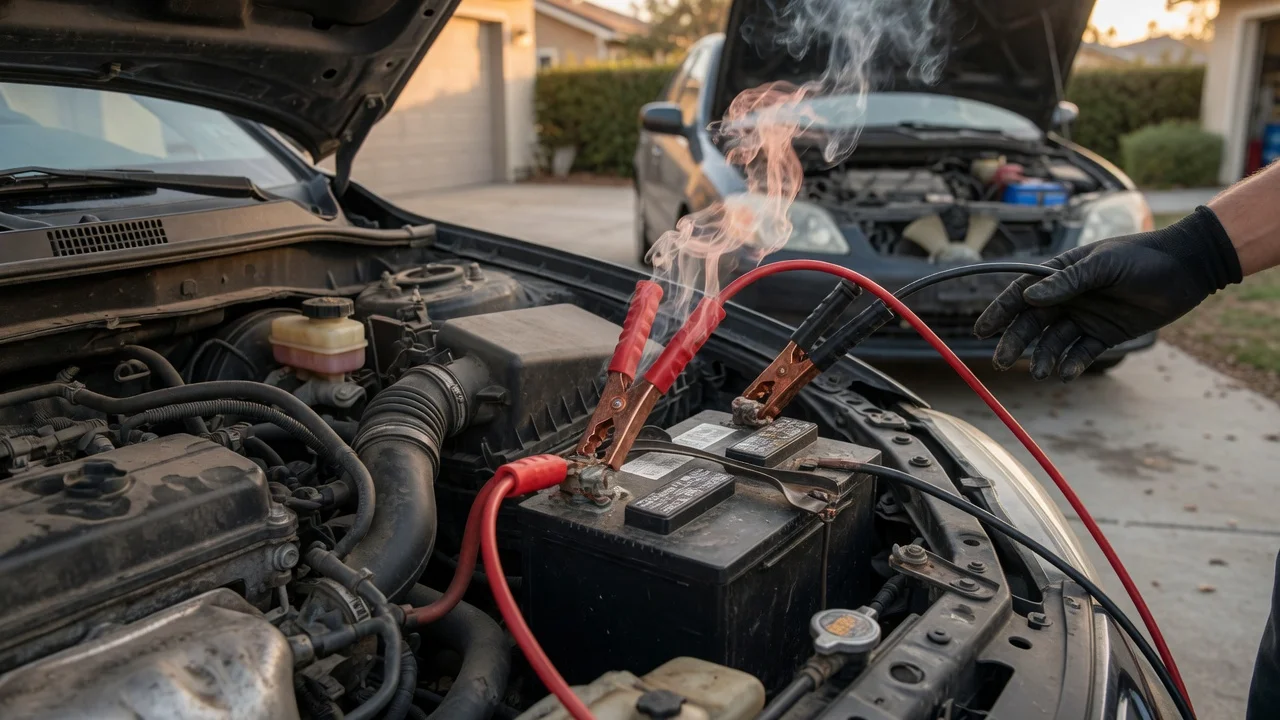
If a battery terminal or jumper cable clamp starts smoking while you try to jump start a car, stop. Smoke means something is overheating, and continuing can damage the electrical system, melt cables or, in the worst case, ignite gases around the battery. The two most common explanations are a poor connection at the clamp, which heats up because it resists the current trying to flow through it, and cables connected with reversed polarity, meaning positive was attached to negative. Less often, the clamp is touching other metal and causing a short, the cables are too light for the current involved, or the battery itself is damaged.
The exact cause cannot be confirmed from smoke alone. What you do next depends on what you find when you inspect the connections, and the safe first step is the same in every case: stop cranking and remove power.
What to do right away
Stop cranking the engine and turn the ignition off in the vehicle being started. If it is safe to reach the cables, disconnect them in the reverse order they were connected, starting with the last clamp attached. Do not grab clamps or cables that are visibly melting or too hot to touch. Give them time to cool. Keep sparks, flames and cigarettes away from the battery. Step back and do not attempt another jump if the battery is hissing, bulging, leaking or giving off a strong rotten-egg smell.
Lead-acid batteries can release hydrogen gas, especially while charging or under heavy load. That is why a spark or heat source near the battery is a real hazard rather than a theoretical one, and why a battery that is swollen, cracked or leaking should not be jumped at all.
Likely causes, from most to least common
Poor clamp contact
A jump start pushes a large amount of current through the cables. If a clamp is only touching the edge of a terminal, is biting into corrosion, or is resting on a painted surface, the small contact area resists that current and turns it into heat. The result can be smoke from the clamp, the terminal, or melting cable insulation. This is often the case when only one connection smokes and the polarity is correct. Cleaning corrosion off the terminal and seating the clamp firmly on bare metal usually addresses it.
Reversed polarity
Connecting positive to negative creates a direct short between the two batteries. This tends to produce heavy sparking, rapid heating and smoke, sometimes within seconds. Beyond the cables themselves, reversed polarity can blow fuses or fusible links and may damage components such as the alternator or electronic control modules. How much damage occurs varies by vehicle and by how long the connection was made, so it cannot be predicted in general terms. If you discover the cables were reversed, have the vehicle's fuses and charging system checked before relying on it.
A clamp touching other metal
If the positive clamp brushes against the body, the engine or the other clamp, it can short to ground. Clamps that slip off during cranking are a common way this happens.
Undersized or damaged jumper cables
Thin cables, or cables with frayed strands or loose clamp crimps, can overheat under the load of a starter motor. Larger engines generally draw more current when cranking, so lighter cables are more likely to struggle with them. Warm cables after a long crank are not unusual, but smoke is not normal.
A damaged or failing battery
A battery with an internal fault, a cracked case, or one that has frozen can behave unpredictably when current is forced into it. Visible swelling, leaking or hissing are signs to stop and replace the battery rather than keep trying to jump it.
Smoke or steam?
What looks like smoke may sometimes be vapor from moisture or electrolyte on a hot terminal, especially in cold or damp conditions. That distinction does not change the right response: any visible smoke or vapor during a jump start calls for stopping and inspecting. A burning plastic smell points to cable or terminal insulation overheating, while a sulfur or rotten-egg smell points to the battery itself.
Trying again safely
Only attempt another jump once the cables have cooled, you have confirmed the polarity, and neither battery shows signs of damage. The sequence below is the one commonly recommended for conventional setups. Some vehicles use remote jump-start posts under the hood or have specific procedures for hybrids and other powertrains, so the owner's manual for the vehicle takes priority.
Red clamp to the positive terminal of the dead battery. Other red clamp to the positive terminal of the good battery. Black clamp to the negative terminal of the good battery. Last black clamp to clean, unpainted metal on the disabled vehicle's engine or chassis, away from the battery. Start the assisting vehicle, then try to start the disabled one. Remove the clamps in the reverse order.
Before reconnecting, clean any white or green corrosion from the terminals and make sure each clamp grips solid metal. If the same connection smokes again with correct polarity and a firm grip, the problem is likely the cable, the terminal or the battery, and it is time to stop jump starting and have the system inspected.
When to call for help
Get professional help if cables were connected in reverse, if any part of the battery is damaged, if the vehicle shows warning lights or electrical faults after the attempt, or if the car still will not start after a clean, correct connection. A no-start that persists after a good jump may point to a problem other than a flat battery, such as the starter, the charging system or a blown fuse, which a smoke incident alone cannot identify.