How to tell if a charging problem is the battery or the alternator
The short answer
The battery stores electrical energy and starts the engine. The alternator is the engine-driven generator that recharges the battery and powers the electrics while the engine runs. To tell which one is at fault, measure the battery voltage with the engine off, then again with the engine running. Suppose the engine-off reading is low but the voltage rises clearly once the engine runs. Then the alternator is charging, and the battery is the more likely problem. Suppose the voltage stays at or below the engine-off figure, or falls while the engine runs. Then the charging system is not doing its job. That points to the alternator, its drive belt, its wiring or a blown alternator fuse rather than the battery.
Two conditions change this answer. First, many modern cars use smart or variable charging. On these cars the alternator output is controlled by the engine computer and can sit close to battery voltage at times, so one reading can mislead. Second, a battery that is badly discharged or internally damaged can make a healthy alternator look weak, so the battery should be charged and tested before you condemn the alternator.
Symptoms and what they suggest
Symptoms do not confirm a diagnosis on their own. Treat the list below as a guide to what to check first.
Slow cranking or clicking when starting, but the car runs normally once started: points first to a weak or discharged battery, a poor battery connection or a starter problem, not the alternator. Battery or charging warning light, or a charging fault message, while driving: points to the charging system. Possible causes include the alternator, the drive belt, the alternator fuse or wiring, or the sensor that monitors the battery. The car starts after a jump start but dies again soon after, or flattens the battery repeatedly while driving: points to the charging system. The battery goes flat after the car has been parked, but charges normally while running: points to an ageing battery or an electrical drain when the car is switched off. Lights that dim and brighten with engine speed, or electrical items behaving erratically: can point to a failing alternator, a slipping belt or poor connections. Bulbs failing early, a swollen battery case, a rotten-egg smell or a hot battery: possible overcharging, covered in its own section below. Smoke, a burning smell or a squeal from the alternator area: stop the vehicle, covered in its own section below.
Battery or alternator, or the starter?
The starter motor is a separate electric motor that turns the engine over when you start it. A starter fault usually shows up only at the moment of starting. You may hear a single click with no cranking, or a grinding or whirring noise. A starter fault does not normally trigger a charging warning while you drive. The test that separates them is battery voltage. With the headlights on and the battery voltage reading healthy, a click and no crank points towards the starter or its circuit. Dimming lights and a low reading point to the battery or its connections. An alternator problem usually reveals itself while driving rather than only at start-up.
How to check it step by step
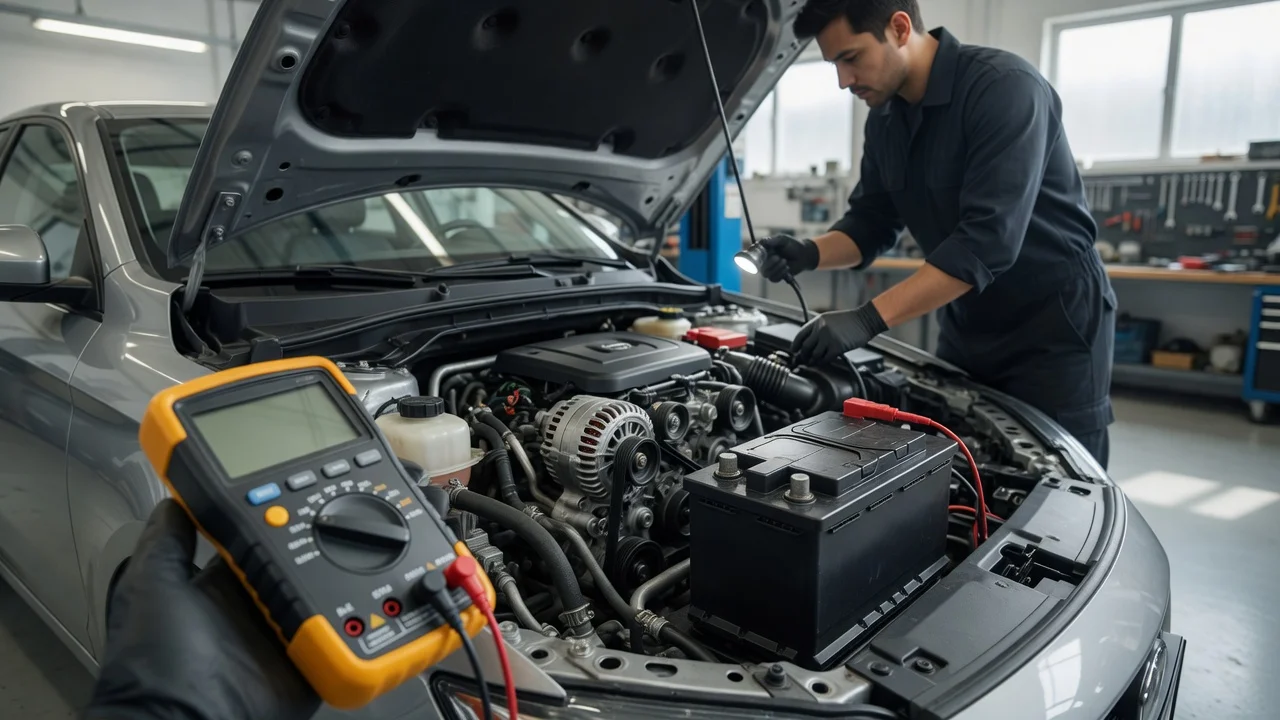
You will need a digital multimeter that can read DC voltage, eye protection and gloves. If you have them, a battery charger and access to a battery tester help. Many parts shops and garages can test a battery and charging system. Work in a ventilated area with the parking brake on. Keep sparks and flames away from the battery, because batteries can release flammable hydrogen gas. Keep hands, hair, clothing and tools clear of the drive belt and cooling fan whenever the engine is running. The cooling fan may also start with the engine off.
1) Inspect first. With the engine off, look for corroded, loose or damaged battery terminals and cables, a cracked or swollen battery case, and a worn, cracked, loose or missing alternator drive belt. A swollen, leaking or very hot battery should not be charged or jump-started. Have it dealt with professionally. 2) Measure resting battery voltage. Ideally the car should have stood for a few hours so that surface charge has dissipated. With everything switched off, place the red probe on the positive terminal and the black probe on the negative terminal. Note the reading. 3) Start the engine and measure again at the battery terminals with the engine idling and electrical loads off. Note the reading. 4) Add load. Switch on headlights, heater fan and rear screen demister, then raise the engine speed slightly, or have a helper do so. Measure again. A healthy system should hold the voltage up. A falling voltage suggests the alternator cannot keep up. 5) Do not disconnect the battery while the engine runs. This old test of whether the engine keeps running without the battery can cause voltage spikes that damage the alternator and vehicle electronics. 6) If the battery tested low at rest, fully charge it with a suitable charger and have it load-tested or checked with an electronic battery tester. Many stop-start cars use AGM or EFB batteries, which need a charger setting suitable for that type. Then repeat steps 2 to 4. 7) Completion check: you should be able to place the fault in one of three groups. These are a battery that will not hold charge, a charging system that does not raise the voltage, or connections and fuses. Any result that does not fit neatly should go to a qualified technician with your readings noted.
Reading the voltages
The figures below are general guidance for typical 12-volt lead-acid systems. They are not specifications for any particular model. The correct charging range varies by manufacturer, battery type, temperature and charging strategy, so check your vehicle's service information where possible.
Reading | Condition | What it suggests; About 12.6 V or slightly above | Engine off, rested | Battery is well charged; About 12.2 to 12.4 V | Engine off, rested | Battery is partly discharged and should be recharged and tested; Below about 12.0 V | Engine off, rested | Battery is heavily discharged or may be faulty; Roughly 13.5 to 14.7 V | Engine running | Typical of a conventional system that is charging; At or below the engine-off reading | Engine running | Charging fault likely, unless a smart system is in a low-charge phase; Consistently above about 15 V | Engine running | Possible overcharging, which needs investigation
On cars with smart charging, a running reading close to 12.5 to 13 V is not necessarily a fault, because the system may be deliberately limiting charge. On these vehicles, watch the reading over several minutes and under load. Better still, have the system checked with diagnostic equipment that can read the charging-system data and fault codes.
Checking the alternator fuse
Many vehicles protect the heavy cable between the alternator output and the battery or main fuse box with a high-current fuse or a fusible link. A fusible link is a section of wire designed to burn through under overload. If this fuse blows, the alternator can be working perfectly yet unable to charge the battery. The symptoms match a failed alternator: a charging warning and a battery that drains while driving. Some cars also have a smaller fuse in the alternator's control, sensing or warning-lamp circuit, and a fault there can also stop or disrupt charging.
Locate the fuse using the owner's handbook or fuse box lid. High-current fuses are often in a fuse box under the bonnet or mounted on or near the battery's positive terminal. The location and rating vary by model, and some are not clearly labelled. Disconnect the battery negative terminal before removing or touching high-current fuses or alternator wiring. The alternator's main output terminal is connected to the battery at all times, even with the ignition off. A short to the bodywork can cause sparks, burns or a fire. On some cars, disconnecting the battery can reset settings or require reinitialising windows, the alarm or a battery management system, so check the handbook first. Inspect the fuse for a broken element or discolouration, or test it for continuity with the multimeter. Replace a blown fuse only with one of the same type and rating. Never fit a higher-rated fuse or bridge it with wire. If a replacement blows again, or the fuse looks heat-damaged or melted, there is a short circuit or another underlying fault. Stop and have the wiring and alternator inspected by a qualified technician.
Signs of an overcharging alternator
Overcharging usually comes from a faulty voltage regulator, the alternator component that limits output. On some cars it can also come from faulty wiring or a fault in the engine control of the charging system. A running voltage that stays well above the normal range is the clearest evidence. Other warning signs include a hot or swollen battery, a sulphurous or rotten-egg smell, battery fluid leaking, bulbs failing repeatedly and erratic electronics. Overcharging can damage the battery and electronics. In severe cases a battery can vent hot gas or rupture. If you see these signs, switch off and keep away from the battery, and do not attempt to charge or jump-start it. Have the system checked before driving further.
If the alternator is smoking or smells of burning
Smoke or a burning smell from the alternator area can come from several sources. These include a seized alternator bearing or pulley making the belt slip and overheat, overheating alternator windings, a shorted or overloaded output cable, or something else in the engine bay, such as an oil leak. Pull over as soon as it is safe, switch the engine off and get everyone out of the vehicle if there is visible smoke or any sign of fire. Do not open the bonnet fully if you suspect a fire. Call emergency services if there are flames. Do not restart or continue driving until the cause has been found. Smoke from electrical components carries a fire risk, and a failing belt can also affect other belt-driven parts on some engines.
Vauxhall "Battery charge fault, stop the vehicle" message
Some Vauxhall models display a driver message along the lines of "Battery charge fault, stop the vehicle". The wording tells you that the car's systems have detected a charging problem serious enough to advise stopping. It does not by itself identify the cause. Possible causes include an alternator fault, a drive belt problem, a blown fuse or wiring fault, a failing battery, or a fault with the battery sensor that monitors charging. The exact meaning and recommended response can vary by model and year, and the evidence available here does not cover specific Vauxhall models. Follow the guidance in your vehicle's owner's handbook for that message.
As a general rule, follow the message's instruction. Stop where it is safe, switch off non-essential electrical loads and arrange assistance. Whether, or how far, the car can safely be driven cannot be stated here. With a charging fault the car runs on stored battery power, and the battery will eventually be unable to support the engine, lights or other systems. On some cars, systems such as electric power steering may be affected, and if the drive belt has failed, other belt-driven components may also stop working. A dealer or qualified technician can read the stored fault codes to identify the cause.
When to hand over to a professional
The visual checks, voltage readings and simple fuse inspection above are within reach of most owners with a multimeter. Leave the following to a qualified technician: replacing an alternator or drive belt where you lack the vehicle-specific procedure or tools; diagnosing a smart charging system or a battery sensor fault, which needs diagnostic equipment; repeatedly blowing fuses or any sign of wiring damage or overheating; replacing the battery on vehicles that require the new battery to be registered with the car's battery management system; any case with smoke, a burning smell, overcharging signs or a damaged battery.
Limits of this guide
The voltage ranges here are general figures for 12-volt lead-acid systems. They are not specifications for a particular make, model, market or battery type. Hybrid and electric vehicles use different charging arrangements, usually a DC-DC converter instead of a conventional alternator for the 12-volt battery, and are outside the scope of these steps. Fuse locations, ratings, charging strategies and warning messages differ between models and years. Check your owner's handbook or manufacturer service information before relying on any specific figure or procedure.