Recognize Bad Engine Air Filter Symptoms
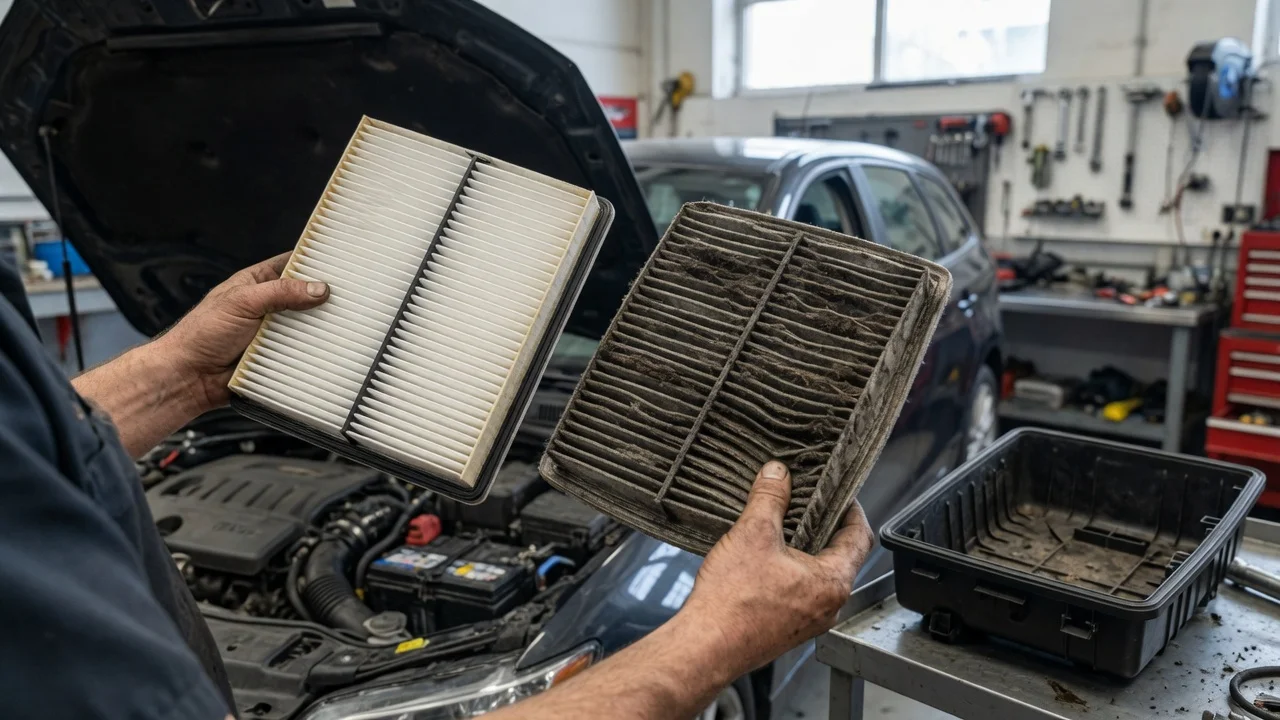
The Short Answer
A restricted engine air filter most often shows up as sluggish acceleration and reduced power under heavy load, such as merging, climbing hills or towing. The most direct evidence is the filter itself: a filter packed with dirt, debris, oil or moisture, or one that is torn or poorly sealed, needs attention. Most other symptoms people link to air filters, such as poor fuel economy, rough running or a check engine light, can come from a dirty filter but are also caused by many other faults. For those symptoms, the filter is a reasonable first check, not a confirmed cause.
How a dirty filter affects a vehicle depends on how the engine manages fuel. On modern fuel-injected engines, the engine computer adjusts fuel delivery to match the air it measures, so restriction mainly limits peak power. On older carbureted engines, restricted airflow can make the engine run rich, meaning it gets too much fuel for the available air. That can cause fuel economy, smoke and spark plug problems that are less typical on modern engines.
Engine Air Filter vs. Cabin Air Filter
Many vehicles have two air filters, and they are easy to mix up. The engine air filter cleans the air entering the engine. It usually sits in a plastic housing, often called the airbox, under the hood, connected to the engine by a large intake duct. The cabin air filter cleans air for the heating and air-conditioning system. A clogged cabin filter causes weak airflow from the vents, musty odors or slow window defogging. It does not affect engine power. If your symptoms involve the vents rather than the engine, the cabin filter is the more likely suspect. Filter locations and housing designs vary by model, engine and model year, so check the owner's manual or service information for your vehicle.
Symptoms Associated With a Bad Engine Air Filter
Reduced acceleration or power, most noticeable at full throttle or under load. This is the symptom most directly tied to restriction. A visibly dirty, clogged, wet, oil-soaked or damaged filter element when inspected. Unusual intake sounds, such as whistling or a stronger sucking noise, which can come from restriction or from air bypassing a poorly seated filter. On older carbureted engines: black exhaust smoke, a fuel smell, rough idle, fouled spark plugs or noticeably worse fuel economy linked to rich running. A check engine light in some cases. This is indirect: a torn or poorly sealed filter can let dirt reach the airflow sensor, or a disturbed intake can create an unmetered air leak. Both can trigger airflow or fuel-mixture fault codes.
How much a dirty filter affects fuel economy on a modern fuel-injected engine is uncertain and probably small in many cases, because the engine compensates for reduced airflow. If fuel economy has dropped noticeably, consider tire pressure, driving conditions, sensor faults, brakes dragging and other causes alongside the filter.
What Else Could Cause the Same Symptoms
Observation | Possible causes besides the air filter | Check that helps distinguish them; Weak acceleration or low power | Fuel delivery problems, ignition faults, a restricted exhaust or catalytic converter, boost leaks on turbocharged engines, sensor faults | Inspect the filter first. If it is clean and sealed, check for stored fault codes and look into fuel, ignition and exhaust restriction. Whistling or hissing from the engine bay | Vacuum leaks, a cracked intake duct, a loose clamp, turbo or boost hose leaks | Inspect the airbox, duct and clamps. Listen to narrow down where the sound comes from. Check engine light | Many unrelated faults | Read the code with an OBD-II scanner and look up its definition for your vehicle. Rough idle or hesitation | Dirty or failing airflow sensor, vacuum leaks, ignition or fuel injector problems | Check the filter and intake for leaks, then follow the code-specific or symptom-specific diagnostic procedure. Black smoke (mainly older or carbureted engines) | Carburetor faults, leaking injectors, fuel pressure problems | Inspect the filter. If it is clean, check the fuel system.
How to Check Whether the Filter Is the Cause
Work from the simplest, most direct check toward the broader ones. Each step either confirms the filter as a factor or tells you to look elsewhere.
Inspect the filter. With the engine off, open the air filter housing following your vehicle's service information and remove the element. Look for heavy dirt buildup, leaves, insect or rodent debris, moisture, oil contamination, tears and a deformed or damaged sealing edge. A heavily loaded or damaged filter supports replacement. Light surface discoloration alone does not necessarily mean the filter is restricting airflow. Check the housing and intake path. Confirm the housing closes fully and its clips or fasteners are secure. Check that the intake duct is not cracked, collapsed or loose at its clamps. Leaks after the filter can let unfiltered or unmeasured air into the engine. That can cause drivability problems or fault codes even when the filter element is fine. Consider recent work. If symptoms began right after a filter change, look for an improperly seated filter, a pinched seal, a loose duct or a disconnected sensor connector near the airbox. Read any fault codes. Use an OBD-II (on-board diagnostics) scanner to retrieve diagnostic trouble codes (DTCs). Look up each code's definition and test procedure for your specific vehicle. A code describes a condition the engine computer detected, such as an airflow reading out of range or a fuel mixture that is too lean. It does not by itself prove the air filter, or any particular part, has failed. Freeze-frame data, if your scanner supports it, records the operating conditions when the code was set and can help interpret it. See whether the symptom changes after correcting the filter. If a clearly clogged filter is replaced and the power loss goes away, that supports the filter as the cause. If the symptom remains, the filter was not the main problem, and further diagnosis is needed.
Airflow Sensor Considerations
Many fuel-injected engines use a mass airflow (MAF) sensor, located in the intake path after the air filter, to measure incoming air. A torn filter or a gap in the seal can let dust reach this sensor and contaminate it, causing inaccurate readings. Over-oiled reusable filters are also commonly reported to contaminate airflow sensors. Some engines use a different sensing method instead of, or in addition to, a MAF sensor, so whether this applies depends on your engine. If airflow-related codes or drivability problems persist after fixing the filter and intake, follow the diagnostic procedure for your vehicle's airflow sensing system rather than assuming the sensor needs replacement.
When to Replace the Filter
Replacement intervals vary by vehicle and operating conditions, so use the maintenance schedule in your owner's manual. Many schedules call for more frequent inspection or replacement when driving in dusty conditions, on unpaved roads or in heavy pollution. Some trucks and heavy-duty vehicles have a filter restriction indicator on the housing. Where fitted, it gives a more objective signal than a visual check. Read its markings according to the vehicle's documentation.
Gaps to Keep in Mind
This guide does not give replacement intervals, filter part numbers, housing locations or code definitions for specific vehicles, because these depend on make, model, engine, model year and market. Confirm those details in your vehicle's owner's manual or service information before buying parts or acting on a diagnostic result.