What Does an Engine Air Filter Do?
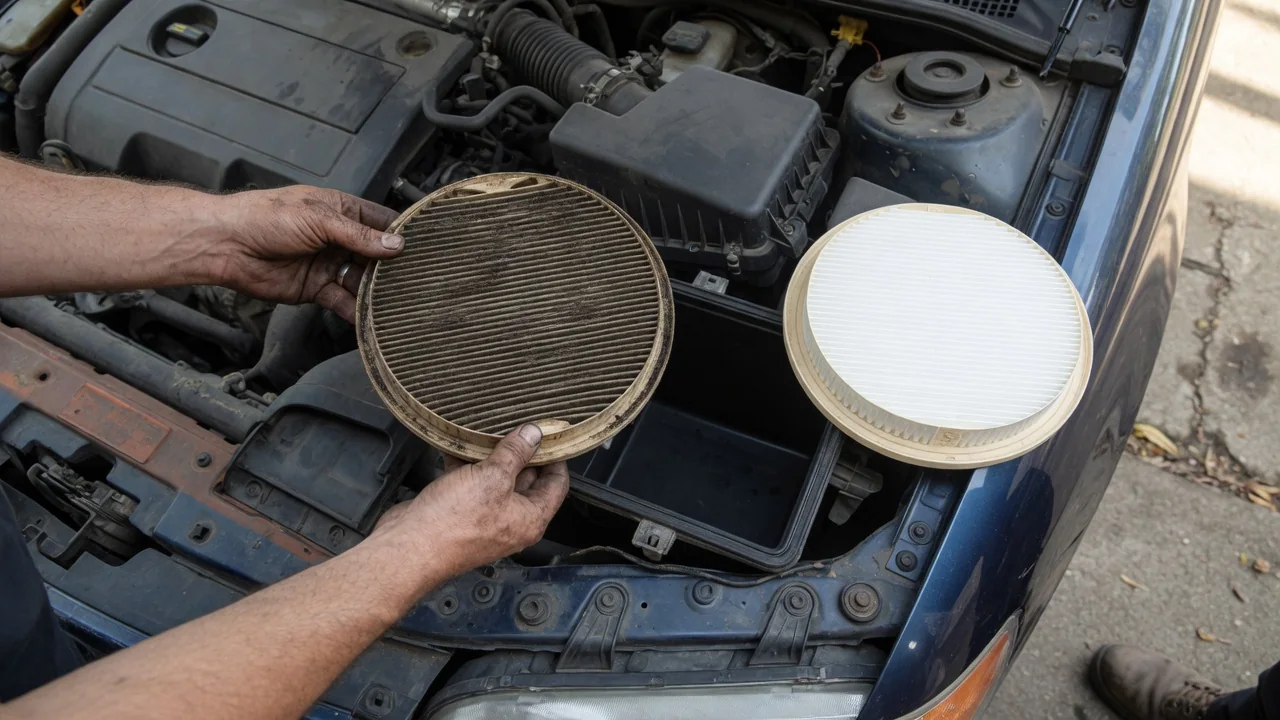
Every gallon of fuel an engine burns needs a very large volume of air, and that air arrives carrying dust, sand, pollen, insects and road grit. So what does an engine air filter do? It traps those contaminants before they reach the cylinders while still letting air pass freely. Understanding that balance between filtration and restriction helps owners judge when the filter needs attention.
Air path
Outside air usually enters through an inlet duct positioned behind the grille, near a fender, or high in the engine bay, where it is cooler and less likely to pick up water. From there it flows into the air filter housing, often called the airbox, and passes through the pleated filter element. The pleats pack a large surface area into a small box, so the filter media can hold a meaningful amount of dirt before airflow begins to suffer.
Downstream of the filter, clean air typically passes a mass airflow sensor on many gasoline engines, then moves through the intake tube to the throttle body, intake manifold and cylinders. Turbocharged engines route it through the compressor and often an intercooler first. Because everything after the filter is supposed to see only clean air, a torn element, a poorly seated seal or a cracked duct matters as much as a dirty filter. Layouts differ by vehicle, and some engines use a manifold pressure sensor instead of an airflow meter.
Inspection
A basic inspection starts with locating the airbox, which is commonly a black plastic housing held closed by clips, screws or clamps. With the engine off and cool, the element can usually be lifted out and examined in good light. A new paper filter is typically white, off-white or lightly tinted, so even gray discoloration is normal with use. What matters more is heavy packed dirt in the pleats, leaves and debris, oil saturation, moisture damage, or a crushed or split sealing edge.
Holding the filter up to a bright light gives a rough sense of how loaded the media is, though it is not a precise measurement. Look at the clean side of the housing as well; dust trails past the seal suggest unfiltered air has been bypassing the element. Some trucks and diesel vehicles include a restriction indicator on the airbox that shows when the pressure drop across the filter has grown. Access varies widely, and certain housings sit under covers or ducts that make removal less straightforward, so the owner's manual is the best guide.
Replacement timing
There is no single replacement schedule that suits every vehicle. Manufacturers publish an interval in the maintenance schedule, usually with a shorter recommendation for severe service, and that document should take priority over general rules of thumb. The reasoning is simple: a filter loads at a rate set by the air it has cleaned, not just by the miles covered. A car driven on paved highways in a wet climate may keep its element serviceable far longer than one working in dust.
Gravel roads, construction zones, farm work, desert conditions and heavy pollen seasons all shorten filter life, sometimes dramatically. In those conditions, checking the element between scheduled services makes sense, and replacing it early costs little compared with the wear that abrasive dust can cause. Replacing too frequently has little benefit, though, because a lightly used filter still flows well and each time the housing is opened there is a chance of disturbing the seal or dropping debris onto the clean side. Condition and the published schedule together give the best answer.
Everyday Use and Observations
In daily driving a healthy filter goes unnoticed, and that is the point. Modern fuel-injected engines measure incoming air and adjust fuel delivery to match, so a moderately dirty filter usually does not cause a rich mixture the way it could on older carbureted engines. The effect tends to show up instead as reduced airflow at high demand. Drivers may notice weaker acceleration when merging, towing or climbing grades, since wide-open throttle is when the engine asks for the most air.
Other observations are subtler. A severely restricted element can change the intake sound, and on some vehicles it may contribute to hesitation or a check engine light related to airflow or fuel trim readings. Such symptoms have many possible causes, including vacuum leaks, sensor contamination and fuel delivery problems, so the filter is one item to check rather than an automatic answer. Fuel economy effects on modern engines are generally modest, although diesel and turbocharged engines can be more sensitive to restriction because they move large volumes of air under boost.
Limits and Next Steps
An air filter has clear limits. It only cleans combustion air; the cabin air filter is a separate part that serves the climate control system, and the two are often confused. A fresh element will not add power to an engine that was already breathing properly, nor will it correct misfires, worn spark plugs or a failing sensor. If a fault code is stored, treat it as evidence that points toward a system needing diagnosis, not proof that any particular part has failed.
For next steps, confirm the correct filter by the vehicle's year, engine and model, since similar-looking elements may differ in dimensions and seal design. Reusable oiled filters need careful servicing, because excess oil can reach and contaminate an airflow sensor on some engines. After any filter change, the housing should close fully with the seal seated evenly and the ducts reconnected. If performance concerns continue with a clean, properly fitted filter, a qualified technician can test the intake tract, sensors and fuel system to find the actual cause.