Australia Vehicle Import Laws and Eligibility: How the Rules Work
The short answer
Australia lets private individuals and businesses import vehicles, but only through defined eligibility pathways. In almost all cases you must get a vehicle import approval from the federal government before the vehicle is shipped. Without one, the vehicle can be refused entry, held at the border or required to be exported again at the importer's expense. Eligibility depends mainly on the vehicle's age, whether that model already meets Australian standards, and whether it appears on a government register of approved or specialist vehicles. Passing the import stage does not guarantee you can drive the car. Registration is a separate step run by each state and territory, and it has its own requirements.
The legal framework behind Australian vehicle imports
The current system is built on the Road Vehicle Standards Act 2018, often shortened to RVSA. It replaced the older Motor Vehicle Standards Act regime after a transition period. The RVSA governs how road vehicles are first supplied to the Australian market, whether they are new cars from a manufacturer or individual used vehicles brought in by private importers.
The technical benchmark is the Australian Design Rules (ADRs). These are national standards covering safety, emissions, lighting, occupant protection and related areas. A central question for any import is whether the vehicle already complies with the applicable ADRs, can be modified to comply, or falls under a pathway that exempts it from full compliance.
Several agencies are involved. The federal transport department administers import approvals and the vehicle registers. The Australian Border Force handles customs clearance and enforces the ban on importing goods that contain asbestos. The federal agriculture department manages biosecurity inspections. State and territory road authorities decide whether a vehicle can be registered for road use.
Import approval comes first
An import approval is a permit tied to a specific vehicle and a specific pathway. Applications go through the government's online vehicle import system. You typically supply details such as the vehicle identification number or chassis number, the build date, proof of ownership or purchase, and evidence that the vehicle meets the criteria of the pathway you are applying under.
Timing matters. The approval should be granted before the vehicle leaves its origin country. Buying and shipping a vehicle on the assumption that approval will follow is one of the most common and expensive mistakes importers make.
The main eligibility pathways
Most private imports fall into one of the following routes. Each has different conditions, and a vehicle that fails one route will not necessarily qualify under another.
Pathway | Who it suits | Key condition; Register of Approved Vehicles (type-approved) | Mainly manufacturers and their authorised importers | The vehicle type has been certified as meeting the ADRs; Specialist and Enthusiast Vehicles (SEV) Register | Private buyers of models not sold new in Australia | The model is on the SEV Register and is modified and checked by a Registered Automotive Workshop; Older vehicles | Collectors and enthusiasts | The vehicle was manufactured at least 25 years before it is imported; Other or special-purpose approvals | Racing, exhibition, testing and similar uses | Restricted use, often with conditions that rule out normal road registration
The 25-year older vehicle rule
The older vehicle pathway is the most widely used route for enthusiasts. A vehicle manufactured at least 25 years before the date of import can generally be approved without proving it meets current ADRs. The relevant date is the manufacture date, not the model year printed in brochures or the date of first registration overseas. Importers should be able to document that date clearly.
The 25-year rule only covers the import stage. A car approved this way still has to pass state or territory registration requirements, which may include a roadworthiness inspection. Some jurisdictions also have rules for left-hand-drive vehicles.
Specialist and Enthusiast Vehicles
The SEV Register lists specific makes, models and variants that the government has accepted for entry because they were not sold new in Australia, or were offered only in limited forms. Models are assessed against criteria such as performance, environmental features, mobility features or rarity. Eligibility is variant-specific. One engine, transmission or body style of a model may be listed while another is not, so the exact build of your vehicle matters.
An SEV is not imported straight onto the road. It must go through a Registered Automotive Workshop (RAW), a business approved under the federal scheme to inspect and, where needed, modify the vehicle to meet the relevant standards. Only after the workshop has completed its work can the vehicle be entered onto the Register of Approved Vehicles under a concessional entry and then presented for state registration. For SEVs, the workshop arrangement is usually settled before the import approval is sought.
Personal imports and returning residents
Under the previous law there was a personal import scheme for people who had owned and used a vehicle overseas. That scheme did not carry over into the RVSA in the same form. Anyone planning to bring a personally owned vehicle home, particularly a newer one that is neither on the SEV Register nor 25 years old, should check which current pathway, if any, applies before committing to shipping.
Vehicles that commonly fail to qualify
Recent used vehicles that are not type-approved for Australia and do not appear on the SEV Register. Variants of SEV-listed models that differ from the listed specification. Vehicles younger than 25 years where the importer is relying on the older vehicle pathway. Vehicles containing asbestos, which can affect older vehicles with original brake, clutch or gasket components. Vehicles whose identity or manufacture date cannot be adequately documented.
Border checks: asbestos and biosecurity
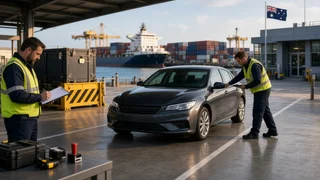
Australia prohibits the import of goods containing asbestos, and vehicles are included. Older vehicles and some vehicles from markets where asbestos components remained in use are at higher risk. Importers may need to show that the vehicle is asbestos-free, often through inspection, testing or replacement of suspect parts before shipping. If asbestos is found at the border, the vehicle can be held until it is remediated, at the importer's cost.
Biosecurity rules require vehicles to arrive clean, without soil, plant material, seeds, insects or animal residue, including underneath and inside the engine bay. Vehicles that are not clean may be directed to professional cleaning before release. Seasonal pest measures can also apply to vehicles shipped from certain countries during certain months, which may mean mandatory treatment before or after arrival.
Taxes and charges
Imported vehicles are generally subject to Goods and Services Tax (GST) at 10 percent, calculated on the customs value plus certain duties and shipping costs. Customs duty may also apply, although free trade agreements between Australia and some countries can reduce or remove it for vehicles that meet the agreement's origin rules. Higher-value vehicles can attract Luxury Car Tax above a threshold that is adjusted periodically. Add in shipping, port fees, inspection, cleaning, any workshop modifications and state registration costs, and the total landed cost is often much higher than the purchase price.
Registration is a separate step
Once a vehicle has cleared customs and biosecurity and, where relevant, completed RAW work, it still needs to be registered in the state or territory where it will be used. Requirements vary by jurisdiction and can include a safety or roadworthiness inspection, proof of identity and ownership, and compliance with local rules on modifications or left-hand drive. Some jurisdictions offer concessional or club registration for historic vehicles with limited use conditions. These rules are worth checking early, because a car that is legal to import may still be impractical to register for the way you plan to use it.
A typical sequence for a private import
Identify the pathway the vehicle realistically fits: older vehicle, SEV, or another approval type. Confirm the exact variant and manufacture date against that pathway's criteria. For an SEV, arrange a Registered Automotive Workshop before applying. Apply for and receive the import approval before the vehicle is shipped. Address asbestos risk and clean the vehicle thoroughly before export. Ship the vehicle, then complete customs clearance, pay taxes and pass biosecurity inspection. Complete any required workshop modifications and concessional entry. Present the vehicle for state or territory registration.
Notes for buyers sourcing vehicles from the United States
Australia drives on the left, and most US-market vehicles are left-hand drive. For older vehicles under the 25-year pathway, left-hand drive does not by itself block import, but state registration rules for left-hand-drive vehicles differ and may limit use or require conditions. Newer US-market vehicles generally need to be on the SEV Register in their exact variant to be imported for road use, and many are not. Converting a vehicle to right-hand drive is a specialised job with its own compliance requirements. US-sourced vehicles also face the same asbestos and biosecurity scrutiny as vehicles from anywhere else.
Bottom line
Australia's import laws focus on whether a specific vehicle fits an approved pathway, not on whether the vehicle is merely used or privately owned. For most private importers the realistic options are the 25-year older vehicle route or the SEV Register combined with a Registered Automotive Workshop. Secure import approval before shipping, plan for asbestos and biosecurity checks, budget for taxes and modifications, and confirm state registration requirements early. Following that order avoids most of the costly surprises.