5R110W TCC Solenoid Identification and Location
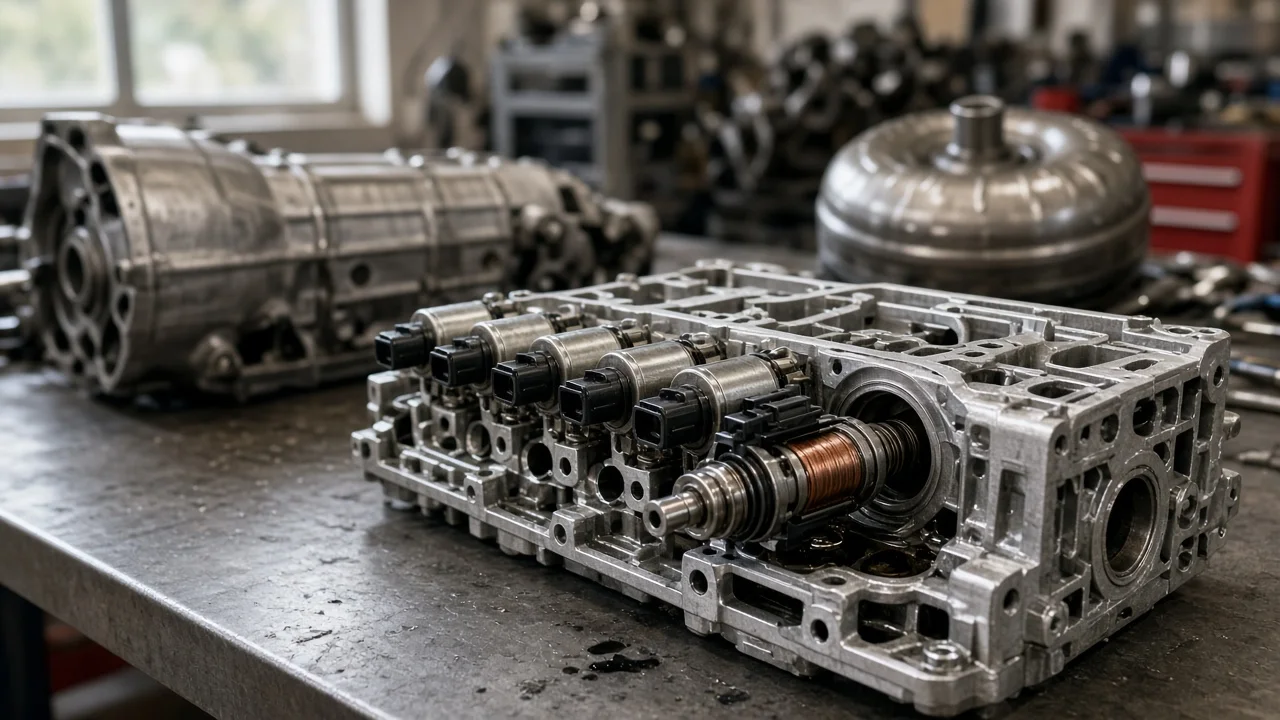
On Ford's 5R110W TorqShift five-speed automatic, the torque converter clutch (TCC) solenoid is not a separate part bolted to the outside of the case. It is one of several solenoids on the solenoid body assembly attached to the valve body, under the oil pan. To reach it, you first confirm that your vehicle actually has a 5R110W, then drain the fluid and remove the pan. A lockup symptom is where diagnosis starts. It does not prove the solenoid has failed.
Where the 5R110W TCC solenoid is located
The 5R110W was used behind both gasoline and diesel engines in heavy-duty Ford trucks and vans. Its electronic controls are grouped into a solenoid body assembly mounted on the underside of the valve body. The shift solenoids, the line pressure control solenoid and the TCC solenoid are all on that module. The module connects to the vehicle harness through a single connector on the side of the transmission case. You cannot unplug or swap the TCC solenoid from under the truck without opening the transmission.
To see the solenoid, drain the fluid, remove the pan and filter, and look at the solenoid body from below. Each solenoid is identified by its position on the module and by the terminal assignments in the wiring diagram for your exact model year. Layouts and part numbers changed during production, so use the factory diagram or the label on your own solenoid body rather than a photo of a different unit. Ford commonly supplies the solenoid body as a complete assembly. Some aftermarket suppliers sell individual solenoids.
What the TCC solenoid controls
A torque converter normally transfers power through fluid, which always involves some slip. The converter clutch locks the engine to the transmission input mechanically, usually at steady cruising speeds. This cuts heat and wasted energy. The powertrain control module decides when to apply lockup based on vehicle speed, throttle position, engine load, gear and fluid temperature. It then commands the TCC solenoid, which regulates the hydraulic pressure that applies and releases the clutch through valves in the valve body. Lockup can be applied smoothly, held with a small controlled slip, or released completely.
The solenoid only converts an electrical command into a hydraulic signal. How well lockup works also depends on the converter clutch itself, the valve bores and valves, seals, fluid condition and line pressure. That is why a lockup complaint can come from several components besides the solenoid.
What changes the answer
Start by confirming the transmission type. Not every Super Duty or E-Series has a 5R110W. Earlier and later trucks use different automatics with different internal layouts. Check the identification tag on the case, the vehicle build information, or a dealer lookup by VIN. Model year and engine affect the calibration, connector details and solenoid body revision, and all three matter for both diagnosis and parts fitment.
On many units, the solenoid body carries identification or calibration information that the control module uses. A replacement assembly may need that information programmed with a capable scan tool before the transmission shifts and locks up correctly. The fluid specification has also changed over the years, so check the dipstick, owner documentation or service information instead of assuming. A transmission that was rebuilt before may contain aftermarket valve body parts or a non-original converter, which can change how lockup behaves.
What the owner can check
Write down the symptoms precisely and note the conditions when they happen. Common lockup-related complaints include: • Shudder at light throttle in the upper gears; • Engine speed that stays higher than expected at steady cruise; • Lockup that does not release, causing harsh stops or stalling; • Fluid running hotter than usual, especially when towing; Also note the road speed, the fluid temperature if your gauge shows it, the load, and whether the problem appears only when hot or only when towing. This makes later testing much faster.
Read diagnostic codes with a scan tool that can access transmission data, not just engine codes. Codes in the P0740 to P0744 range, and related TCC pressure control codes where used, point to a lockup circuit or performance concern. A circuit code can come from the harness, the case connector or the control module rather than the solenoid. A performance code can be mechanical or hydraulic. If your tool shows live data, compare commanded lockup with actual converter slip during a steady cruise. Check the fluid level and condition using the temperature-specific procedure for your vehicle, because low, burnt or contaminated fluid affects lockup directly.
Review the service history before buying parts. Look for fluid changes, earlier rebuilds, converter replacement and any solenoid body work. If the pan comes off, keep the debris and inspect it. Fine friction material or metal particles suggest wear that a new solenoid will not fix. Electrical checks at the case connector should follow the factory resistance and circuit tests for your model year.
Repair options and fitment
Repair options depend on what testing confirms. They include: • Replacing the complete solenoid body; • Replacing an individual solenoid, where a matching part is available; • Repairing a worn valve body; • Replacing the torque converter; • Rebuilding the transmission when wear is widespread; Each part must match your model year, calibration and solenoid body revision. A solenoid body that physically bolts on can still be the wrong part if its identification data does not suit the vehicle. Replacing only the solenoid when the cause is a worn converter clutch or valve bore will usually bring the symptom back.
Limitations and next step
An owner can gather useful evidence, but symptoms alone cannot confirm a failed TCC solenoid. Shudder, missing lockup and high fluid temperature are shared by electrical, hydraulic and converter faults. Exact solenoid positions, test values and programming steps vary by model year, so factory service information for your specific vehicle is necessary for accurate work.
See a transmission specialist if codes return after basic checks, if the pan shows significant debris, if the replacement needs programming you cannot perform, or if the truck tows heavy loads, where lockup faults quickly create damaging heat. Bring your symptom notes, stored codes and service history so the diagnosis starts from evidence rather than guesswork.