2000 Dodge Dakota Transfer Case Linkage Bushing Identification
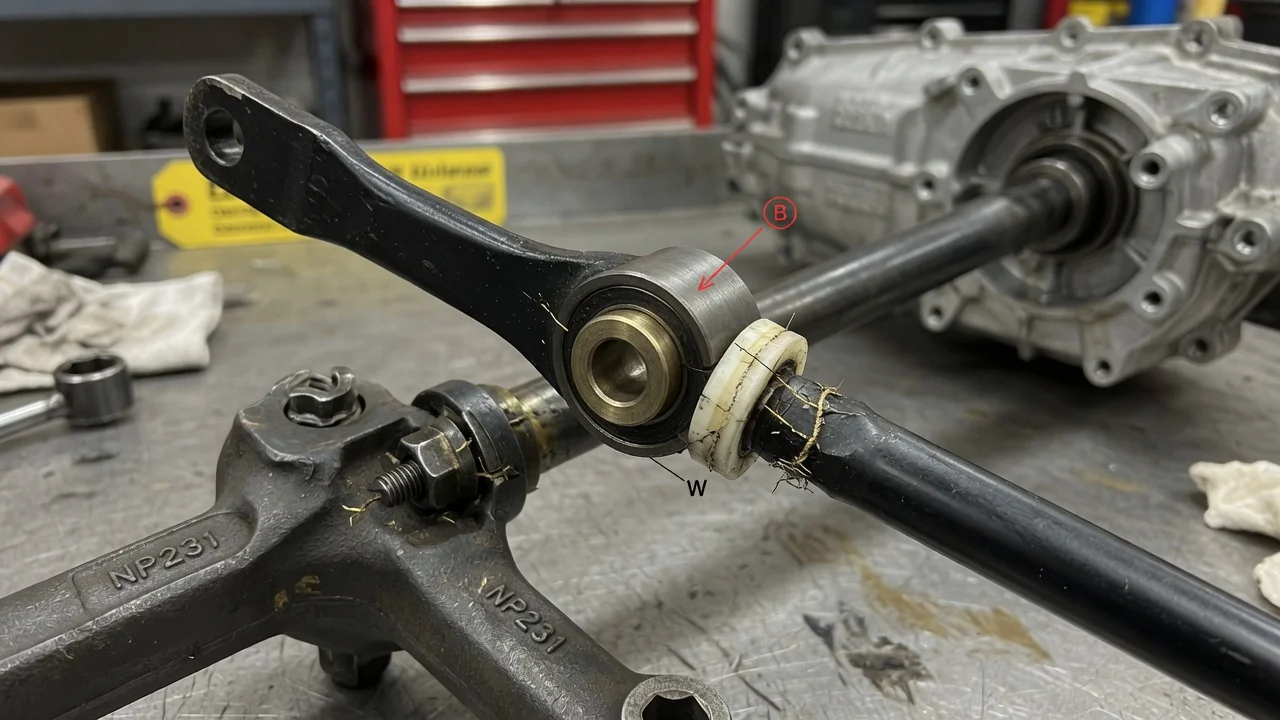
When the four-wheel-drive lever on a 2000 Dodge Dakota feels loose, rattles, or won't select a range cleanly, check the small bushing in the transfer case shift linkage first. This guide explains how to find that bushing on your truck and why it wears out. It also covers which details of your truck's configuration decide the correct replacement, and when the problem is more likely somewhere else in the system.
Identifying the linkage bushing on a 2000 Dakota
On a four-wheel-drive 2000 Dakota, you shift the transfer case mechanically with a floor-mounted lever in the cab. A rod runs from the lower end of that lever assembly to an arm on the side of the transfer case. Where the rod connects to a lever arm, it passes through a small bushing, usually a plastic or nylon grommet pressed into the hole in the arm and held by a clip or retainer. When owners and parts counters say transfer case linkage bushing, this grommet is usually what they mean. The material hardens with age, so it can crack, shrink, or fall out entirely. That leaves the metal rod rattling in an oversized hole.
To identify the bushing correctly, look at both ends of the linkage rod instead of assuming it sits in one location. Note three things: the diameter of the rod end, the thickness of the arm it passes through, and whether the bushing snaps in or uses a separate retaining clip. Those observations, plus your exact vehicle configuration, are what separate the right part from one that only roughly fits.
How the shift linkage moves the transfer case
When you move the floor lever, it pivots on its mount and pushes or pulls the linkage rod. The rod rotates the selector arm on the transfer case. That arm moves the internal shift mechanism into the range you selected, such as two-wheel drive, four-wheel high, neutral, or four-wheel low on a part-time unit. The bushing sits at a pivot point, so it takes the full shift load every time the lever moves. Its job is to give the rod a snug, quiet pivot with no metal-to-metal contact.
As the bushing wears, play builds up in the linkage. The lever may travel noticeably before the transfer case responds, the detent positions can feel vague, and the case may not fully engage a range. In some cases the rod slips free of the arm, and then the lever moves without doing anything. A missing bushing can also let vibration rattle through the floor at certain speeds. These symptoms point toward the linkage, but other faults can cause the same ones, so inspect before you order parts.
Configurations that change the answer
Not every 2000 Dakota has this part. Two-wheel-drive trucks have no transfer case and therefore no transfer case linkage. On four-wheel-drive trucks, the transfer case and shifter details can vary with the drivetrain package and options the truck was built with. Check your actual vehicle configuration rather than going by the model year alone. The identification tag on the transfer case and a VIN lookup are the most reliable ways to confirm what is installed.
Service history matters as much as the factory build. A truck with a replacement transfer case, a swapped shifter assembly, or earlier linkage repairs may have parts from another year or a related vehicle. A previous owner may also have used a bolt, washer, or zip tie in place of the original bushing. Operating conditions affect wear too. Trucks driven off-road or through mud, salt, or deep water, and trucks shifted often, tend to wear the bushing faster than trucks that rarely use four-wheel drive. Don't expect a fixed replacement interval for this part; replace it based on its condition at inspection.
What the owner can do
Start with a visual check. Park on level ground with the engine off, the parking brake set, and the wheels chocked. If you need to get underneath, support the truck on properly rated jack stands, never on a jack alone. Find where the linkage rod meets the transfer case arm and, if you can reach it, where it meets the bottom of the shifter. Have a helper move the lever slowly through its positions while you watch. On a healthy joint, the arm moves immediately. On a worn joint, the rod shifts inside the hole before the arm moves. Look for cracked, flattened, heat-damaged, or missing plastic, and check that the retaining clip is still there.
If the bushing is worn, use the details from your inspection to match a replacement. Many replacement bushings come in small kits with more than one size, which helps when the original is missing and you don't know the exact dimension. To replace it: 1) Release the clip and separate the rod from the arm. 2) Pry or cut out the old grommet. 3) Seat the new bushing in the arm. 4) Reinstall the rod and secure the clip. Afterward, cycle through every range with the truck stationary. Then confirm engagement on a short, slow drive on a loose surface, following the shifting procedure in the owner's manual. If your truck has a part-time system, don't drive on dry pavement in four-wheel drive. If the lever positions no longer line up with the ranges, the linkage may need adjustment.
Limitations and next step
A loose shifter isn't always a bushing problem. Other causes can produce similar complaints: • worn shifter mount components; • a bent or misadjusted rod; • low or incorrect transfer case fluid; • internal wear in the transfer case; • faults in the front driveline; The fault is probably elsewhere if a new bushing removes the play but the truck still won't engage four-wheel drive. The same applies if you hear grinding, find fluid leaks, or see the four-wheel-drive indicator behaving erratically.
This guide covers the common arrangement and how to identify the part, but it can't confirm the exact bushing for an individual truck. For the correct manufacturer specifications, linkage adjustment procedure, and fluid requirements, use the factory service information for your exact model and configuration, or give your VIN to a parts specialist. Have a qualified technician inspect the transfer case and linkage if shifting feels heavy, the case jumps out of gear, or you aren't comfortable working under the vehicle.