Dodge Transfer Case Linkage Identification: How to Tell Which Setup You Have
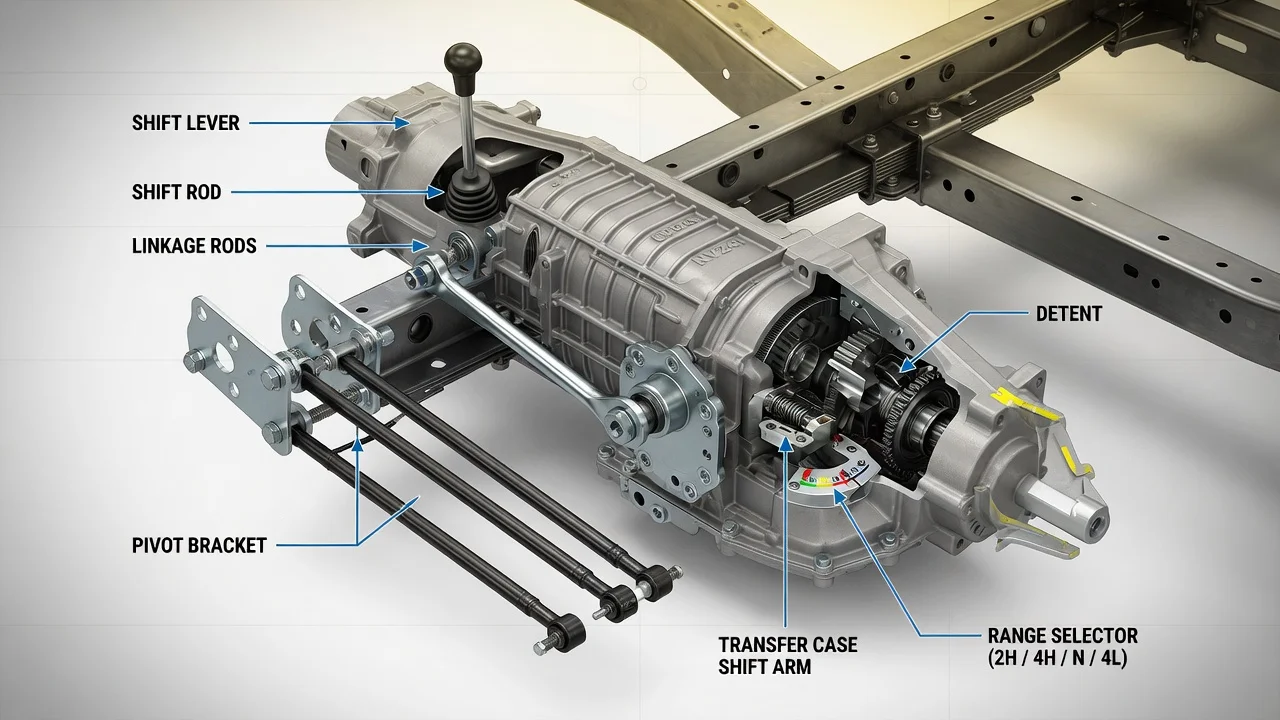
Before you order a bushing, rod or shifter for a four-wheel-drive Dodge, you need to know which transfer case and which shift mechanism the vehicle actually has. Dodge and Ram trucks, along with models such as the Dakota and Durango, were built with several transfer cases and more than one way of shifting them. A part that looks right in a photo can still fit poorly or not at all, so identification comes first.
The short answer
Identifying the linkage on a Dodge transfer case usually takes three steps. First, confirm whether the case is shifted by a floor lever or by an electronic switch on the dash, because electronic-shift cases have no mechanical rod to replace. Second, read the identification tag on the transfer case itself to get the exact model and assembly number. Third, match that information to the vehicle configuration: model year, body and chassis, transmission and drivetrain. Linkage components are often specific to the combination of case, transmission and body rather than to the case alone, so the case model by itself may not narrow the choice to one part. The tag matters more than the original build data whenever there is any chance the case has been replaced or swapped.
How the shift linkage works
On a manually shifted case, the lever in the cab pivots on a bracket mounted to the floor, the transmission or the transfer case. A shift rod connects the bottom of that lever to a selector arm on the side of the transfer case. When you move the lever, the arm rotates a shift shaft inside the case, which moves the internal forks that select two-wheel drive, four-wheel drive, neutral and low range. Spring-loaded detents inside the case hold each position. The linkage normally includes an adjustable joint, such as a swivel with a clamp bolt or a threaded rod end, that sets the relationship between lever and case. Plastic or rubber bushings at the pivot points and retaining clips at each end keep the rod in place. When those bushings wear, the lever develops play, and the case may not fully reach a detent even though the lever appears to be in position.
Electronic-shift cases replace the rod with a motor mounted on the case and a selector switch in the cab. If your truck has a dash switch or knob instead of a floor lever, a linkage parts search is the wrong path; the relevant components are the shift motor, its position sensor, the wiring and the control module.
Reading the transfer case identification tag
Most Dodge transfer cases carry a small metal tag fastened to the housing, commonly near the rear of the case. The tag shows a model designation and an assembly or part number, and often a serial or date code. Dodge applications have included cases with designations such as NP205, NP241, NV231, NV241 and NV271, but the model name alone is rarely enough. Variants of the same case can differ in input spline, output style, mounting and selector arm details, which affects the linkage. Clean the tag gently with a degreaser and a soft brush rather than a wire wheel, which can erase stamped characters. Photograph it and write down every number exactly as shown. If the tag is missing or unreadable, cast numbers on the housing can help a parts specialist, but they are less precise than the tag.
What changes the answer
Several factors can change which linkage is correct. Light-duty and heavy-duty versions of the same model year often used different cases and different brackets. Manual and automatic transmissions can change where the shifter bracket mounts and how the rod is routed. A part-time case and a full-time case may have different shift patterns, so a lever or gate from one may not suit the other. Mid-year production changes are another reason to rely on the VIN and the tag rather than the model year alone.
Later modifications matter as much as factory equipment. A replacement or salvage-yard transfer case may not match the original build. Aftermarket short-throw or relocated shifters use their own hardware. Body lifts and changed body mounts alter the distance between a floor-mounted lever and a frame-mounted case, which can affect rod length and geometry. Operating conditions also show up in the hardware: trucks used off-road or in areas with heavy road salt often have seized adjusters, corroded clips and hardened bushings that make the linkage harder to identify and adjust.
What the owner can do
Start with a careful inspection. Park on level ground, shut the engine off, set the parking brake and chock the wheels; if you need to get underneath, support the vehicle on proper stands. Trace the rod from the bottom of the lever to the selector arm on the case. Look for cracked or missing bushings, missing clips, a bent rod, a loose clamp bolt at the adjuster and excessive play at each pivot. Have a helper move the lever through every position while you watch whether the selector arm moves fully and the case settles into each detent. Check whether the dash indicator, if equipped, agrees with the lever position. Photograph the linkage from several angles before removing anything; those pictures make part matching and reassembly much easier.
Review the service history for signs of a previous transfer case replacement, transmission swap or lift kit. When ordering parts, give the supplier the VIN together with the numbers from the case tag. That combination identifies the original configuration and confirms whether the case still matches it.
Interpret symptoms with care. Difficulty shifting into or out of low range can simply mean the procedure was not followed; many cases require the vehicle to be stopped or rolling slowly with the transmission in neutral, so check the owner's manual for your truck. A case that jumps out of gear may have a misadjusted or worn linkage, but internal wear can cause the same complaint. Disconnecting the rod and moving the selector arm by hand helps separate the two: if the case engages cleanly and holds each position without the linkage, the problem is likely in the linkage.
Limitations and next step
There is no single adjustment position, rod length or fastener torque that applies to every Dodge transfer case. The factory service procedure for your exact configuration specifies the reference position for adjustment and the manufacturer specifications for hardware, and it should be followed rather than general advice. Linkage parts are not something to replace on a fixed maintenance schedule; inspect them when shifting quality changes or when other work brings you under the vehicle.
Seek professional help if the case will not engage or hold a position with the linkage disconnected, if you hear grinding or see fluid leaking around the selector shaft, or if an electronic-shift system shows a warning or will not change ranges. Those conditions point to internal or electrical faults that need proper diagnosis. If the tag is missing and the build history is unclear, a dealer parts department or a drivetrain specialist can usually confirm the configuration from the VIN and the case itself before you buy parts.