12V Battery Disconnect Switches: How to Choose the Right One for Your Vehicle

A 12V battery disconnect switch cuts the connection between the battery and the vehicle's electrical system without unbolting a cable. It is a good fit for a vehicle that sits for weeks, a project car, a boat or RV, or a car with a small drain you can't track down right away. The right switch depends on four things: your battery terminal style, where you want the switch mounted, the current it has to carry, and how your vehicle's electronics react to losing power. On most modern cars, the last point matters most.
The Short Answer
For a typical car or light truck stored for long periods, a terminal-mount disconnect on the negative battery post is the simplest choice. It is cheap, needs no wiring changes, and a knob or lever isolates the battery. Choose a different type in these cases: the battery has side posts, you want to switch it off from inside the cabin or from a distance, the vehicle has a battery monitoring sensor on the negative terminal, or the vehicle needs constant power for modules, security or telematics. The sections below explain each case.
What a Disconnect Switch Does and Doesn't Do
When open, the switch breaks the main circuit, so nothing on the vehicle can draw current from the battery. That stops parasitic draw, which is the small, constant current pulled by clocks, control modules, alarms and accessories while the vehicle is off. A normal drain can still flatten a battery over long storage. A faulty one can kill a battery in days. The switch also isolates the battery while you work on the electrical system, and it can act as a basic anti-theft measure.
A disconnect switch is not a fuse and does not replace circuit protection. It only interrupts the circuit when you operate it, not automatically during a short. Keep all factory fuses and fusible links. If you add a remote switch with new cable runs, protect those runs properly. A switch also does not fix a drain. It hides the symptom. If the battery is going flat faster than it should, measure parasitic draw with a multimeter to find the cause, then decide whether a switch is still worth adding.
Main Types of Battery Disconnect Switches
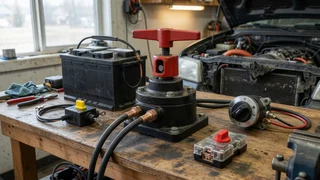
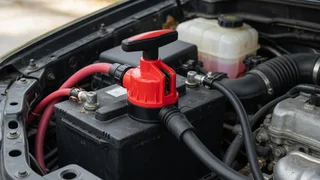
Type | How it works | Best suited to | Main trade-offs; Terminal-mount knob (top post) | Fits between the battery post and the cable clamp; a knob opens the circuit | Stored cars, occasional use, simple drain prevention | Must open the hood to operate; adds height and a connection point at the terminal; Side post disconnect | Threads into a side-terminal battery in place of the cable bolt, with a knob or lever | Vehicles with side-terminal batteries | Thread and clearance must match; can crowd tight battery trays; Blade or lever terminal disconnect | Quick-release lever clamps or releases a contact at the post | Frequent disconnecting, workshop use | Exposed contacts; fit varies by post size; Remote rotary switch | Heavy-duty switch mounted in the cable run, often with a removable key | Off-road, motorsport, RV, marine, trailers | Requires new cable runs, mounting and correct lugs; Solenoid or relay-type disconnect | Electrically operated switch controlled by a button or key fob | Switching from the cabin or remotely | More wiring; some designs draw a small current themselves
Match the Switch to Your Battery Terminals
Check the battery terminals first. Many fitment problems come from buying the wrong style.
Top post (tapered round posts): The most common style on cars and light trucks. Most terminal-mount knob switches are made for this, but the positive and negative posts usually differ slightly in diameter, so check which post the switch fits. Side post: Common on many General Motors vehicles and some others. The cable bolts into a threaded hole in the side of the battery case. A battery disconnect switch for side post use replaces or extends that bolt, so the thread and length must match your battery and cable end. Dual terminal: Has both top posts and side terminals. You can use either style of switch, but make sure the unused terminals stay covered. Stud terminals: Common on marine and deep-cycle batteries. Here a remote rotary switch in the cable run usually works better than a post-mount design.
Also check physical clearance. A terminal-mount switch adds height or width at the post. Before buying, confirm it won't touch the hood, a strut brace, the battery hold-down, or a metal panel. A switch body that can bridge to bodywork creates a short-circuit risk, especially on the positive side.
Negative or Positive Side?
Terminal-mount switches usually go on the negative post. If a tool touches the switch and the vehicle body at the same time, nothing happens, because both are already at ground. On the positive side, the same accident can cause a dead short. Remote rotary switches in heavier-duty installations are often wired into the positive cable so that the whole run past the switch goes dead. That job takes more care with cable routing, mounting and circuit protection. If you are unsure, follow the switch maker's instructions and a wiring diagram for your vehicle.
Current Rating: Read It Carefully
Switches are usually rated for continuous current and a much higher short-duration or cranking current. The cranking figure matters because the starter motor briefly draws far more than anything else on the vehicle. The continuous figure matters if accessories or the charging output pass through the switch while the engine runs. Engine size, compression and cold weather all raise starter current. Diesels and large gasoline engines need more headroom than small four-cylinders.
Ratings are not always presented the same way. Some listings give only one number, and some don't say whether it is continuous or intermittent. If the rating is unclear or missing, treat that as a reason to pick another product. An undersized switch or one with poor contact surfaces causes voltage drop: lost voltage across the switch itself. That can show up as slow cranking, flickering electronics, or a switch that gets hot.
Modern Vehicle Electronics: Check Before You Disconnect
Older vehicles with few electronic modules tolerate repeated disconnection well. Newer ones may not. Before installing a switch you plan to use often, consider these points:
Memory and relearn: Radio presets, clock, seat and mirror memory may reset. Some vehicles also need relearn steps for idle, power windows, sunroof or steering angle after power is restored. Battery monitoring sensors: Many vehicles, especially those with start-stop systems, have a sensor clamped to the negative terminal that tracks battery state. A terminal-mount switch may not fit with the sensor in place, and installing it the wrong way can disrupt battery management. If your vehicle has one, a different switch location or a battery maintainer may suit you better. Security and telematics: Alarms, immobilizers and connected-car services may react to a power loss, and some radios need a code to restart. Hybrids and EVs: These have a 12V battery, but disconnecting it can involve specific steps. Check the owner's or service information for your exact model year and powertrain first. Never open the switch with the engine running: Interrupting the battery while the alternator is charging can cause a voltage spike that damages electronics. Turn the ignition off and let modules power down before switching off.
These behaviors vary by manufacturer, model year, trim and market, so don't assume one vehicle will behave like another. If you need the vehicle to keep its settings and only want to protect the battery during storage, a quality battery maintainer is often the better tool. You can use one alongside a switch or instead of it.
Build Quality Checklist
Contact material and plating: Solid copper or brass contacts with corrosion-resistant plating hold up better than thin or unclear materials. Terminal fit: The clamp should seat fully on the post with no gaps, and should tighten without bending. Housing: Look for an insulated, sturdy body. A knob that stays put under vibration matters on off-road or rough-road vehicles. Weather and corrosion resistance: Under-hood heat, moisture and road salt all affect a switch. Marine and off-road use call for sealed designs. Clear ratings: Continuous and cranking current should both be stated. Removable key (remote switches): Useful as a theft deterrent and to stop others from turning the system back on.
Buying In-Store vs Online
Auto parts chains such as AutoZone usually stock a few common terminal-mount and side post designs. Buying in person lets you compare post sizes and thread fit, and staff can often look up your battery group size. Bring your old terminal hardware or a photo of the battery if you're unsure. If you search for a battery disconnect switch on Amazon or another marketplace, you will see a much wider range, including heavy-duty remote and solenoid units. Quality and accuracy vary a lot between listings. Confirm the seller states the terminal type, current ratings and dimensions, read reviews for comments on heat and fit, and check the return policy in case the switch doesn't clear your hood or tray.
Installation Basics
Turn off the ignition and remove the key, and let the vehicle sit long enough for modules to go to sleep. Disconnect the negative cable first and reconnect it last. Clean the battery terminals and cable ends so the new connection has good metal-to-metal contact. Tighten connections firmly but don't overtighten soft lead posts or side-terminal threads. After installation, check for voltage drop by measuring across the switch while cranking. A noticeable reading means a poor connection or an undersized switch. For remote switches, use cable and lugs sized for the current, route cables away from heat and sharp edges, and follow a wiring diagram.
When a Disconnect Switch Isn't the Right Fix
Repeated dead batteries aren't always caused by parasitic draw. An aging battery, corroded or loose terminals, or a weak charging system can produce the same symptom. Charging output problems, such as a failing alternator or a bad connection in the charging circuit, mean the battery never fully recharges while driving, and a disconnect switch won't help. Test battery condition and charging voltage, and measure the draw with the vehicle asleep, before deciding a switch is the answer. If those check out and the vehicle simply sits a lot, a disconnect switch is a sensible, inexpensive addition.
Quick Decision Guide
Older or simple vehicle, top posts, stored occasionally: Negative-side terminal-mount knob switch. Side-terminal battery: A side post disconnect matched to your thread and clearance. Off-road, motorsport, RV, marine or trailer: A remote rotary switch with properly sized cables, often with a removable key. Want to switch from the cabin or remotely: A solenoid-type disconnect. Check its own current draw. Modern vehicle with a battery sensor, telematics or many modules: Check vehicle-specific guidance first, and consider a battery maintainer as an alternative.