Why Should Battery Cable Ends Be Clean? Contact, Starting, and Service
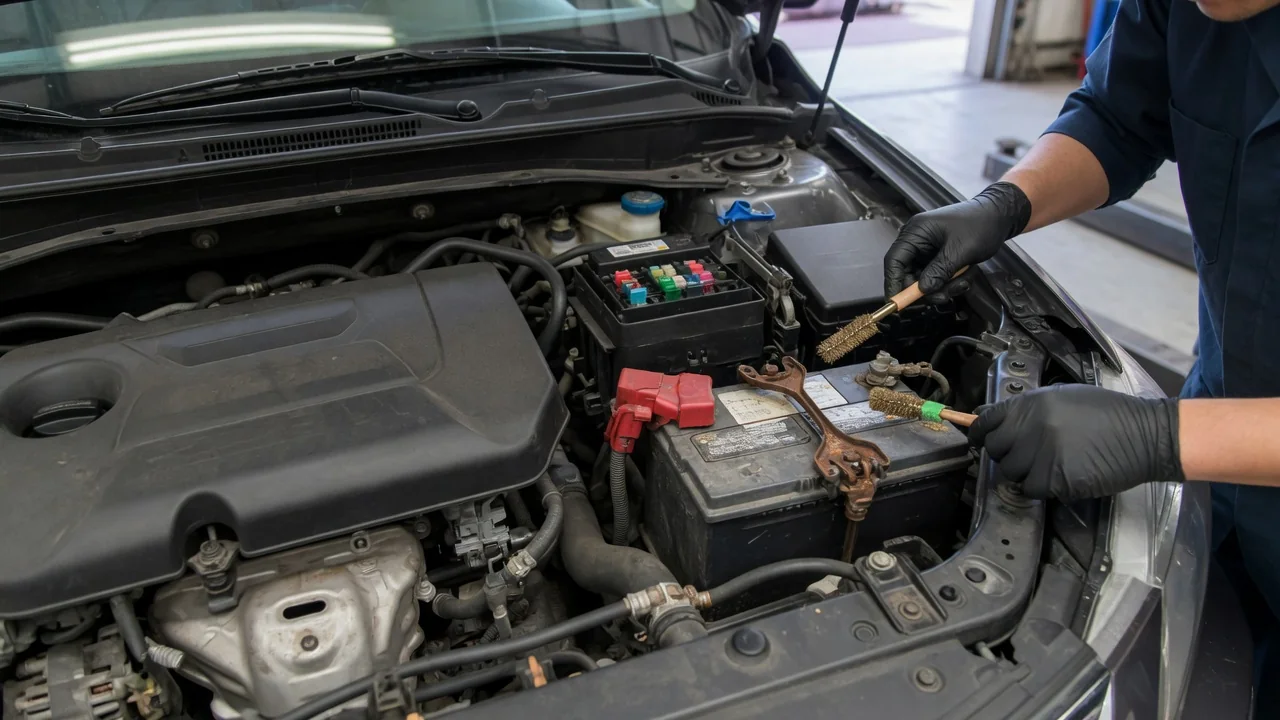
Battery cable ends should be clean because the starter, charging system, and every electrical module depend on current passing through a small metal-to-metal joint at each battery post. Corrosion, dirt, and oxide films add resistance to that joint, and resistance turns into lost voltage and heat whenever current flows. A clean, tight terminal lets the battery deliver what it has, while a contaminated one can make a healthy battery seem weak. This guide explains battery cable connection resistance and how to service it.
Contact Area: Where Current Crosses the Terminal
A battery terminal looks like a large connection, but the true electrical contact between a clamp and a post is far smaller than the visible surfaces. At a microscopic level, metal surfaces touch only at their high points, and current must squeeze through those spots. The added opposition at this interface is called contact resistance. Clamping force increases the number and size of the touching points, which is why a properly tightened clamp matters as much as clean metal. Most automotive battery posts are lead or lead alloy, and clamps are typically lead alloy or plated copper. Both form surface films over time, and when acid mist or electrolyte residue escapes from the battery, those films can grow into the white, gray, or bluish-green crusts often seen around terminals. That deposit conducts electricity poorly.
Contamination reduces effective contact area in several ways. A crust can physically hold the clamp away from the post, so only part of the mating surface carries current. A thin oxide layer that is barely visible can still interrupt many of the tiny contact points. Corrosion that creeps under the clamp or into the cable strands also traps moisture and accelerates further damage. The result is a joint whose resistance is higher than it should be and may change with temperature, vibration, and how recently the clamp was disturbed. That inconsistency is why a dirty connection can cause problems that come and go rather than failing outright.
Starting: Why Cranking Exposes a Dirty Connection
Most electrical loads in a parked or running car draw modest current, so a slightly resistive terminal can go unnoticed for a long time. Cranking is different. A starter motor draws a very high current, commonly hundreds of amps on passenger vehicles, and the voltage lost across any resistance rises in direct proportion to current. As simple arithmetic, a joint with three thousandths of an ohm of resistance would drop about 0.9 volts at 300 amps. That loss occurs at each poor connection in the circuit and subtracts directly from the voltage reaching the starter.
Lower voltage at the starter means less torque and slower cranking, which can make an engine harder to start, especially in cold weather when oil is thicker and battery output is already reduced. In more severe cases the starter solenoid may click without engaging, or dash lights may flicker and modules may reset as system voltage sags. The same resistance also converts energy into heat at the joint, in proportion to the square of the current, so a bad terminal can become noticeably warm after repeated cranking attempts. Heat speeds further oxidation, which can make the connection progressively worse. Because these symptoms resemble a weak battery or a failing starter, dirty cable ends are worth ruling out before replacing either part.
Service: Cleaning and Protecting Cable Ends
Cleaning battery cable ends is routine maintenance, but it involves acid residue and a high-current source, so basic precautions apply. Wear eye protection and gloves, keep sparks and flames away from the battery, and avoid placing tools where they could bridge the terminals or touch the positive post and the body at the same time. The general practice is to disconnect the negative cable first and reconnect it last, which reduces the chance of a short if a wrench slips. Before disconnecting, check the owner's manual: on many modern vehicles, removing battery power can clear stored settings or require relearning procedures, and some vehicles have a battery monitoring sensor attached to the negative terminal.
Once the clamps are off, a solution of baking soda and water is commonly used to neutralize acidic deposits; fizzing shows that acid is being neutralized. Keep the solution out of any battery vents. A post-and-clamp brush or a small wire brush then removes remaining oxide from the post and the inside of the clamp until bright metal shows. Rinse the area with clean water and dry it thoroughly. Inspect the cable while it is accessible: swollen insulation, green discoloration along the wire, broken strands, or a cracked clamp indicate damage that cleaning alone will not repair.
Reinstall each clamp fully seated on its post and tighten it firmly, following the torque value in the vehicle's service information where available, since overtightening can distort soft lead posts or crack clamps. A light coat of terminal protectant spray or grease applied after the connection is made, along with anti-corrosion washers if desired, helps slow future buildup. Finish by confirming that neither clamp can be twisted on its post by hand.
Practical Implications and Limits
Clean cable ends restore the path between battery and vehicle, but they cannot add capacity that a battery has lost. If cranking remains slow after proper cleaning, the battery may be discharged or worn, the starter may be drawing excessive current, or resistance may sit elsewhere, such as in engine and chassis ground straps, fusible links, or the starter's own connections. Technicians often locate these problems with a voltage-drop test, measuring voltage across each part of the circuit while the engine cranks, because a connection can look acceptable at rest yet fail under load.
Terminal condition also affects charging. Resistance at the battery connection makes it harder for the alternator to replenish the battery, so a vehicle used mainly for short trips may drift toward a lower state of charge, which tends to shorten battery life. On vehicles whose charging control relies on measurements taken at the battery, a poor connection can distort what the system sees. How strongly any of this shows up depends on the specific vehicle's electrical design, so its service information remains the authority for that model.
Recurring corrosion is itself a clue. Heavy buildup that returns quickly can point to electrolyte seeping around a post seal, a cracked case, or a charging voltage high enough to cause excess gassing. Sealed and absorbed glass mat batteries are generally less prone to acid deposits than vented flooded types, though their terminals can still oxidize. Cleaning treats the symptom; finding the source keeps the connection reliable between services.