Why Is Module Communication Checked After Body Repair?
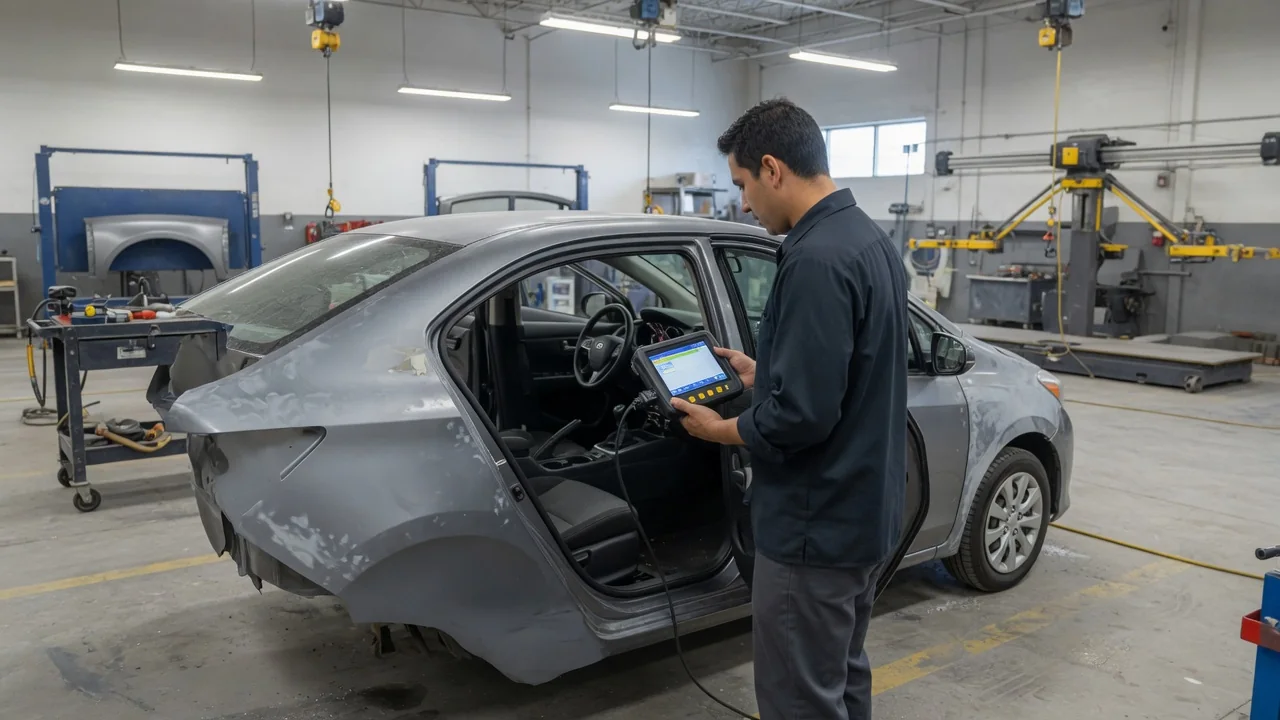
Modern vehicles spread their functions across many electronic control modules that share information over an in-vehicle data network. Body repair often means removing bumpers, doors, lamps, trim panels, and seats, and all of them can carry sensors, modules, and wiring. That is why module communication is commonly checked after body repair. A scan of the vehicle network after repair confirms that every expected module is present and reporting. It can also reveal faults that a visual inspection or a quick test drive may miss.
Sensor reconnection
Many components behind or inside body panels are electronic. Depending on the vehicle and its equipment, a bumper may hold parking sensors, radar units, or cameras. A door may contain a control module for the windows, locks, and mirrors. Pillars, doors, or the front structure may house impact sensors for the airbag system. To repair or replace a panel, these parts are often unplugged and set aside. When they go back in, a connector can end up only partly seated, its locking tab may not engage, or a terminal can be pushed back out of its cavity. The part may look installed while it is electrically disconnected or only intermittently connected.
A network scan finds these problems directly. The scan tool asks each module on the network to identify itself and report any stored diagnostic trouble codes. If a module fails to answer, or other modules log a lost-communication code for it, the likely cause is a connection, power, or ground problem at that location. Not every sensor is a network node. Many simple sensors report to a module through dedicated wires, so their faults appear as codes in the module that reads them. A replaced module or sensor may also need configuration, programming, or calibration before it works correctly. Whether that applies depends on the specific vehicle, and the manufacturer's service information defines the procedure.
Wiring
Harnesses run through door hinge areas, pillars, rocker panels, wheel wells, and the space behind bumpers. These are the same areas that absorb collision damage. An impact can stretch, pinch, or cut wires, and the repair itself adds risk. Cutting, drilling, straightening, and welding near a harness can damage insulation. Welding can also expose electronics to voltage spikes if the manufacturer's precautions are not followed. Body repair can disturb ground connections that bolt to sheet metal, too. A ground point reinstalled over fresh paint or corrosion may make a poor connection, and that can cause erratic module behavior and communication faults that come and go.
Network wiring needs particular attention because several modules share it. Many vehicles use a controller area network, or CAN bus, carried on a twisted pair of wires that links several modules together. A short to ground, a short to voltage, or a short between the two bus wires can disrupt communication for every module on that bus, not just the one near the damage. Bus termination is usually built into specific modules, so leaving one of them disconnected can degrade signal quality across the network. Repairs to network wiring must follow the manufacturer's guidance on splicing and on keeping the wires twisted. Some manufacturers restrict repairs to certain circuits, such as those for airbags.
Warning lights
Most dashboard warnings depend on network messages. The instrument cluster typically receives status information from other modules. It turns on a lamp or displays a message when a system reports a fault or stops reporting altogether. After body repair, this can appear as an airbag, ABS, stability control, or driver assistance warning, or as a message that a feature is unavailable. The lamp tells the driver that something needs attention, but it rarely identifies the cause. A single wiring fault on a shared bus can trigger several seemingly unrelated warnings at once, while some stored faults never light a lamp at all. Reading codes from every module is the only way to see the full picture.
Disconnecting the battery or unplugging modules during repair commonly leaves codes behind, even when nothing is wrong afterward. For this reason, repair facilities often record a scan before work begins, clear codes once the vehicle is reassembled, and scan again to confirm that none return. A warning lamp that stays off at startup does not prove a system is healthy. Some self-tests run only under particular conditions, such as a certain speed, steering input, or a complete drive cycle, so a fault may not set until the vehicle has been driven. The airbag system is the most critical case, because an unresolved fault may mean part or all of the system will not function as designed.
Practical implications and limits
For a car owner, the practical step is to ask whether pre-repair and post-repair scans were part of the job and whether a report is available. Many vehicle manufacturers publish repair guidance that calls for these scans, though requirements vary by make, model, and year. The scan tool matters as well. A basic code reader plugged into the diagnostic port usually reads only emissions-related powertrain codes. Body, chassis, restraint, and driver assistance modules generally require a more capable scan tool with broader coverage. After picking up the vehicle, return promptly if you notice new warning lights, features that no longer work, or a battery that drains overnight. A drain can occur when a module fails to go to sleep and keeps the network active.
A clean communication check also has limits. It confirms that modules respond and report no active faults at the time of the scan. It does not confirm that a camera or radar sensor is aimed correctly, that a sensor is mounted at the right angle, or that a damaged harness will hold up over time. Intermittent faults caused by vibration, moisture, or temperature changes may not appear during a short check. Calibrating driver assistance systems is a separate procedure with its own requirements. The network scan is best understood as one verification step among several. It shows which systems are online, but it does not prove that every system performs exactly as it did before the damage.