Why Does Heat Increase Tire Pressure During Driving?
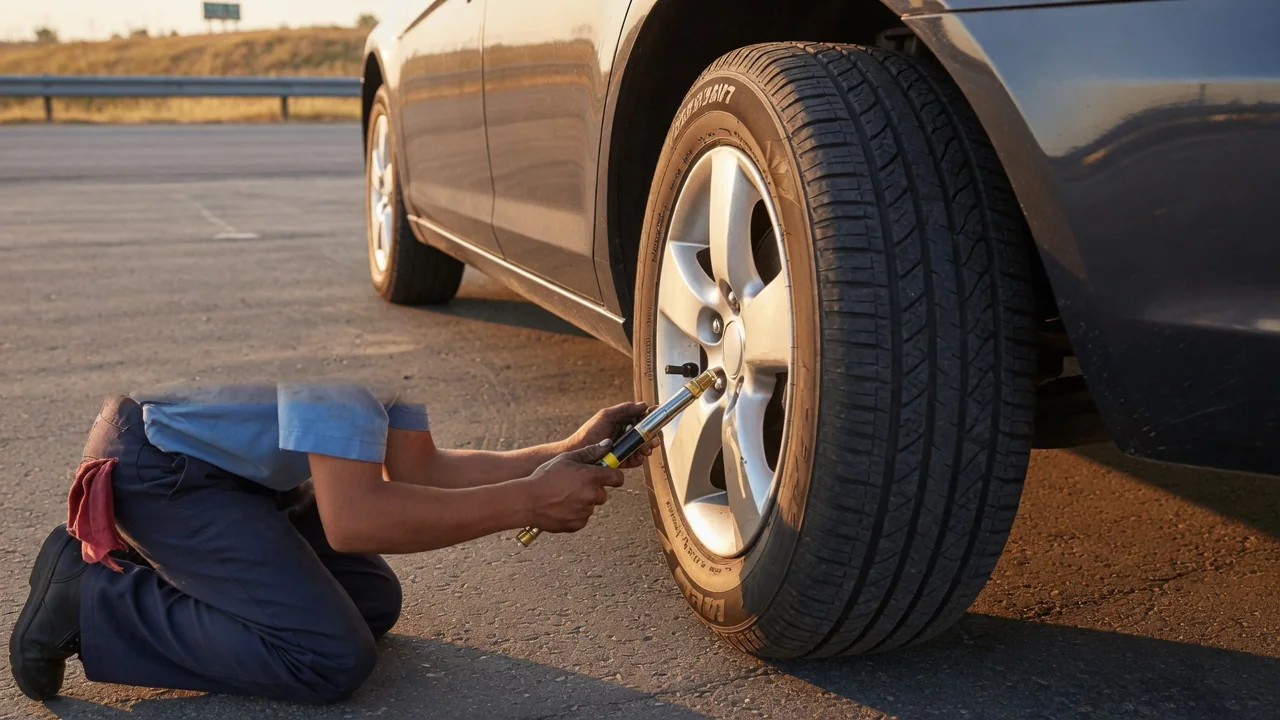
If you check your tires after a highway drive and again the next morning, the numbers rarely match. A hot tire pressure rise is normal. The air inside a tire warms up while you drive, and warm air in a nearly fixed space pushes harder on its container. Knowing why heat increases tire pressure during driving helps you measure correctly, read the gauge with realistic expectations, and spot the cases where the rise points to a problem.
Flex and Road Heat: Where the Warmth Comes From
The main heat source is the tire itself. As a wheel rolls, the section of tread and sidewall touching the road flattens into a contact patch, then springs back as it rotates away. This happens with every revolution, many times per second at highway speed. Rubber is not perfectly elastic, so some of the energy used to deform it is not returned when it recovers. Engineers call this hysteresis, and the lost energy turns into heat inside the rubber, the internal cords, and the air the tire holds. The more the tire flexes and the more often it flexes, the more heat it produces. That is why higher speeds, heavier loads, and underinflation all tend to make a tire run warmer: each one increases how much or how often the casing bends.
Outside sources add to that internal heat. Pavement that has been sitting in strong sun can be much warmer than the surrounding air, and the tread picks up heat through direct contact. Sunlight shining on the sidewalls warms one side of a parked car more than the other. Brakes convert motion into heat, and some of it passes through the wheel to the tire bead and the air inside, especially in stop-and-go traffic or on long downhill grades. Ambient air temperature sets the baseline that all of these effects build on, so the same drive generally produces higher tire temperatures on a hot summer afternoon than on a cool night.
Once the air inside warms up, basic gas physics takes over. A tire's internal volume changes very little once it is inflated, so when the temperature of the trapped air rises, its pressure rises roughly in proportion to its absolute temperature. Because absolute temperature is measured from absolute zero, a change of a few dozen degrees is a modest percentage change, which is why the pressure increase is noticeable but not dramatic. As a rough approximation derived from the gas law, a typical passenger tire changes by around one psi for every ten degrees Fahrenheit of air temperature change. Treat that as a ballpark figure rather than a precise prediction.
Measuring Tire Pressure the Right Way
Recommended inflation pressures are cold pressures. Vehicle manufacturers list them on a placard, usually on the driver's door jamb, and in the owner's manual. The number molded into the tire sidewall is the maximum the tire is designed to hold, not the pressure your vehicle should run. To compare your tires with the recommendation, check them when they are cold: before driving, or after the vehicle has been parked for several hours, ideally out of direct sunlight. A short, slow trip to a nearby air pump adds a little warmth, but far less than an extended drive.
Use a reliable gauge and, where possible, the same gauge each time, since different gauges can disagree slightly. Press it squarely onto the valve stem to avoid leaking air during the reading, and replace the valve cap afterward. If your vehicle has a tire pressure monitoring system that displays individual readings, remember that it shows live pressure. Those numbers will climb as you drive and settle back as the tires cool, so a dashboard reading taken mid-trip is not a cold measurement. Noting the outside temperature and whether the car had been driven gives each reading useful context when you compare checks over time.
Interpreting a Hot Reading
A pressure increase after driving is expected and is already accounted for in the cold recommendation. Manufacturers specify cold pressure precisely because tires are meant to warm up and gain pressure in use. For that reason, you should not let air out of a hot tire to bring it down to the placard number. Once it cools, it would end up underinflated, which increases flex and heat on the next drive and can affect handling, braking, and tread wear.
The pattern of readings often tells you more than any single number. Tires on the same axle usually warm up by similar amounts, so a hot reading that rises much more on one wheel than its partner is worth investigating. Possible causes include that tire having started out lower than the others, a brake that is dragging and feeding extra heat into the wheel, a wheel bearing problem, or uneven loading. A sun-facing side of a parked car may also read higher than the shaded side, which is harmless. If one wheel feels noticeably hotter than the others after a normal drive, have the brakes and bearing inspected.
A hot reading that is at or below the cold recommendation is a clear sign the tire is low, since it will drop further as it cools. Add air and recheck it cold later, and look for a slow leak if the tire keeps losing pressure between checks.
Practical Implications and Limits
The same temperature relationship works in reverse, which explains a common seasonal pattern. When autumn nights turn cold, tires that were set correctly in summer can fall below the recommended pressure, and a monitoring warning may appear on a chilly morning only to clear after some driving. A car kept in a warm garage and then parked outside in freezing weather can see a similar drop. Checking pressures at least monthly and after large temperature swings keeps the cold baseline accurate through the year, so the normal rise while driving starts from the right place.
Some limits apply to everything above. The one-psi-per-ten-degrees figure is an approximation, and actual heating depends on tire construction, size, load, speed, road surface, and climate. Recommended pressures are vehicle-specific, and some manufacturers list different values for full loads, sustained high speed, or towing, so the placard and owner's manual remain the authority for your vehicle. Gauge accuracy varies between tools, and monitoring systems differ in how they display pressure and when they trigger warnings. Driving to a significantly different altitude can also shift gauge readings slightly, independent of temperature. When readings seem inconsistent or a tire repeatedly runs much hotter than the others, a tire professional can inspect it rather than relying on general rules alone.