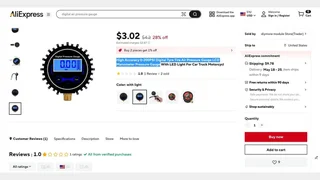
Air/Water Tire Pressure Gauge
Choosing an air/water tire pressure gauge starts with understanding what this dual-purpose tool actually measures. A standard tire gauge reads air pressure, while a water-filled or liquid-column design uses fluid displacement to indicate pressure changes. For drivers comparing options, the useful check is whether the gauge suits a tire valve, reads in familiar units, and remains accurate across a reasonable measurement range. That practical focus helps a buyer avoid tools that are sized for plumbing, lab use, or cooling-system work rather than passenger vehicle tires.
The direct answer
An air/water tire pressure gauge can give a usable tire-pressure reading when it is built for a Schrader valve and marked in psi or bar, but the result depends on calibration, connection quality, and the tool’s intended medium. A liquid-column gauge works by showing how far fluid moves under pressure, so the scale must be readable and the fill level stable. Air-only versions using a bourdon tube or digital sensor are typically more practical for routine tire checks because they are sealed, compact, and less affected by orientation.
For ordinary vehicle use, verify the gauge offers a measurement range covering the vehicle specification rather than just a narrow industrial band. Pressing the chuck squarely onto the valve stem reduces leakage during the reading, and repeating the measurement can help separate a true low tire from a poor connection. Accuracy is not proof of calibration, so if the reading conflicts with observed handling or repeated results vary widely, compare it with another gauge before adjusting tire pressure.