Why Does a Weak Battery Affect Car Electronics?
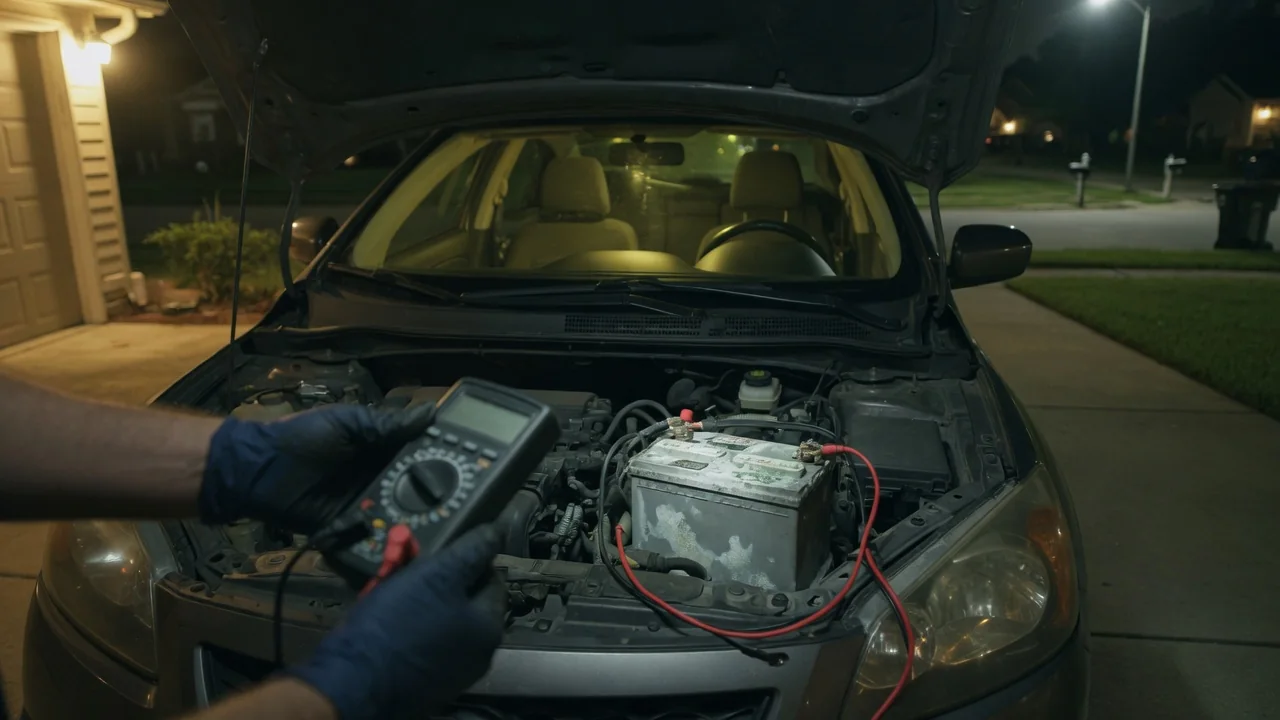
A weak battery rarely fails all at once. Long before the engine refuses to crank, a battery that can no longer hold or deliver adequate voltage can cause flickering dash lights, warning messages, radio resets, and erratic accessory behavior. Modern vehicles depend on many electronic control modules that expect a stable supply. This guide explains why low car battery electronic issues happen, how modules respond to unstable voltage, and how to find the root cause before replacing parts unnecessarily.
Voltage drops: what a weak battery does to the electrical system
A car battery does more than start the engine. It acts as a reservoir that stabilizes the vehicle's electrical system, absorbing load changes and smoothing the supply that every circuit receives. As a lead-acid battery ages, sulfation, plate wear, and loss of active material raise its internal resistance and reduce its usable capacity. A battery in that condition may still show an acceptable reading at rest, yet its voltage sags sharply the moment a significant load is applied.
The largest load most vehicles place on the battery is the starter motor. During cranking, even a healthy battery's voltage dips briefly. A weak battery dips much further and recovers more slowly, and that deeper sag is shared by every component connected to the system at the same moment. The same effect, on a smaller scale, can occur when high-draw devices such as the cooling fan, rear defroster, heated seats, or electric power steering demand current, particularly at idle when alternator output is limited.
The alternator normally covers running loads once the engine is on, but it is designed to maintain a battery, not to compensate for one that is failing. A battery with a damaged cell or high internal resistance can pull system voltage down, make the charging system work harder, and leave the electrical supply less stable than it should be. Corroded terminals, loose clamps, or a poor ground connection add resistance of their own and produce very similar symptoms, which is why connections matter as much as the battery itself.
Module behavior: how control units react to low voltage
Electronic control modules contain microprocessors, memory, and internal regulators that convert the vehicle's nominal 12-volt supply into the lower, tightly controlled voltages their circuits need. Those regulators can only do their job while the incoming voltage stays above a certain minimum. If the supply drops below that threshold, even for a fraction of a second, a module may reset, reboot, or temporarily stop communicating. The exact threshold and the module's response depend on its design and cannot be assumed to be the same from one vehicle to another.
Because modules share information over in-vehicle communication networks, a brief brownout in one unit can ripple through others. When a module drops offline, neighboring modules may notice the missing messages and store communication-related trouble codes or display warnings. That is why a weak battery can produce a confusing set of seemingly unrelated alerts, such as stability control, brake, airbag, or driver assistance messages, all appearing at once and then disappearing after the engine is running or the battery is recharged.
Some modules also monitor supply voltage deliberately. Many vehicles include battery monitoring or energy management functions that reduce or switch off nonessential loads, such as infotainment or comfort features, when voltage is low. Other systems may disable a function rather than risk operating it unreliably. Low voltage can also disturb stored settings: radio presets, the clock, seat or mirror memory, and learned values such as window positions may be lost or need to be relearned after a deep voltage dip or disconnection, depending on the vehicle.
Diagnosis: separating battery problems from electronic faults
Diagnosis starts with confirming the battery's condition rather than chasing individual warning lights. A resting voltage reading with a digital multimeter, taken after the vehicle has sat with no loads and no recent charging, gives a basic indication of state of charge. A fully charged conventional 12-volt lead-acid battery typically reads around 12.6 volts or slightly higher at rest, and noticeably lower readings suggest a discharged or failing battery. Voltage alone does not reveal capacity or internal resistance, however, so a battery can pass this check and still fail under load.
A load test or a conductance-based battery tester gives a better picture of whether the battery can deliver current while holding its voltage. It is also worth checking the charging system with the engine running, since an alternator that undercharges can leave a good battery chronically depleted. Watching voltage during cranking can reveal an excessive dip that a resting reading hides. For vehicles with AGM or EFB batteries, including many stop-start models, testers and chargers should be set to the correct battery type to avoid misleading results or improper charging.
Physical inspection completes the picture. Look for corrosion, loose or damaged terminals, and frayed or swollen cables, and confirm that the main ground connections are clean and tight. If the battery is recharged or replaced and the warnings clear, stored trouble codes may still need to be read and cleared with a scan tool. If symptoms persist with a confirmed healthy battery and charging system, the cause may be a parasitic drain, a wiring fault, or a genuine module failure, which calls for further electrical diagnosis.
Practical implications and limits
In everyday use, the key takeaway is that multiple electronic warnings appearing at startup, especially in cold weather or after the vehicle has sat unused, often point to supply voltage before they point to failed electronics. Addressing the battery and its connections first is usually the least expensive step and can prevent unnecessary replacement of modules or sensors. Frequent short trips, long parking periods, and accessory use with the engine off all reduce charge and make these symptoms more likely, while a battery maintainer can help vehicles that sit for extended periods.
General guidance has limits. Manufacturers set their own voltage thresholds, battery monitoring strategies, and relearn procedures, and some vehicles require a new battery to be registered with the energy management system using a scan tool. Disconnecting the battery can also trigger security codes or reset functions on certain vehicles. Electronic symptoms that persist after the battery, charging system, and connections have been verified are not explained by battery weakness alone, so the vehicle's service information or a qualified technician should guide the next step.