Why Do Some Headlights Need Projector Lenses?
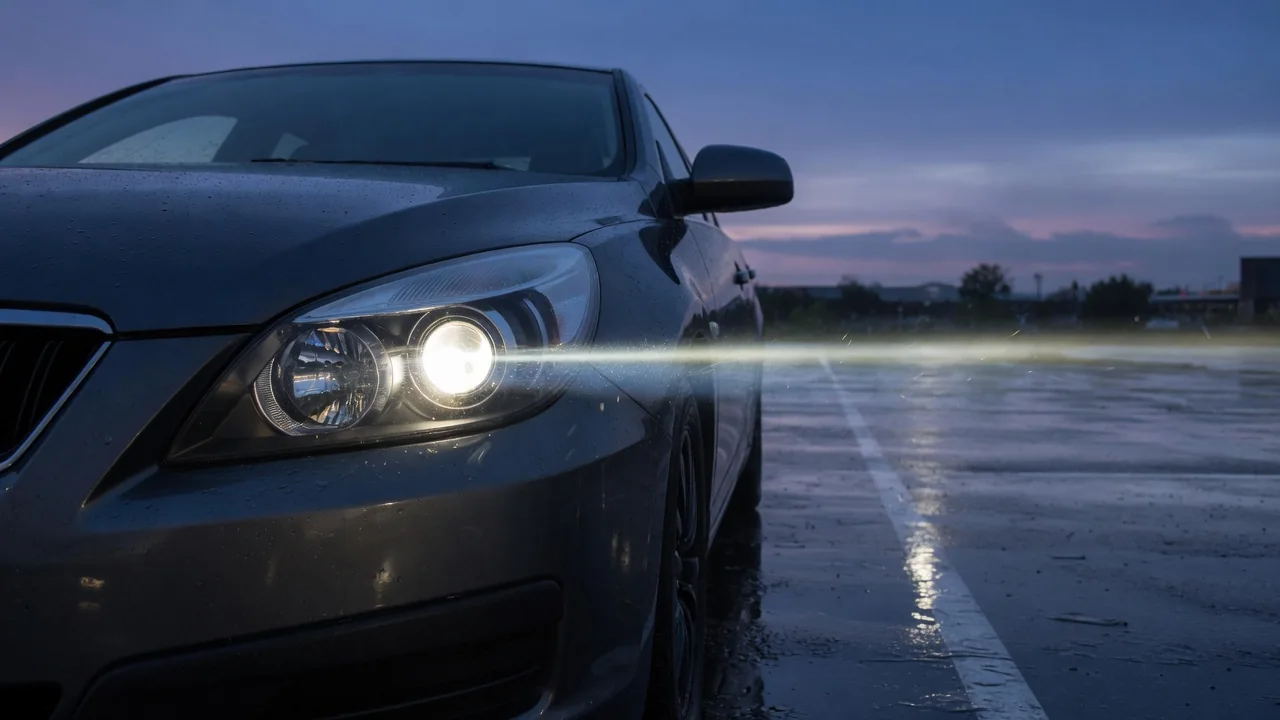
Headlights have two jobs that pull in opposite directions: put plenty of light on the road and keep it out of oncoming drivers' eyes. Many headlamps do this with a shaped reflector alone, but others place a small, thick lens in front of the light source. That lens is not decorative. Some combinations of light source, beam pattern, and housing size are simply easier to control with projector headlight optics than with a reflector. Here is why some headlights need projector lenses.
Light cutoff: controlling where the beam stops
A low beam is defined less by how bright it is than by where it stops. The cutoff is the boundary between the lit area below and the darker zone above, where the eyes of oncoming drivers and the mirrors of cars ahead sit. A good low beam places intense light just below that line, spreads it wide toward the road edges, and lets very little stray above it. The sharper and more consistent the boundary, the closer strong light can be placed to it without causing glare.
In a typical projector, an ellipsoidal reflector gathers light from the source and focuses it toward a second focal point in front of the bulb. A metal shield, often called a cutoff shield, sits near that point and physically blocks part of the light. The lens then projects an image of the shield's edge onto the road. Because the lens inverts the image, the top edge of the shield becomes the upper edge of the beam. The shield's profile can include a step or angled section, which produces the raised portion of the cutoff on the side of the road where pedestrians and signs are found.
A reflector headlamp has no shield to trace. It builds its pattern from countless reflections, each depending on exactly where light leaves the source. That works well when the filament or emitter position is tightly controlled, and modern multi-surface reflectors can produce clean cutoffs. It becomes harder when the source is very small and very bright, or when designers want an exceptionally crisp edge in a compact housing. A projector addresses that by turning the cutoff into a physical edge rather than the combined result of many reflections.
The lens: projecting a sharp beam pattern
The lens is the part that gives the projector its name. It is usually a thick convex element, often aspheric, positioned so that its focal point coincides with the shield edge. Light passing through it is redirected into a controlled beam, and the shield edge is reproduced as a defined line in front of the vehicle. Without the lens, the shield would cast only a fuzzy shadow, and the light from the ellipsoidal reflector would spread unpredictably after passing its focal point.
The lens also shapes the character of the cutoff. Glass and optical plastics bend different colors of light by slightly different amounts, so many projectors show a thin blue or purple fringe along the cutoff when viewed on a wall. Some designs deliberately soften the edge with surface texturing or a modified lens profile so the transition is less abrupt for the driver while glare stays controlled. The lens's size and focal length also influence how wide and tall the beam can be, which is one reason projector modules vary so much in size.
The projector lens sits behind the outer headlight cover and is a precision component. Haze, internal contamination, heat damage, or a lens that has shifted in its mount can blur the cutoff, scatter light upward, and reduce useful output. Because the beam depends on the alignment of reflector, shield, and lens together, a projector is generally serviced or replaced as an assembly rather than adjusted piece by piece.
Aiming: putting the cutoff in the right place
A sharp cutoff is useful only when it sits at the right height and angle. Most headlamps have vertical adjusters, and many have horizontal ones, that tilt the whole lamp or the internal module. The aiming procedure in a vehicle's service information typically specifies conditions such as tire pressure, fuel level, load, and distance to a vertical surface, then gives a target position for the cutoff line. Those values differ between vehicles and regions, so the official procedure for the specific model should be followed.
Projectors make aiming more repeatable because the cutoff is easy to see. On a wall, the horizontal portion and the step are clearly visible, giving a definite line to set. With a reflector beam that has a softer boundary, finding the correct position involves more judgment. The trade-off is that a crisp cutoff is less forgiving: a small aiming error moves a well-defined band of intense light, so aiming too high produces glare and aiming too low shortens how far the driver can see.
Aim also changes while driving. Passengers, cargo, and towing tilt the body and raise the beam. For that reason, many vehicles include a manual leveling control or an automatic leveling system that adjusts the headlights using body height sensors. Whether a particular vehicle has either, and how it is calibrated, depends on its design and on local requirements.
Practical implications and limits
Projectors solve a control problem; they do not guarantee better lighting. A well-engineered reflector lamp can outperform a poorly designed or poorly adjusted projector, and many modern LED headlights use reflectors, projectors, or both depending on the beam function. The more useful question about any headlamp is whether its optics were designed around its light source, not simply which style it uses.
That principle explains a common problem with conversions. Installing a different light source, such as an aftermarket HID or LED bulb, in a housing designed for a halogen filament can move the light-emitting area away from where the optics expect it. In a reflector, the result is often scattered glare. In a projector, the shield may hide some errors, but dark spots, a weak center, or light above the cutoff can still appear. Fitting a projector module into a reflector headlamp changes the lamp's optics, and its legality and performance depend on the parts, the installation, and local rules.
For everyday ownership, a few checks go a long way. Shine the low beams on a flat wall to see whether the cutoff is level, crisp, and matched on both sides. Watch for cloudy lenses or moisture inside the housing, and have the aim checked after suspension work, collision repairs, or headlamp replacement. If the vehicle has automatic leveling, a warning message or a beam that stays too high or too low points to a leveling system issue rather than a bulb problem.