Why Do Some Classic Cars Use Bias-Ply Tires?
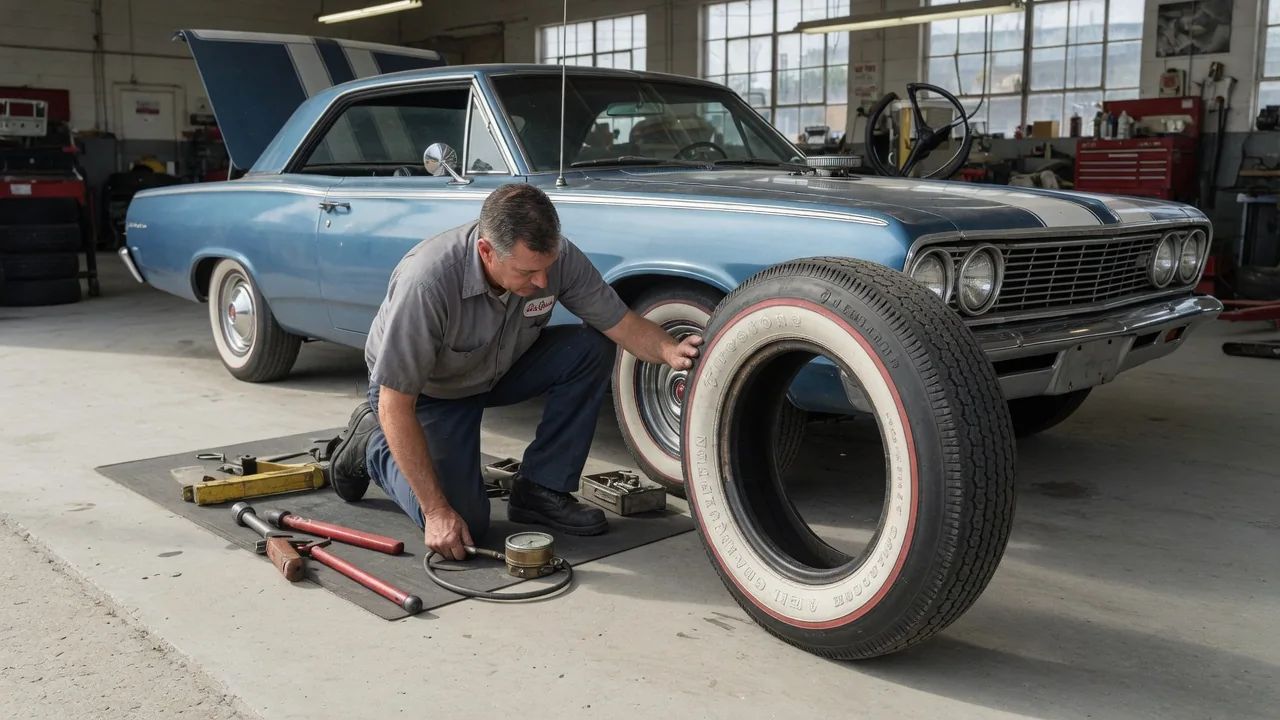
When a classic car needs new tires, the owner has to pick between modern radials and the bias-ply type the car may have been built around. Some classic cars still run on bias-ply tires for reasons that go beyond nostalgia. To see why, it helps to look at three things: how the tire carcass is built, how that construction affects steering and ride, and how the tire fits the wheel, the body, and the car's original design.
Carcass construction
The body of a bias-ply tire is made from layers of fabric cord, called plies. The plies run from bead to bead at a diagonal angle to the direction of travel. Each layer is laid at the opposite angle to the one beneath it, so the cords form a crisscross pattern. The same plies make up both the sidewall and the section under the tread, so the whole carcass acts as one connected structure. Higher load ratings are traditionally reached by adding plies, and the overlapping layers produce a tough, durable casing.
A radial tire is built differently. Its body cords run straight across from bead to bead, roughly perpendicular to the direction of travel. Belts, often steel, sit under the tread to stabilize it. Because of this split, the sidewall can flex on its own while the tread stays flatter on the road. In a bias-ply tire, sidewall flex passes into the tread, so the contact patch distorts more when the tire rolls, carries load, or corners. Most of the other differences between the two designs come from this, including heat buildup, wear patterns, and the feel through the steering wheel.
Many vehicles from before radials became common were engineered and delivered on bias-ply tires. For those cars, bias-ply is simply the original construction, and that history is a big reason some owners keep using it.
Handling
Because the crisscrossed plies tie sidewall and tread together, a bias-ply tire usually builds cornering force more gradually and lets the tread squirm more. Drivers often describe the feel as softer and less precise than a radial. Bias-ply tires also tend to follow grooves, seams, and ridges in the pavement, which is often called wandering or tramlining. Their grip limit is generally lower than a comparable radial's. The tread also wears differently, because the contact patch moves more as the tire rolls through each revolution.
Tires don't work alone. Engineers set a car's suspension geometry, spring and damper rates, steering ratio, and alignment specifications around the tires available at the time. If a vehicle was developed on bias-ply tires, its steering effort, self-centering, and balance reflect that. Switching to radials can change those traits. Some owners notice heavier steering at parking speeds, a different on-center feel, or more road harshness coming through a suspension that was never tuned for a stiffer, belted tread. Others like the extra grip and straight-line stability. Whether the change is an improvement depends on the specific vehicle, its suspension condition, and its alignment. The car's own service literature is a better guide here than general claims.
Fit
Fit starts with physical dimensions. A bias-ply tire and a radial labeled with similar sizes may not be identical. Overall diameter, section width, and sidewall shape can differ, and many older sizing systems do not convert one-to-one into modern metric radial sizes. Small differences can affect clearance at the fenders, inner wheel wells, and suspension parts, especially at full steering lock. Speedometer and odometer readings also depend on rolling diameter. Wheels need checking too. Rim width, bead seat design, and whether a tire is meant to run with an inner tube should be confirmed against the tire maker's guidance and the wheel itself.
Fit also covers appearance and historical accuracy. Bias-ply tires usually have a tall, rounded sidewall and period tread patterns that shape a classic car's stance and look. If an owner is restoring a car to factory-correct condition, or showing it where originality is judged, correct tire construction can be part of that authenticity. That is why reproduction tires based on period designs exist. Some tire makers also offer radial construction with a period-style sidewall for owners who want the look with modern internals.
Practical implications and limits
The most important rule is consistency. Standard tire guidance says not to mix bias-ply and radial tires on the same vehicle, because the two respond to steering and load so differently that the car's balance can become unpredictable. A spare of a different construction should be treated as a temporary measure, not a permanent part of the set. If you switch, change all positions together. Afterward, check alignment and clearance, since the car may react differently than it did before.
The best choice depends on how the car is used. Bias-ply tires suit cars driven occasionally, at moderate pace, to shows or on short trips, where period character matters more than maximum grip. An owner who drives a classic often, on highways, or in wet weather may decide that radial traction and stability matter more than strict originality. Storage habits matter as well. Bias-ply tires can develop temporary flat spots after a car sits, which shows up as a thump or vibration until they warm up. Any tire also ages over time whatever its tread depth, so a stored car's tires should be checked for cracking, hardening, and date codes before regular use.
This explanation covers general mechanisms, not how any particular car behaves. Results with either tire type depend on the suspension design, the condition of bushings, steering parts, and shocks, and the exact wheel and tire. Recommended inflation pressures and load capacities belong to each specific tire, so confirm them with the tire manufacturer and the vehicle's service manual rather than assuming an original figure still applies.