What Is a Sensor Offset Error? Consistent Bias, Causes and Testing
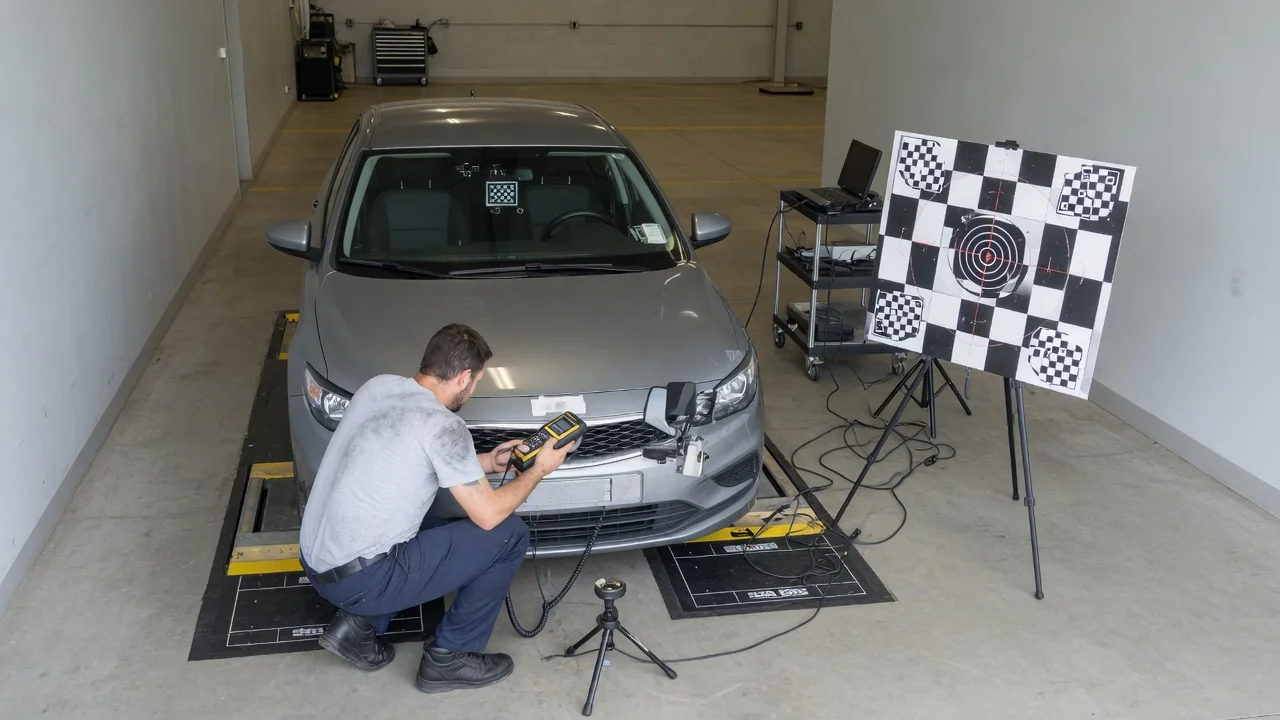
A sensor offset error is a measurement fault in which a sensor reports values that are shifted away from the true value by a roughly constant amount. The signal still rises and falls as conditions change, but every reading starts from the wrong baseline. Control modules rely on these readings to manage fuel, ignition, braking and comfort systems, so even a modest offset can push their decisions in the wrong direction. This guide explains what consistent bias looks like, why a vehicle sensor offset develops, and how it is tested.
Consistent Bias: What Makes an Error an Offset
The defining feature of an offset error is that the mistake is additive and stable. If a coolant temperature sensor reads a few degrees high when the engine is cold, it also reads roughly the same few degrees high when the engine is warm. The shape of the response is correct. Only the starting point is wrong. Engineers often call this a zero error, because the sensor would report a nonzero value even when the true quantity sits at its reference point. Other common faults behave differently. A gain or slope error grows or shrinks as the measured value changes, so the sensor may be accurate at one end of its range and wrong at the other. Noise produces random scatter. Intermittent faults produce dropouts or spikes. A failed sensor usually sticks at one value or goes out of range entirely.
Consistent bias is often harder to notice than an outright failure. The readings remain plausible and change smoothly. They usually stay inside the window that a control module accepts as valid, so a simple circuit-range check may not flag anything. Many modern systems also run plausibility or correlation checks, comparing one sensor against another or against a calculated model. These checks can set range or performance codes when the disagreement becomes large enough, but smaller offsets can slip under their limits. In some systems, adaptive strategies such as fuel trim correction partly absorb the error. That can hide the root cause while the adaptation values quietly drift away from normal.
Common Causes of Sensor Offset
Many offsets begin in the wiring rather than in the sensor itself. Most analog sensors deliver a voltage that the module interprets as a physical value, so anything that adds or subtracts voltage along the way shifts the result. Extra resistance in a ground path can raise the voltage the module sees. Common sources are corrosion, a loose terminal or a weak shared ground point. A reference voltage that sits slightly away from its intended value moves every reading that depends on it. Moisture inside a connector, chafed insulation or a partial short to a neighboring circuit can leak small currents into the signal line and bias it in a steady direction.
The sensing element can also drift. Pressure diaphragms, thermistors, hot-film airflow elements and similar components age with heat cycling, vibration and exposure to contaminants. Deposits on an airflow sensor element, for example, can change how it responds to the air passing over it. Mechanical and installation factors matter too. Examples include a pressure sensor connected through a cracked or partly blocked hose, a temperature sensor mounted where it picks up heat from a nearby source, or a replacement part that is not the correct type for the application. Some sensors, such as certain steering angle or position sensors, must be zeroed or relearned after installation or alignment work. A skipped calibration step leaves a built-in offset. Whether a given sensor needs this depends on the vehicle, so the service information is the authority.
Testing for an Offset Error
The core idea of offset testing is to compare the sensor against a known reference at a moment when the true value is predictable. A cold soak is a common example. After a vehicle has sat long enough for everything to reach ambient temperature, the coolant, intake air and other temperature sensors should read close to one another and close to the outside temperature. With the key on and the engine off, a manifold pressure sensor should read close to atmospheric pressure. On vehicles that also report barometric pressure, the two values can be compared directly. Where no internal reference exists, a separate gauge, thermometer or meter of suitable accuracy provides an independent check.
To confirm that the error is truly an offset rather than a slope problem, check at more than one point. If the difference between the sensor and the reference stays about the same at two or more conditions, the pattern points to offset. If the difference changes noticeably as the measured value changes, a gain error or a nonlinear fault is more likely. Electrical testing then separates sensor faults from circuit faults. Measure the signal voltage at the sensor connector and compare it with the value shown on a scan tool to reveal whether the wiring is altering the signal. Other useful checks are voltage drop tests on the ground and signal circuits, verifying the reference voltage, and inspecting terminals. Gently flexing the harness while watching live data can expose resistance or intermittent contact. Acceptable values and test procedures come from the manufacturer's service information for the specific vehicle.
Practical Implications and Limits
In everyday driving, an offset usually shows up through its consequences rather than as an obvious sensor fault. A biased temperature input can affect cold-start fueling, idle quality or cooling fan operation. A biased pressure or airflow input can influence fuel delivery and fuel economy. A biased position or angle input can affect stability or driver-assistance functions. Because the symptom appears in another system, the sensor may not be the first suspect. Replacing a sensor without checking its circuit can leave the problem in place, since a high-resistance ground will bias the new part just as it biased the old one. After a repair, learned adaptation values may need time or a reset procedure to return to normal.
Any general test also has limits. No universal threshold separates acceptable variation from a real offset, because tolerances are set for each sensor and application. Some disagreement between sensors after a cold soak can be normal if the vehicle was parked in the sun or near a heat source. Reference tools have their own accuracy limits, so a small discrepancy may fall within the combined uncertainty. The absence of a diagnostic trouble code does not prove a sensor is accurate, and the presence of one does not prove the sensor itself is defective. Treat an offset finding as evidence that narrows the diagnosis. Confirm it against the manufacturer's procedures before replacing parts or changing calibrations.