Why Do Some Cars Need Battery Registration After Replacement?
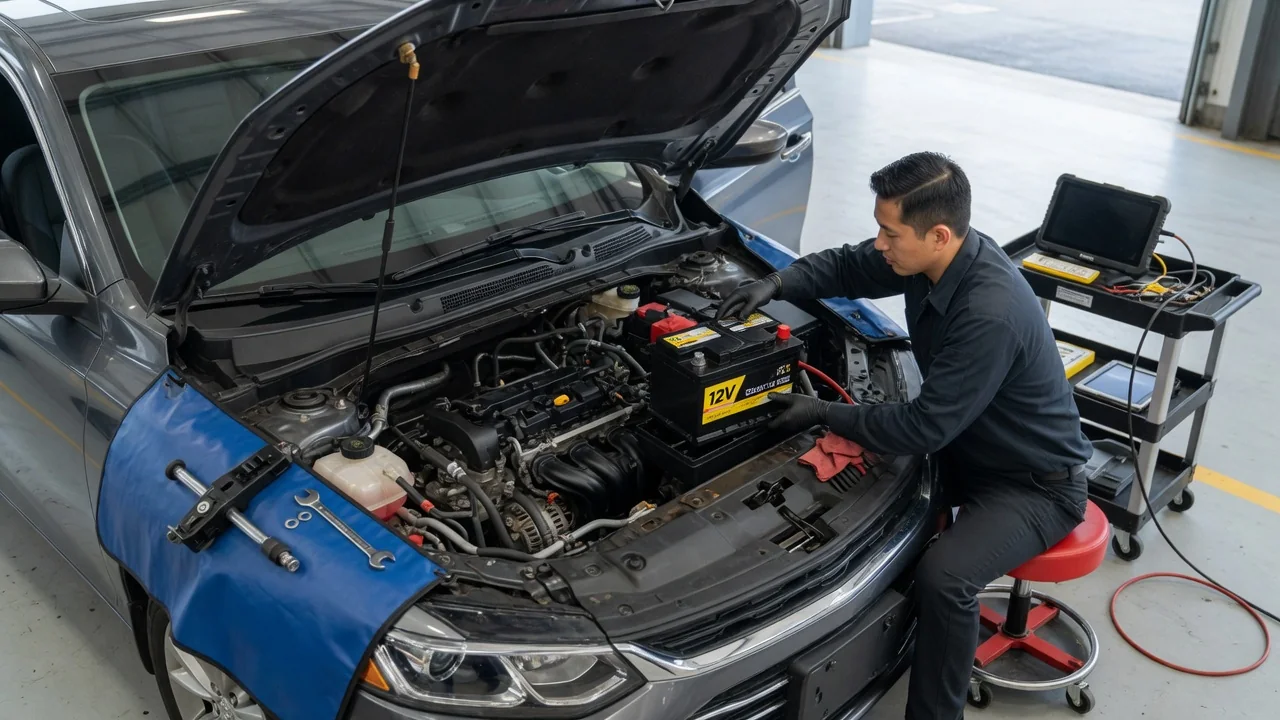
Replacing a car battery used to be a purely mechanical job: disconnect the old one, install the new one, reconnect. On many modern vehicles, the battery is part of an electronically managed energy system, and the car's control modules keep records about the battery they expect to find. Battery registration tells those modules that a new battery has been installed, and sometimes what kind it is. The purpose of battery registration comes down to three things: how the car charges, which battery type it uses, and how service is carried out.
Charging strategy: why the car tracks battery history
Many vehicles no longer charge the battery at a fixed voltage. Instead, an energy management function monitors the battery. It often works with a battery sensor mounted on the negative terminal and tracks current flowing into and out of the battery, along with voltage and temperature. From these readings, the system estimates state of charge and state of health. It uses those estimates to decide how hard the alternator should work at any moment. This lets the vehicle reduce alternator load to save fuel and recover energy during deceleration. It also lets the car keep the battery within a target charge window rather than holding it fully topped up at all times.
Over time, the system builds a model of how the battery is aging. As a battery loses capacity, the management logic typically adapts its strategy to compensate for a weaker battery. If a fresh battery is installed without registration, the system may keep treating it as the old, worn unit. The result can be a charging profile that does not suit the new battery, which may contribute to overcharging, undercharging, or premature wear. Registration resets the stored history so the estimates start again from a new-battery baseline.
The same estimates often control features beyond charging. Start-stop operation, for instance, typically depends on the system judging that the battery has enough reserve to restart the engine reliably. Some vehicles also reduce or switch off nonessential electrical loads when the estimated charge falls too low. An outdated battery record can therefore change how these functions behave, even when the new battery itself is healthy.
Battery type: why chemistry and capacity matter
Registration is not only about telling the car that the battery is new. On some vehicles, the procedure also records the battery's technology and rated capacity. This matters because different lead-acid designs respond best to different charging conditions. Conventional flooded batteries, enhanced flooded batteries (EFB), and absorbent glass mat (AGM) batteries differ in three ways. They tolerate deep cycling differently, they accept charge voltage differently, and they hold up differently under frequent start-stop use. A charging strategy tuned for one type may not suit another.
Capacity is part of the same picture. The energy management logic uses the battery's rated amp-hour capacity to interpret current measurements and judge how much charge remains. If a battery of a different capacity is fitted but the system still assumes the original value, its state-of-charge estimates can be skewed. On vehicles that support it, coding the new capacity and type keeps those calculations aligned with the hardware actually installed.
This is also why vehicle manufacturers generally recommend replacing a battery with one of the same technology the car was designed for. Switching from AGM to a conventional flooded battery, for example, may conflict with the vehicle's charging approach and with the demands of start-stop operation. Whether a different type can be coded at all, and with what consequences, depends on the specific vehicle. Check this in the vehicle's service information.
Service: how battery registration is done
Battery registration is normally performed with a diagnostic scan tool that can communicate with the relevant control module. The general sequence has four steps. Install the new battery, connect the tool, select the battery registration or battery replacement function, and confirm or enter the battery details the system requests. Depending on the vehicle, those details may include battery type, capacity, and sometimes manufacturer or serial information. Professional shops use dealer-level or advanced aftermarket tools, and some consumer-grade scan tools offer this function for supported vehicles.
The exact steps vary widely. Some vehicles only need a reset of the stored battery aging data. Others also require coding of a new capacity or chemistry. Some allow part of the process through an onboard menu or a specific ignition sequence, while others require a tool. Because the procedure is vehicle-specific, the owner's manual and the manufacturer's service information are the authoritative sources. They say whether registration is required and how to perform it.
Battery replacement on these vehicles often involves related steps. Where the manufacturer recommends it, keep the vehicle supplied with power during the swap so stored settings are preserved. Afterward, check whether any adaptive settings, such as power window positions, need to be relearned. These steps are separate from registration, but they are commonly handled during the same service visit.
Practical implications and limits
Not every car needs battery registration. Vehicles with simpler charging systems and no battery monitoring generally accept a new battery without any electronic step. Registration tends to matter on vehicles with intelligent charging, start-stop systems, or a battery sensor, but those features alone do not confirm the requirement. The reliable answer for any particular car comes from its documentation, not from general rules of thumb.
When registration is required but skipped, the effects are rarely immediate or dramatic. The car will usually start and run normally. Any consequences tend to be gradual. Possible examples include a battery that ages faster than expected, start-stop that works inconsistently, or warning messages about the electrical system. Because these symptoms develop over time, owners may not trace them back to a missed registration step.
Registration also has clear limits. It does not test the new battery, repair a faulty alternator, locate a parasitic drain, or make up for a battery of the wrong size or type. It simply updates the information the energy management system relies on. If electrical problems continue after a correct replacement and registration, they need separate diagnosis. Seen this way, the reason some cars need battery registration after replacement is simple: the car's charging decisions are only as good as the battery data it is given.