Why Do Some Cars Have a Rotary Gear Selector?
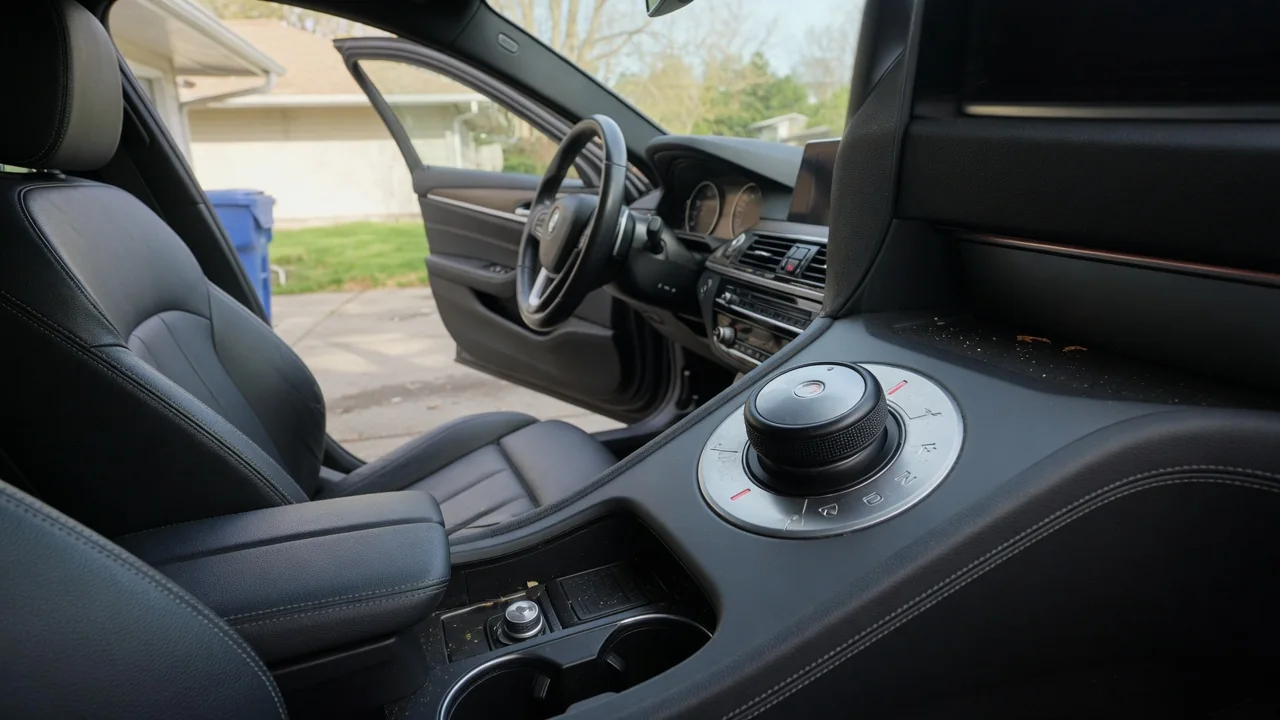
Drivers who ask why do some cars have a rotary gear selector are usually looking at a dial where a lever used to be. The short answer is packaging: modern automatic transmissions are often shifted electronically, so the control no longer needs a mechanical linkage and can shrink to a compact knob that frees console space for storage, cupholders and other controls.
Selection feedback
A traditional lever tells the driver its position through travel and location: the hand feels the handle move through a gate and rest somewhere distinct. A rotary dial has little travel, so designers have to build feedback in other ways. Most use detents, small mechanical clicks felt through the fingertips as the knob passes each position. Illuminated letters beside or on the dial show the selected range, and the instrument cluster normally repeats that indication so the driver can confirm Park, Reverse, Neutral or Drive without looking down at the console.
Because the dial sends an electrical request rather than moving a cable, the displayed gear reflects what the transmission control module has accepted, not simply where the knob was turned. If a request is refused, for example selecting Reverse while traveling forward at speed, many systems ignore it and show a message instead. Some dials spring back to a center position, while others stay where they are turned, and some retract into the console when the vehicle is switched off. These behaviors differ by manufacturer, so the cluster indicator is the reliable reference.
Emergency use
Electronic shifting changes how a car behaves when something unexpected happens. With no physical connection to the transmission, the software decides whether a request is safe to carry out. Many vehicles with a rotary selector will engage Park automatically under certain conditions, such as when the engine is switched off or the driver's door opens with the seat belt unbuckled at very low speed. That logic exists because a small dial is easier to leave in the wrong position than a tall lever, and rollaway prevention became a design priority for shift-by-wire systems.
Selecting Neutral while moving is still possible in most designs, which matters if the driver needs to remove drive from the wheels. The harder situation is a dead battery or electrical fault, because an electronic selector may not release Park without power. Manufacturers usually provide a manual park release for towing or recovery, often a strap, lever or tool-operated mechanism hidden under a console trim panel or elsewhere. Its location and operation are vehicle-specific, so the owner's manual is the right place to find it before a tow truck is ever needed.
Driver adaptation
Drivers coming from a console or column lever often need a few days to adjust. Years of muscle memory teach the hand to pull a handle back, and a dial asks for a twist of the wrist instead. The most common early mistakes are reaching for a lever that is not there, overshooting the intended position, or glancing down longer than usual during a three-point turn. Parking maneuvers that alternate quickly between Drive and Reverse expose this most, because the driver cannot judge the selection by hand position alone.
Placement can add to the learning curve. On some dashboards the gear dial sits near a similar-sized knob for audio volume, climate or drive modes, and a distracted hand can grab the wrong one. Makers address this with different sizes, textures, raised surrounds or a dial that rises only when the car is on. A sensible habit is to pause briefly after each selection and check the cluster before releasing the brake. Renters and drivers who share several vehicles benefit most from that routine, since layouts and shift logic are not standardized.
Everyday Use and Observations
In daily driving, the benefit of the space-saving interface is easy to see. With the lever gone, the center console can hold deeper storage bins, larger cupholders, a wireless charging pad or a flat surface between the seats. In some trucks and minivans, the dial moves to the dashboard, leaving the console area open or allowing a wider armrest. The lower profile also keeps the control clear of a forearm reaching for the touchscreen, and it gives interior designers freedom that a mechanical shifter, tied to the transmission's location, never allowed.
Operation itself is light and quick. The foot stays on the brake, the dial turns a click or two, and the transmission engages after a brief electronic confirmation. Some drivers notice a slight delay compared with a mechanical lever, since the control module checks brake input and vehicle speed before acting. Manual gear control, where offered, usually moves to steering wheel paddles or a separate button, because a dial has no natural plus and minus motion. Whether low range, sport or towing modes sit on the dial or elsewhere depends on the vehicle.
Limits and Next Steps
A rotary selector is not better for every driver or every task. Those who rock a stuck vehicle between Drive and Reverse, tow frequently, or want direct manual shifting may find a dial slower and less intuitive than a lever. Gloved hands can struggle with a small knurled knob, and the lack of a physical position can feel vague to anyone who prefers tactile certainty. The design also depends on electrical power and sound switch contacts, so a low battery or a fault in the selector circuit can leave the car unable to change range.
When a dial stops responding, fails to light, or the cluster shows a shifter warning, the cause could lie in the selector, its wiring, the battery, a brake switch input or the transmission control system. Any stored fault code is a starting point for diagnosis rather than proof that one component has failed, and its meaning should be confirmed for the specific vehicle. Before buying a car with this control, a test drive that includes tight parking maneuvers is worthwhile, along with reading the manual sections on automatic Park behavior and the manual park release.