Why Do Older Cars Have Grease Fittings?
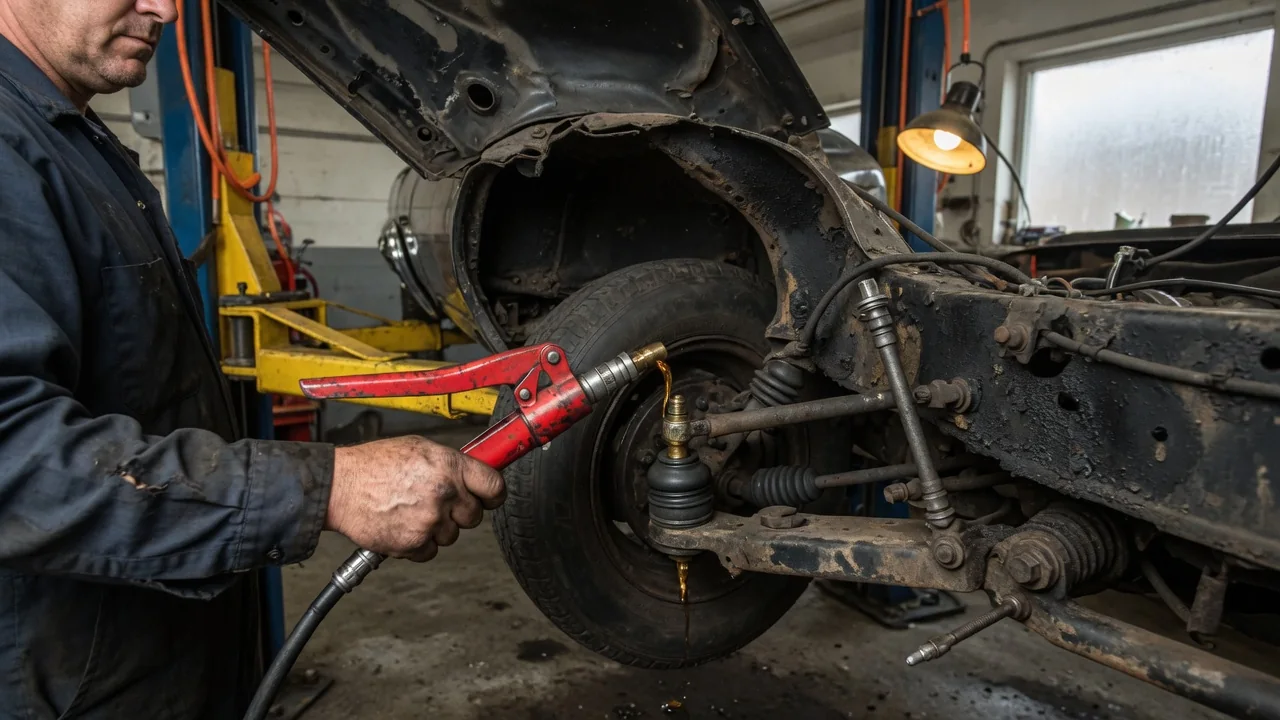
Crawl under many older cars and you will find small nipple-shaped fittings on the steering, suspension and driveline. These grease fittings, often called Zerk fittings, are there because many older chassis joints were designed to be lubricated regularly rather than sealed for life. Knowing why classic car grease fittings were used, where they sit, how often they need attention and what happens when they are ignored helps owners keep steering precise and joints lasting.
Lubrication Points on Older Chassis
A grease fitting is a small check valve threaded into a component. When a grease gun is pressed onto it, grease flows past a spring-loaded ball into internal passages, and the ball then reseals to keep dirt out. Older cars used these fittings because many moving joints relied on metal-to-metal bearing surfaces with limited sealing. Grease in those joints gradually washed out, broke down or picked up grit, so the design assumed it would be replenished. Pumping in fresh grease also pushed old, contaminated grease out of the joint, which was part of the purpose.
Typical lubrication points sat wherever parts pivot under load. On many older vehicles that included upper and lower ball joints or, on earlier designs, kingpins and their bushings; tie rod ends, the idler arm, pitman arm and center link or drag link in the steering linkage; and universal joints and slip yokes on the driveshaft. Depending on the design, fittings could also appear on control arm pivots, leaf spring shackles and some pedal or linkage pivots. The number and location of fittings varies from one vehicle to another, so the factory service manual or owner's manual is the reliable reference for any specific car. On some vehicles, certain joints left the factory with a threaded plug where a fitting could be installed for later service.
Part of the answer to why older cars have grease fittings is what came later. As seal materials, greases and bearing liners improved, many joints moved to durable boots, low-friction polymer liners and long-life grease packed at assembly. Those parts are intended to run without periodic lubrication and are replaced as a unit when worn. Manufacturers also had an incentive to reduce routine maintenance. Grease fittings therefore reflect an earlier engineering approach rather than a flaw: the joint was built to be serviced.
Service Schedule and How Chassis Lubrication Was Done
Older owner's manuals typically listed chassis lubrication as a recurring maintenance item, with intervals given in miles, months or both. Many owners and shops combined it with an oil change because the car was already raised. Recommended intervals differ by manufacturer, model and era, so the manual for the specific vehicle should set the baseline. Many manuals called for more frequent service under severe conditions such as dusty roads, frequent water exposure, heavy loads or towing. A car that sits for long periods still benefits from attention, since grease can harden and moisture can collect even without mileage.
The basic routine is simple. Wipe each fitting clean so dirt is not forced into the joint, attach the grease gun squarely and pump slowly. On joints that allow grease to escape at the seal edge, fresh grease appearing there shows that old grease has been displaced. On joints with a sealed rubber boot, the usual approach is to add grease only until the boot begins to firm up, because excessive pressure can split it. Some manuals specify whether the suspension should be loaded or unloaded during greasing so grease reaches the bearing surfaces; that detail is vehicle-specific. The grease should match the manual's specification, and mixing incompatible grease types is best avoided.
Wear: What Grease Prevents and What Neglect Causes
Grease keeps a film between sliding or rotating surfaces, which reduces friction and the metal-to-metal contact that removes material. It also helps exclude water and abrasive dirt and slows corrosion inside the joint. When lubrication lapses, the remaining grease can dry out or turn into a paste of dirt and water. Wear then accelerates, and clearances open up in ball joints, kingpins, tie rod ends and other pivots.
As that clearance grows, the effects show up in how the car drives. Common signs include extra free play in the steering wheel, clunks over bumps, a tendency to wander and uneven tire wear. A dry universal joint may squeak at first and later cause vibration or clunking when moving between acceleration and deceleration; if ignored, a failing U-joint can come apart. Worn steering and suspension joints can also make a wheel alignment difficult to hold. These symptoms are not unique to lubrication problems, so they call for inspection rather than an assumption about the cause.
Lubrication can create its own problems when done poorly. Over-pressurizing a sealed boot can tear it, which then lets contaminants in. A fitting that will not accept grease may be clogged, or the internal passage may be blocked, and forcing it can damage seals; the fitting itself can usually be cleaned or replaced. The grease that emerges is also informative: grease that comes out rusty, gritty or milky suggests water or dirt has been getting into the joint.
Practical Implications and Limits
For an owner, grease fittings mean a classic car needs a small but recurring commitment: a grease gun, the correct grease, a safe way to raise and support the vehicle, and a list of every fitting so none is missed. Fittings are easy to overlook when they sit behind a tire or above a control arm, and a skipped joint wears as if it had never been serviced. Keeping a simple record of when lubrication was done helps keep the schedule consistent.
Replacement parts present a choice. Many steering and suspension parts are offered in both greasable and sealed versions. A greasable part can be renewed and flushed of contaminants but depends on the owner keeping up with it; a sealed part needs no routine lubrication but cannot be replenished once its factory grease degrades. Neither is automatically better. The right choice depends on how the car is used, how it will be maintained and whether originality matters.
Greasing also has clear limits. It slows wear but cannot remove looseness that already exists, so a joint with noticeable play needs inspection and possibly replacement, not more grease. Lubrication is no substitute for checking boots, mounting hardware and steering components for damage. When a manual's specification, procedure or interval differs from general guidance, the vehicle-specific information should take priority.