Why Do CV Joints Use Grease? Joint Motion, Boots, and Service
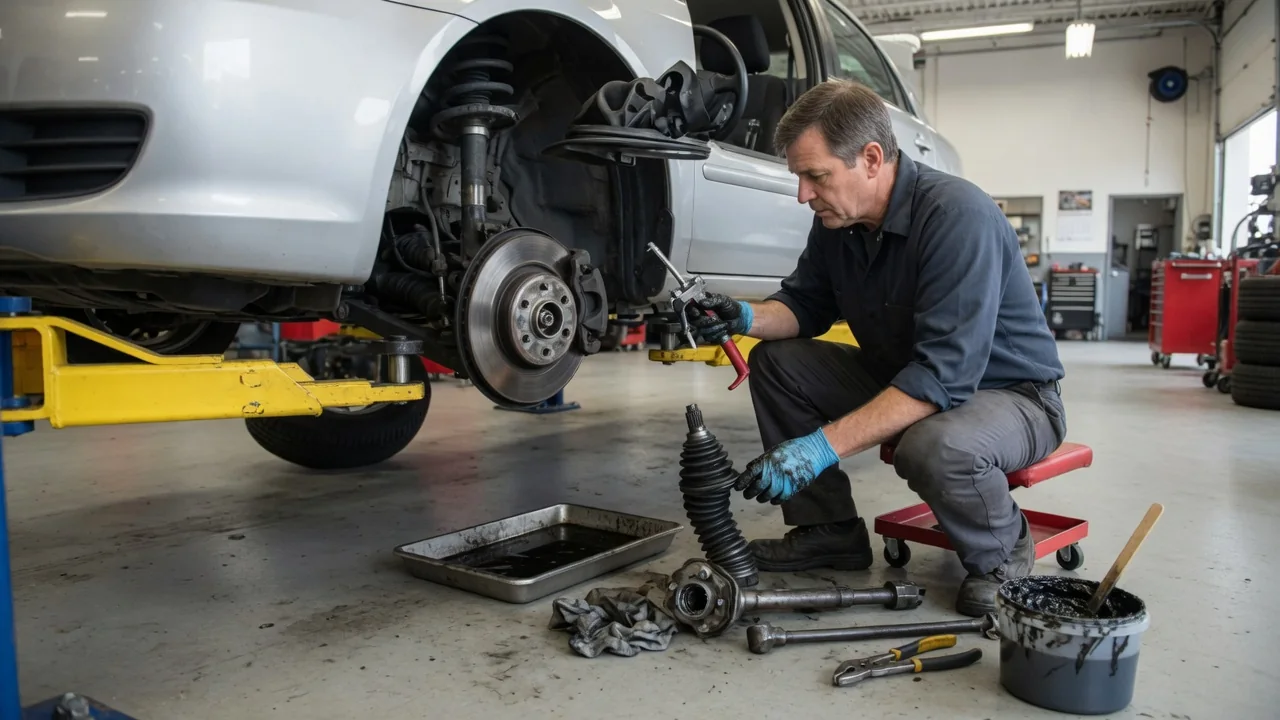
Constant velocity (CV) joints let a vehicle's drive axles send power to the wheels while the suspension moves up and down and the front wheels steer. Inside each joint, hardened steel parts roll and slide against each other under heavy load, and the lubricant protecting them is grease rather than oil. Understanding why CV joints use grease comes down to three connected ideas: how the joint moves, how the boot seals it, and how the assembly is serviced.
Joint motion
The outer joint on a front-drive axle is commonly a ball-type design. An inner race with grooves sits inside an outer housing with matching grooves, and steel balls held in a cage ride between them. As the wheel steers or the suspension moves, the balls shift along their grooves so the joint transmits rotation at a steady speed even at an angle. Inner joints are often tripod or other plunging designs, where rollers on a three-armed spider slide in and out of the housing as the suspension travels and the effective axle length changes.
This movement is a mix of rolling and sliding, concentrated on small contact areas under high pressure, especially during acceleration with the wheels turned. Under those conditions the lubricating film between metal surfaces can be very thin, a situation described as boundary or mixed lubrication. That is why grease formulated for CV joints typically relies on extreme-pressure and anti-wear additives, and many contain solid lubricants such as molybdenum disulfide to help where the oil film alone would break down. The exact formulation depends on the joint design and the manufacturer's specification.
The choice of grease over oil follows directly from how the joint spins. A CV joint rotates with the wheel, and centrifugal force would throw a free-flowing liquid outward and away from the parts that need it. Grease is base oil held in a thickener, so it stays packed around the balls, cage, races, or rollers while gradually releasing oil to the contact surfaces. It needs no pump, sump, or circulation system, which suits a compact rotating component mounted at the end of a moving axle.
Sealed boot
Grease can only do its job if it stays in the joint and stays clean. That task falls to the boot, a flexible bellows made of rubber or thermoplastic material that is clamped to the joint housing at one end and to the axle shaft at the other. Its folds allow it to flex as the joint articulates and to stretch or compress as a plunging joint moves in and out, while keeping grease inside and water, road salt, sand, and dirt outside.
The sealed boot is what makes a grease-packed design practical. Because the joint is a closed volume, there is no fluid level to check or top up, and the grease can last a long time when nothing disturbs it. The boot is also the most vulnerable part of the assembly. It is exposed to flying debris, heat from nearby exhaust components in some layouts, ozone and age-related hardening, and constant flexing at its folds, which is where cracks often begin.
Once a boot tears, rotation flings grease out through the opening, often leaving dark streaks on the inside of the wheel, the brake area, or nearby suspension parts. At the same time, contaminants get in. Grit mixed into grease forms an abrasive paste that wears balls, grooves, and cage windows, and moisture encourages corrosion on hardened surfaces. This damage can progress for some time before any noise appears.
Service
In general, CV joints are not regreased on a routine schedule and usually have no grease fittings. They are treated as lubricated for the life of the joint, provided the boot remains intact. Routine maintenance therefore centers on inspection: looking for cracks, splits, loose or missing clamps, and grease thrown onto surrounding parts. Such checks are commonly done when the vehicle is raised for tire rotation or other service. The vehicle's own maintenance schedule is the authority on recommended inspection intervals.
When a damaged boot is found early, before contamination has worn the joint, replacing the boot is a common repair. The general process involves removing the axle or joint as the service procedure specifies, cleaning out the old grease, inspecting the internal parts, repacking with the correct type and quantity of grease, and fitting a new boot with new clamps. Boot kits often include grease intended for that joint type. Split-style boots that install without full disassembly also exist, though their sealing depends heavily on careful installation.
Grease choice matters during this work. General-purpose chassis grease is not necessarily suitable for the pressures and motion inside a CV joint, and inner and outer joints on the same axle may call for different products. Mixing greases with incompatible thickeners can reduce lubricating performance, which is one reason thorough cleaning precedes repacking. If the joint is already worn, fresh grease will not restore damaged surfaces, and replacing the joint or the complete axle assembly is the usual course.
Practical implications and limits
For an owner, the main takeaway is that a CV joint's condition depends more on its boot than on any lubricant change interval. A quick visual check costs little compared with replacing a joint, and the earlier a tear is found, the more likely a boot replacement alone is enough. Driving conditions that are harder on boots, such as rough or unpaved roads, heavy winter salt use, or suspension modifications that increase joint angles, are reasonable grounds for looking more often, even though no single interval applies to every vehicle.
There are clear limits to what grease and inspection can tell you. Smearing grease into a torn boot without sealing it does not protect the joint, and the outside of a joint cannot reveal how much grit has already entered or how long a tear has been open; a technician may need to disassemble and inspect it to decide between repair and replacement. Noises often associated with worn CV joints, such as clicking during tight turns or a clunk under load, can overlap with problems in wheel bearings, suspension bushings, or engine mounts, so sound alone is not a diagnosis. Joint designs, grease specifications, boot materials, and fastener requirements also vary between vehicles, so the manufacturer's service information should guide any hands-on work.