Where to Find Your Car's VIN
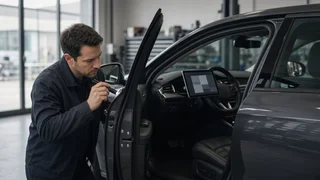
Your car's Vehicle Identification Number (VIN) is usually easiest to find in two places. The first is a small plate at the base of the windshield on the driver's side, readable from outside the car. The second is a label on the driver's door jamb, the edge of the door opening that is visible when the door is open. The VIN also appears on your title, registration and insurance documents, so you can often get it without going to the car at all. Exact positions vary by manufacturer, model year and body style, but these locations cover most passenger cars, SUVs and light trucks sold in the US.
What a VIN Is
A VIN is a unique code assigned to an individual vehicle. Dealers, locksmiths, insurers, motor vehicle agencies and parts suppliers use it to identify the exact car, including its manufacturer, model and production details. For cars and light trucks built for the US market from the early 1980s onward, the VIN follows a standardized 17-character format of letters and numbers. Older vehicles may have shorter, manufacturer-specific identification numbers.
The standard format excludes the letters I, O and Q because they are easily confused with the numbers 1 and 0. If a character looks like an O, it is a zero. If it looks like an I, it is a one.
Where to Look on the Vehicle
Dashboard (windshield) plate: Stand outside the car and look through the windshield at the lower corner on the driver's side, where the dashboard meets the glass. A metal or plastic tag shows the VIN. This is usually the quickest check. Driver's door jamb: Open the driver's door and look at the edge of the door or the pillar it closes against. A printed label there, often called the safety certification label, typically includes the VIN along with the manufacture date and weight ratings. Engine bay: Some vehicles have the VIN stamped or labeled on the firewall, the panel between the engine compartment and the cabin, or on another structural part under the hood. Placement varies widely between makes. Frame: On many pickup trucks and body-on-frame SUVs, the VIN may also be stamped on the frame, often in an area that is hard to see without lifting the vehicle or cleaning off dirt. Other labeled parts: Some manufacturers mark major body panels or components with the VIN for theft deterrence. These marks are not meant as a convenient reference point.
Where to Find It Without the Car
Vehicle title: The ownership document lists the VIN prominently. Registration card or certificate: Issued by your state's motor vehicle agency, it includes the VIN. Insurance card and policy documents: Most insurers print the VIN on proof-of-insurance cards and in the policy paperwork. Purchase, lease or loan paperwork: Bills of sale, finance contracts and lease agreements normally identify the vehicle by VIN. Service and repair records: Dealer and shop invoices often record the VIN. Manufacturer app or online owner account: If your car is registered with the maker's connected services, the VIN may appear in the vehicle profile.
Documents are convenient, but the VIN on the car itself is the authoritative reference. If you are verifying a used car before purchase or proving ownership for a replacement key, make sure the VIN on the dashboard, the door jamb and the paperwork all match.
How to Tell the VIN Apart From Other Numbers
Cars carry several labels and codes, and some sit right next to the VIN. These cues help you pick out the right one.
Item | Typical location | How it differs from the VIN; VIN | Dashboard plate, driver's door jamb, title, registration | 17 characters on modern vehicles; no I, O or Q; often labeled "VIN"; Tire and loading information placard | Driver's door jamb or pillar | Shows tire sizes, inflation pressures and load limits, not an identification code; Paint or trim code | Door jamb, under the hood or in the trunk, depending on maker | Short code for color or interior, much shorter than a VIN; Engine serial number | Stamped on the engine block | Identifies the engine as a component; does not identify the whole vehicle; License plate number | Plates and registration | Issued by the state and can change; the VIN stays with the vehicle
Tips for Reading the VIN Accurately
Take a photo of the dashboard plate or door label instead of copying it by hand. This reduces transcription errors. If glare makes the windshield plate hard to read, try a different angle or check the door jamb label instead. Count the characters. A modern VIN that comes out as 16 or 18 characters has been misread. Remember that I, O and Q are never used in a standard 17-character VIN. If a label is damaged, faded or missing, use your title or registration and tell the dealer, locksmith or agency so they can verify the vehicle another way.
Why the VIN Matters for Keys and Ownership
When you request a replacement key, especially a transponder key, smart key or key fob that must be programmed to the car, the dealer or locksmith typically asks for the VIN. They use it to look up the correct key type and, for some vehicles, key codes. Expect to show proof of ownership as well, such as the title or registration with a VIN matching the car, plus photo identification. Requirements differ between businesses and states, so ask what to bring before your appointment.
The VIN is also used to check vehicle history reports, look up open safety recalls, register and insure the vehicle, and order parts that fit your specific configuration. Keep a copy of the VIN somewhere outside the car, such as with your insurance details, so you can reach it if the vehicle is lost, stolen or locked.
Quick Summary
Check the driver's side of the dashboard through the windshield first, then the driver's door jamb. If you are away from the car, look at your title, registration or insurance card. On modern vehicles the VIN has 17 characters with no I, O or Q, which separates it from paint codes, tire placards and engine numbers.