Where Is the Alternator? How to Find and Identify It Under the Hood
The Short Answer
On most gasoline and diesel vehicles, the alternator is mounted on the engine itself, usually toward the front, where the accessory drive belt runs. A belt from the crankshaft pulley spins the alternator's pulley, and the alternator turns that motion into electricity. That electricity powers the vehicle's systems and recharges the 12-volt battery while the engine runs.
The exact position varies by engine design, model year and generation. On some engines the alternator sits high and is easy to spot as soon as you open the hood. On others it sits low, near the bottom of the engine, or is hidden under covers, intake ducting or other components. In those cases you may only be able to see it from below the vehicle or from the wheel well.
One qualification matters a lot. Many hybrids and all battery-electric vehicles do not use a conventional alternator. They keep the 12-volt battery charged with a DC-DC converter fed by the high-voltage battery, and hybrids generate electricity through their electric motor-generators. Some mild hybrids use a belt-driven starter-generator that sits roughly where an alternator would be, but it is a different component with different service requirements.
Where It Usually Sits, by Engine Layout
Engine orientation is the biggest clue to where the alternator ends up.
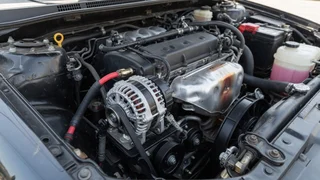
Transverse engines (mounted sideways, common in front-wheel-drive cars, crossovers and minivans): the belt-driven accessories are on the end of the engine, which usually faces the driver or passenger side of the engine bay. The alternator is on that end, either near the top, toward the front of the car, or tucked low toward the firewall or the subframe. Longitudinal engines (mounted front to back, common in rear-wheel-drive cars, trucks and many SUVs): the accessory belt faces the radiator, so the alternator is at the front of the engine, often on the upper left or upper right side of the block. V6 and V8 engines: the alternator is usually bolted to a bracket at the front of the engine, between or beside the cylinder banks, and often high enough to see from above. Compact engine bays: the alternator may be partly hidden beneath the intake manifold, air filter housing, plastic engine cover or coolant hoses, even though it is still on the belt-driven side of the engine.
How to Find It Step by Step
Park on level ground, turn the engine off, remove the key or put a push-button vehicle in an off state, and let the engine cool. Open the hood and find the accessory drive belt, often called the serpentine belt. It is a flat, ribbed rubber belt that loops around several pulleys. Follow the belt around each pulley. The alternator is one of the parts it drives. If you can't see the belt from above, look for a plastic engine cover you can lift off, or check from underneath the front of the vehicle or through the inner fender liner. Trace the positive battery cable. A heavy cable from the battery's positive side usually runs to the starter, and a branch from the battery, often through a high-current fuse, typically connects to the alternator's main output terminal. Check the belt routing diagram. Many vehicles have a sticker under the hood showing how the belt wraps around each pulley, with the alternator labeled, often as ALT or GEN.
What the Alternator Looks Like
Once you have found the belt-driven components, these features help confirm which one is the alternator:
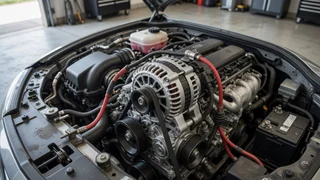
A roughly cylindrical metal housing, often bare aluminum or gray, with cooling slots or vents on the case so you can see inner parts or windings through the openings. A pulley on the front, usually smaller in diameter than the crankshaft pulley. On some vehicles it is a one-way clutch or decoupler pulley with a plastic cap in the center. A cooling fan, either visible behind the pulley or built inside the housing. A thick output wire attached to a threaded post with a nut, typically covered by a red or black rubber boot. This is the main output terminal, often marked B+. A smaller plastic electrical plug, which carries signals between the alternator and the vehicle's charging control system or engine computer. No fluid lines or hoses connected to it. This is one of the quickest ways to tell it apart from neighboring accessories.
Parts Commonly Mistaken for the Alternator
Several other components are also driven by the same belt and sit close by. The differences below are general patterns; the layout on a specific vehicle can vary.
Component | Typical clues | How it differs from the alternator; Alternator | Vented cylindrical housing, heavy wire on a terminal post, small electrical plug | Has wiring only, no hoses or fluid lines; A/C compressor | Pulley with an electromagnetic clutch on the front, two metal refrigerant lines attached | Refrigerant lines are the giveaway; usually no heavy output cable; Power steering pump | Fluid hoses attached, often near a fluid reservoir | Carries hydraulic fluid; many newer vehicles use electric steering and have no pump at all; Water pump | Mounted on the engine with coolant passages, sometimes driven by the timing belt instead | Connected to the cooling system, no electrical output; Idler and tensioner pulleys | Plain pulleys on brackets or a spring-loaded arm | No housing behind them, no wiring; Starter motor | Usually low on the engine near where it meets the transmission, with a heavy battery cable | Not driven by the belt; engages the flywheel only when cranking
Handling Precautions
The alternator's main output terminal is connected directly to the battery, so it is live even with the engine off. If you plan to unplug wires or loosen the belt, disconnect the negative battery cable first. Keep hands, tools and loose clothing away from the belt and fan if the engine is running for any reason. On hybrids, high-voltage cables are typically marked with orange insulation and should not be handled without proper training and procedures.
Why You Might Need to Locate It
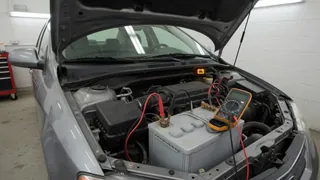
Most people go looking for the alternator after a battery or charging warning light comes on, the battery keeps going flat, headlights dim or flicker, or there's a whining or grinding noise from the belt area. Finding it lets you check for a loose or worn belt, a corroded or loose output connection, or a disconnected plug before deciding on testing or replacement. Since a weak battery and a failing alternator can cause similar symptoms, testing the charging system is the reliable way to tell them apart.
Confirming the Location on Your Vehicle
Because position depends on the engine, model year and trim, the most dependable confirmation is information for your exact vehicle configuration, such as the under-hood belt routing label, the owner's manual or a service manual for that engine. In most cases, though, following the serpentine belt and looking for the vented housing with a heavy wire on a terminal post will lead you straight to it.