Wheel Runout: Definition, Tolerances and How to Measure
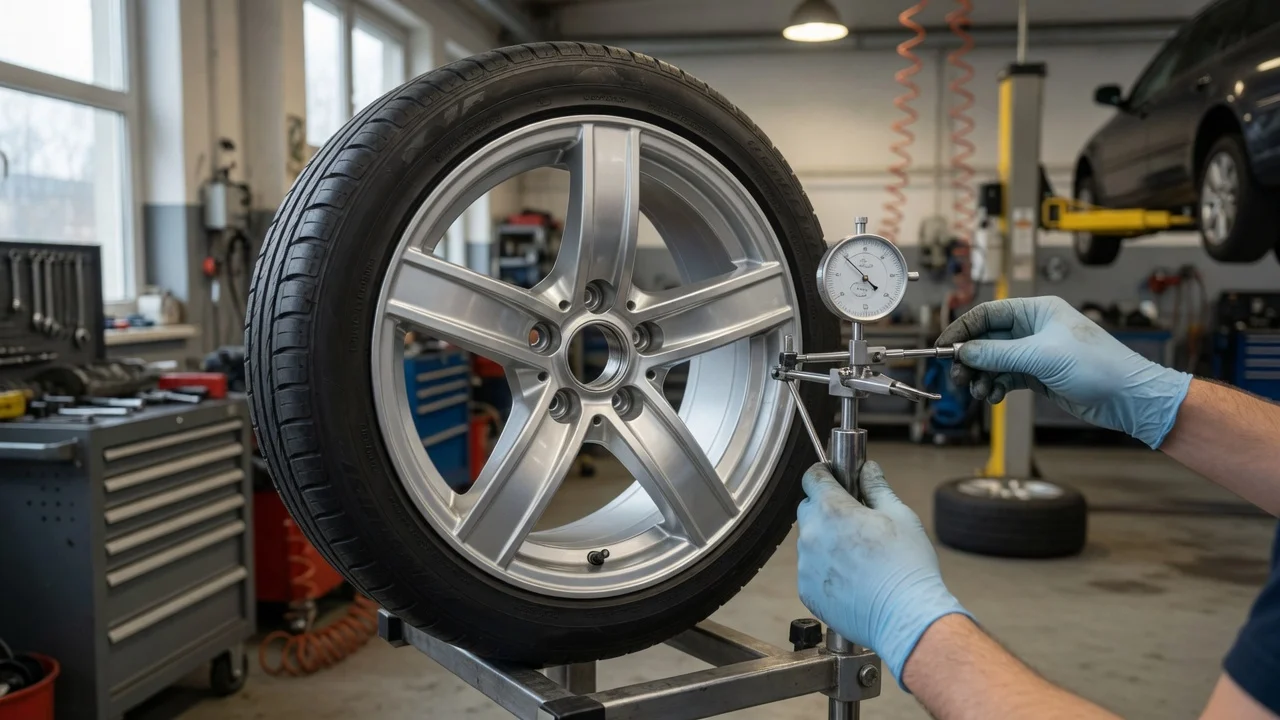
What is wheel runout?
Wheel runout is the amount of wobble or out-of-round movement a wheel or rim exhibits as it rotates. It is measured as a distance, usually in thousandths of an inch or hundredths of a millimeter, between the high and low points of the rotating surface. There are two separate conditions: radial runout and lateral runout.
Radial runout versus lateral runout
Radial runout is the variation in the wheel's radius as it turns. If you look at the tire or rim from the side, radial runout describes how much the surface moves up and down relative to the axle centerline. It means the wheel is not perfectly round under load or as manufactured. Excessive radial runout can create a vertical vibration and uneven tire wear.
Lateral runout is side-to-side movement. If you look at the wheel from the front or rear of the vehicle, lateral runout describes how much the rim face or tire sidewall wobbles left and right as the wheel rotates. Too much lateral runout can cause steering shimmy, pulling, and a vibration that often feels similar to an out-of-balance wheel.
Wheel runout tolerances
Acceptable runout values depend on the vehicle, the wheel size, and whether you are measuring a hub, a bare rim, or a mounted tire and wheel assembly. Because specifications vary by model and market, the primary reference is the vehicle manufacturer's service information. A rule of thumb used in many service environments is that lateral runout at the rim flange of a passenger car should be under about 0.020 to 0.030 inch, while radial runout of a mounted tire assembly is often expected to be under about 0.030 to 0.040 inch, but these are not universal limits. Wheel hub runout is normally much lower, frequently under 0.002 inch, because hub runout is multiplied through the larger diameter of the wheel and tire.
When a specific tolerance is required, use the value published for the exact model year, platform, and wheel diameter. Do not transfer a specification from one vehicle to another.
Equipment needed
Dial indicator with a magnetic base or clamping mount; Clean lifting equipment and properly rated jack stands; Wheel chocks; Torque wrench and lug nut socket; Clean, flat reference surfaces on the rim; Marker or chalk
How to measure wheel runout
Measure runout on a clean rim. Dirt, corrosion, or old wheel weights can produce false readings. If you are measuring an installed wheel, secure the vehicle on a level surface, chock the wheels that remain on the ground, and support the raised corner with a properly rated jack stand before working underneath or alongside it.
Set up the dial indicator
Mount the dial indicator so its stem is perpendicular to the surface being measured. For radial runout, position the tip against the rim's inner barrel or bead seat so the stem points toward the axle center. For lateral runout, position the tip against the rim's outer edge or a flat machined face so the stem points parallel to the axle centerline. Preload the indicator slightly and zero the dial.
Rotate the wheel and record the reading
Rotate the wheel slowly by hand through at least one full revolution. Watch the indicator needle and note the highest and lowest readings. The total runout is the difference between those two values. Mark the high and low spots if you plan to remount the tire or replace parts.
A common practice is to check radial runout at two positions across the rim width and to measure lateral runout at the inner and outer rim flanges. Measuring at multiple points helps separate a bent rim from a poorly mounted tire or a hub problem.
Check the hub separately
If a wheel shows high runout, remove it and measure the hub flange with the dial indicator. Hub runout should be very small. If the hub is true but the wheel is not, the rim or tire mounting is the likely cause. If the hub itself is out of specification, the bearing, hub flange, or axle may need service.
Completion and decision
Compare each measured value against the manufacturer's specification for that vehicle and wheel position. A wheel within tolerance can be balanced and returned to service. A wheel outside tolerance may need tire dismounting, remounting, rim straightening, or replacement. If the hub is outside its specification, have the bearing and hub assembly inspected by a qualified service facility before driving the vehicle further.
Do not use a wheel with a visible crack, impact fracture, or severe corrosion even if runout reads within specification. Structural damage cannot be assessed with a dial indicator alone.