What a Vehicle Black Box Records During an Accident
The short answer
Yes, most modern passenger vehicles have a black box that can record data about a crash, but it is not the cockpit-style recorder many people imagine. The device is formally called an event data recorder, or EDR. It captures a brief snapshot of vehicle data around a crash or near-crash event, such as speed, braking, throttle position, seat belt use and airbag deployment. It does not record audio or video, and it does not keep a continuous log of how the car has been driven.
Two qualifications materially change the answer. First, an EDR only saves data when an event is severe enough to trigger it, so a minor bump may leave no stored record. Second, what is recorded depends on the manufacturer, model year and system design. In the US, federal rules set minimum data requirements for EDRs in light vehicles built from the 2013 model year onward, but they do not force every manufacturer to record the same additional information beyond that baseline.
What an event data recorder is
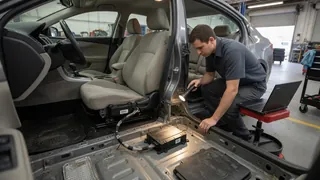
An EDR is usually not a separate box. In most cars it is a function built into the airbag control module, the computer that decides when to fire the airbags and seat belt pretensioners. Because that module already monitors crash forces and receives data from other vehicle systems, it is a logical place to store a short record of what happened.
The term black box is borrowed from aviation, but the comparison is loose. Aircraft flight recorders capture long stretches of flight data and cockpit audio. A car's EDR stores a few seconds of selected data points tied to a specific event, then stops.
How it works
The airbag module constantly reads sensor data, including acceleration measured by internal accelerometers. It holds a short rolling buffer of recent vehicle information in temporary memory, continuously overwriting it as you drive. Nothing is saved permanently during normal driving.
When the module detects a sudden change in velocity that meets its trigger threshold, it treats the moment as an event. It then preserves the pre-crash data in its buffer and records crash-phase data as the collision unfolds. Under the US federal standard, the pre-crash window covers roughly the five seconds before the event, sampled at intervals within that window rather than as a continuous stream.
Events generally fall into two categories:
Deployment events: the airbags or other restraints fired. These records are typically locked so they cannot be overwritten. Non-deployment events: the crash or hard jolt was strong enough to trigger recording but not to deploy airbags. These records may be overwritten by a later event, depending on the system's design.
Data commonly recorded during a crash
In the US, vehicles that are equipped with an EDR and covered by the federal standard must record a defined set of core data elements. Many manufacturers record more. The table below groups the types of information typically captured; exact elements vary by vehicle.
Category | Typical data | What it helps show; Crash severity | Change in velocity (delta-V) during the impact, and the timing of peak force | How hard the vehicle was struck or struck something; Pre-crash speed | Vehicle speed as reported by the car's systems in the seconds before impact | How fast the vehicle was traveling leading up to the event; Driver inputs | Accelerator pedal or throttle position, service brake on or off | Whether the driver was accelerating or braking; Engine data | Engine speed, recorded on many vehicles | Powertrain state before impact; Restraints | Driver seat belt buckle status, airbag warning lamp status, airbag deployment timing | Whether occupants were belted and whether restraints worked; Event context | Number of events in a sequence, time between events, ignition cycle count | Whether there were multiple impacts and whether data is complete; Additional elements on some vehicles | Steering input, stability control or ABS activity, passenger belt status, lateral acceleration, rollover data | A fuller picture of vehicle dynamics
Delta-V deserves a short explanation. It is the change in the vehicle's velocity during the collision, and it is one of the most useful measures of crash severity. A high delta-V indicates a violent impact, regardless of how much visible damage the car shows.
What a car's black box does not record
Audio or conversations inside the cabin. Video of the road or the occupants. Continuous driving history, such as every trip, route or speed over time. GPS location, under the federal EDR requirements. Some vehicles collect location through separate connected-car or telematics systems, which are a different thing from the EDR. Identity of the driver. Phone use or distraction.
This matters when people assume the black box will settle every question about fault. EDR data can show what the vehicle did, but not why. It cannot show a traffic signal's color, another driver's behavior or road conditions unless those can be inferred from the vehicle's own data.
How the EDR differs from other in-vehicle recorders
Device | What it typically records | Key difference from an EDR; Event data recorder | Seconds of vehicle data around a triggering event | Built in, event-triggered, no audio or video; Dashcam | Continuous or event-triggered video, sometimes audio, speed and location | Added by the owner; shows the scene, not internal vehicle data; Manufacturer telematics | Location, diagnostics and sometimes driving behavior, sent to the automaker | Connected service with its own data policies; may operate continuously; Insurance telematics device or app | Driving habits such as hard braking, speed and time of day | Opt-in program tied to an insurance policy; Commercial truck engine module and logging devices | Engine and hours-of-service data; some modules capture sudden-stop events | Different equipment and rules from passenger-car EDRs
Strengths and limitations of EDR data
The main strength of EDR data is objectivity. It is recorded automatically by the vehicle, so it does not rely on memory or witness statements made under stress. Investigators, insurers and safety researchers use it to reconstruct crashes, check whether restraints worked and evaluate claims about speed or braking.
Its limitations are just as important to understand:
Short time window: a few seconds of pre-crash data may not capture events that began earlier. Trigger dependency: low-speed impacts may not create a record at all. Overwriting: non-deployment records can be replaced by later events. Sensor-reported values: recorded speed comes from the vehicle's own sensors, which can be affected by wheel slip, skidding or nonstandard tire sizes. Severe damage or power loss: in some crashes, data may be incomplete. Interpretation required: raw data needs to be read alongside physical evidence, scene measurements and witness accounts.
In practice, EDR data is strongest as one piece of a broader reconstruction. It is most useful for confirming or contradicting specific claims, such as whether the brakes were applied or whether a driver was belted.
Who owns the data and who can access it in the US
Under the federal Driver Privacy Act of 2015, data in a vehicle's EDR is the property of the vehicle's owner or lessee. In general, others may retrieve it only with the owner's consent, a court order or authorization, or under certain limited exceptions, such as federally authorized safety research where personal information is protected, or responding to a medical emergency after a crash.
Many states have their own EDR laws that add detail on access and use. Ownership can also become complicated after a crash. If an insurer declares the vehicle a total loss and takes title, ownership of the car, and arguably its data, may transfer. Anyone concerned about access should get legal advice specific to their state and circumstances.
Federal rules also require manufacturers to disclose in the owner's manual when a vehicle is equipped with an EDR, so the manual is the easiest place to confirm whether your car has one.
How EDR data is retrieved
EDR data is not something an owner can read with an ordinary code scanner. It is downloaded using specialized crash data retrieval equipment and software, usually by trained crash reconstruction specialists, law enforcement investigators or technicians working for insurers or attorneys. Depending on vehicle damage, the data may be read through the diagnostic port or by connecting directly to the airbag control module after removing it.
Not every vehicle's EDR is supported by commercially available retrieval tools, so access can vary by make and model year.
Preserving black box data after an accident
If you think EDR data could matter for an insurance claim or legal dispute, the priority is keeping the vehicle and its airbag module intact until the data can be downloaded. These general steps help:
1) Deal with safety first: get medical help, move to safety where possible and report the crash as required in your state. 2) Document the scene with photos of vehicles, damage, road markings and surroundings. EDR data is most useful alongside this physical evidence. 3) Avoid driving the vehicle further if you can. Additional hard braking or another impact could trigger a new event and, in some systems, overwrite a non-deployment record. 4) Tell your insurer and, if relevant, your attorney that EDR data may be important, and do so early. 5) Do not authorize repairs, airbag module replacement, salvage auction or scrapping until a decision about data retrieval has been made. 6) If the other party's vehicle data matters, an attorney can send a preservation request asking that the vehicle not be repaired or destroyed. 7) Use a qualified crash data retrieval professional for the download, and request a copy of the report.
Repairs after an airbag deployment typically involve replacing the airbag control module, and once the original module is discarded, its data is usually gone. A vehicle released to a salvage yard can also disappear quickly. Acting early is the most reliable way to keep the data available.
Bottom line
A vehicle's black box does record an accident, but only in a narrow sense: it saves a few seconds of vehicle data when a crash is significant enough to trigger it. That record can reveal speed, braking, throttle, seat belt use, airbag performance and crash severity. It does not capture video, audio, continuous driving history or the reasons behind a driver's actions. If the data could matter to you, preserve the vehicle and its airbag module, involve your insurer or attorney promptly, and have the data retrieved by a qualified specialist.