What Is Plastic Creep in a Car Component?
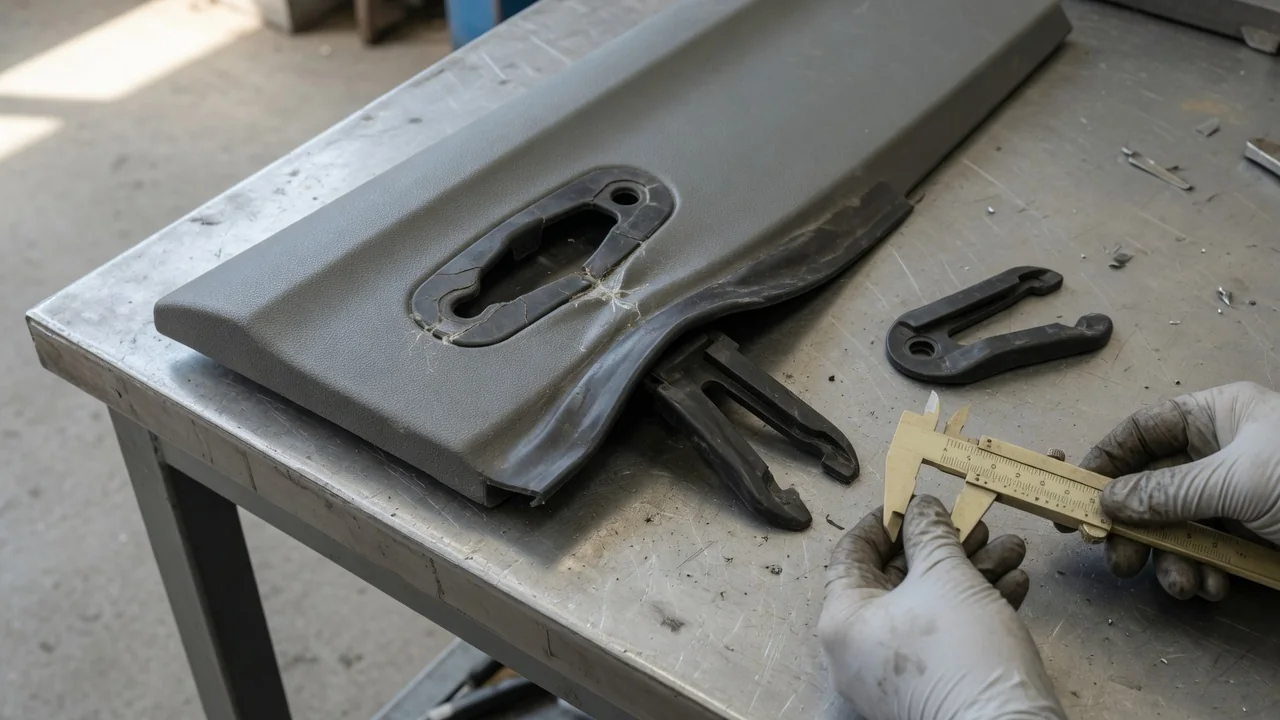
Plastic creep is the slow, largely permanent change in shape that a polymer part undergoes when it carries a load for a long time, even if that load is well below what would break it or visibly bend it right away. In a car, creep helps explain why some plastic brackets sag, clips loosen, and bolted covers lose their seal over years of service. Automotive plastic creep depends on three factors: how long the part is loaded, how hot it gets, and how well it is supported.
Long-term load and slow deformation
Plastics used in car components are viscoelastic. They behave partly like a spring and partly like a very thick fluid. When a load is first applied, the part deflects almost immediately, much as a metal bracket would. If the load stays in place, the long polymer chains inside the material keep sliding and rearranging, so the deflection slowly grows. This is creep. It is usually fastest at the start, then settles into a slower, steadier rate. In heavily stressed parts, it can eventually speed up again toward cracking or rupture. Common steel parts do not creep meaningfully at normal operating temperatures, but many plastics creep measurably at room temperature. That is why time under load matters so much in polymer design.
Creep has a mirror image called stress relaxation, which is often the more important effect in a vehicle. Under creep, a constant load causes growing deformation. Under stress relaxation, a part held at a fixed deformation gradually pushes back with less force. Many joints depend on that retained force: a bolt clamping a plastic flange, a snap fit holding a trim panel, or a plastic hose spigot squeezed by a clamp. As the plastic relaxes, the force drops even though nothing appears to have moved. The joint can then loosen, rattle, or stop sealing properly against a gasket.
Long-term loads in a car come from several sources. Plastic trays and mounts carry the static weight of components, fasteners and clips apply preload, and sealed housings hold constant internal pressure. Vibration adds repeated loading, which is usually classified as fatigue rather than creep. The two can act together, however, because sustained stress can make a part more vulnerable to cracking under cyclic loads.
Heat and why it speeds up creep
Temperature is the strongest accelerator of creep. As a polymer warms, its chains move more freely, its stiffness falls, and slow deformation speeds up. The effect becomes pronounced near the material's glass transition temperature, the range where an amorphous plastic shifts from a rigid, glassy state toward a softer, rubbery one. Semicrystalline plastics, such as many nylons and polypropylenes used in vehicles, keep more stiffness above that range because of their crystalline regions, but they still creep faster when hot. A load that a part tolerates for years in a cool location may cause noticeable deformation in a hot one.
Cars expose plastics to wide temperature swings. Parts near the engine, exhaust, or cooling system run hot whenever the vehicle is driven. Interior parts such as dashboards and parcel shelves can heat up considerably when the car is parked in direct sun. Each warm period adds a small amount of deformation that does not fully recover when the part cools, so creep accumulates over many heat cycles. Plastic and metal also expand at different rates as temperature changes, which shifts clamp loads in mixed-material joints. In some polymers, notably polyamides, absorbed moisture acts as a softener and can increase creep further. Long-term heat aging, which makes plastics brittle, is a separate process, but it often occurs in the same hot locations and can compound the problem.
Support design that limits creep
Because creep depends on time and temperature, engineers designing a plastic car component cannot rely on short-term strength figures alone. They use long-term data such as creep modulus curves and isochronous stress-strain curves, which show how a material deforms after a set time at a set temperature. The usual goal is to keep sustained stress low enough that deformation over the component's intended life stays within acceptable limits.
Geometry does much of the work. Ribs and adequate wall thickness add stiffness without making a part excessively heavy. Shorter unsupported spans and more mounting points reduce bending stress in brackets and trays. Generous radii at corners keep stress from concentrating in small areas, where creep and cracking tend to start. Snap fits are ideally designed so their latches return close to a relaxed position after assembly. A latch that stays permanently flexed slowly loses its holding force.
Material choice and hardware complete the design. Glass fiber or mineral reinforcement substantially reduces creep in many engineering plastics, though the benefit depends on how the molding process orients the fibers. Bolted joints often use metal compression limiters, which are sleeves pressed into the bolt holes so the fastener clamps against metal rather than squeezing the plastic directly. Threaded metal inserts, wide-flange fasteners, and washers spread loads over larger areas. Where a seal must be maintained, designers may rely on the gasket's own elasticity or on dedicated retention features rather than on plastic clamp force alone.
Practical implications and limits
For owners, creep tends to show up gradually rather than as a sudden failure. Typical signs include fasteners on plastic covers that no longer feel snug, slow seepage where a plastic housing meets a gasket, mounts or trays that sit lower than they once did, and trim pieces that start to rattle as clips lose their grip. These symptoms suggest creep as a possible cause, not a confirmed one. Heat aging, ultraviolet exposure, chemical contact, impact damage, and fatigue cracking can produce similar results. A deformed part looks much the same regardless of which process caused it.
How quickly creep develops varies widely with the material, the part design, the loads involved, and the conditions the vehicle sees. No general timeline applies to every car. A component that deforms under one climate or duty cycle may last indefinitely under another. Vehicle-specific behavior and correct service procedures come from the manufacturer's repair information, not from general rules.
Several practical points follow from the mechanism. Tightening a fastener in a plastic part beyond the specified torque raises stress in the plastic, which can speed up creep or crack the part outright. Retightening a relaxed joint may not restore it, because the plastic has already deformed. Replacing the gasket, the part, or single-use clips is sometimes the correct fix. Hanging extra weight from interior trim, or mounting accessories to brackets not intended for them, adds sustained load the original design may not have allowed for. Replacement parts made from a different material, or without the original reinforcement or inserts, may also respond differently to load and heat over time.