What Is Optical Distortion Testing for Windshields?
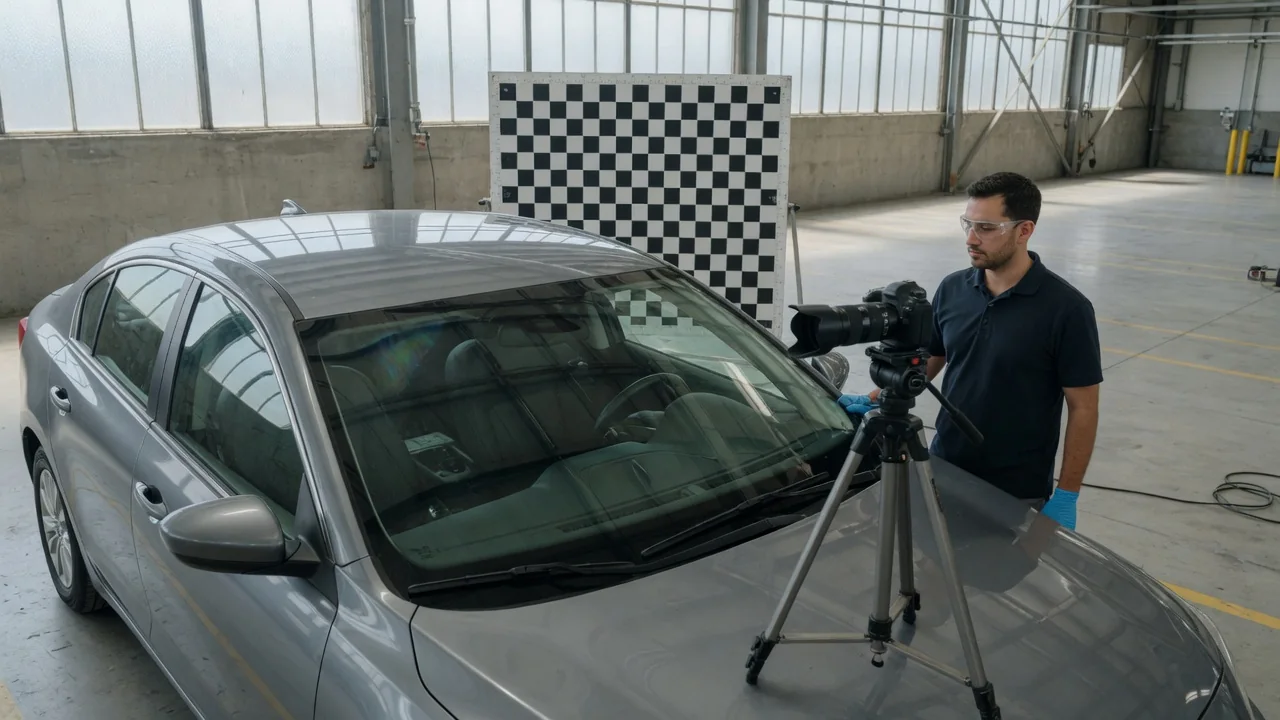
Optical distortion testing checks whether a windshield bends light evenly enough that the road ahead keeps its true shape. A windshield is curved, laminated and mounted at a steep angle, so small variations in glass thickness or surface shape can make straight lines look wavy, stretched or doubled. This windshield optical quality test is a routine part of automotive glass production. It centers on three questions: how the glass is viewed, which areas matter most, and when a part must be rejected.
Viewing Angle and Why It Changes the Result
Drivers do not look through a windshield head-on. In most vehicles the glass is installed at a pronounced rake, so the driver's line of sight passes through it at a shallow, oblique angle. That matters because the steeper the angle at which light meets the glass, the more any optical flaw is magnified. A gentle surface ripple or a slight change in thickness can be nearly invisible when viewed straight on, yet it can bend light noticeably once the glass is tilted back. For this reason, optical distortion testing is generally done with the glass at, or representative of, its installed angle. The observer or camera is placed where a driver's eyes would normally be.
The angle also governs a related effect called secondary or double imaging. Light passing through a sloped laminated pane can reflect inside the glass and reach the eye slightly offset from the main image. This is most noticeable with bright point sources, such as oncoming headlights at night. Windshields designed for head-up displays add another requirement, because the projected image reflects off the inner surface and must not split into two. Some of these windshields use an interlayer with a carefully controlled wedge profile to manage that reflection, which makes accurate positioning during testing even more important. In general, the steeper and more curved the windshield, the more its optical performance depends on how it is viewed.
Distortion Zones Across the Windshield
Some parts of a windshield matter more optically than others, so testing divides the glass into zones. The area directly in front of the driver covers the primary field of view used for reading the road. It is treated as the most critical zone and is typically held to the tightest limits. Surrounding areas, used for peripheral vision and wider scanning, generally allow somewhat more variation. The outermost band near the edges is where the glass is most heavily curved and is often covered by a dark ceramic border. It is usually the least restrictive zone or falls outside the evaluated area altogether.
These zones are not arbitrary rectangles drawn on the glass. They are usually defined relative to the vehicle's design geometry, such as the driver's reference eye position and the layout of the windshield opening. That is why the same test approach produces different zone shapes on different vehicles. Distortion itself is commonly evaluated by observing or photographing a known pattern through the glass, such as a grid, a set of straight stripes or a projected light pattern. Where the glass is uneven, the pattern appears bent, compressed or stretched, and camera-based systems can convert that deformation into a measure of local optical power. The most likely trouble spots are areas shaped most aggressively during bending, regions near the edges, and any spot where glass thickness or the interlayer is not uniform.
Rejection Criteria and What Happens to Failed Glass
A windshield is rejected when its measured or observed distortion exceeds the limit for the zone where it occurs. The same deviation can be acceptable near the edge and disqualifying in the driver's primary viewing area. Limits come from the safety glazing standards that apply in the markets where the vehicle is sold, and from the vehicle manufacturer's own specifications, which can be stricter. Inspectors and automated systems typically weigh two things: how large the distortion is and how sharply it changes over a short distance. An abrupt local change is usually more disturbing to the eye than a gradual one spread across a wide area. Inspection may also cover secondary image separation and visible defects such as bubbles, inclusions or interlayer flaws.
Rejected parts cannot be repaired into compliance. Optical faults in a laminated windshield are built in and cannot be polished or reshaped away after lamination, so the part is scrapped or recycled. The more valuable outcome of a rejection is feedback for the production process. Distortion patterns often point back to a specific step, such as uneven heating during bending, a worn or misaligned mold, a lamination problem or inconsistent base glass. Depending on the production line, inspection may cover every windshield through in-line systems, samples pulled from production, or both. Formal qualification testing confirms that a design meets the relevant requirements before regular production begins.
Practical Implications and Limits for Car Owners
For drivers, the zone approach explains why a new windshield can look slightly wavy at the edges without being defective, while waviness directly in the primary view is a legitimate concern. Mild distortion in the central area can make the scenery seem to swim as the head moves. Some people report eye fatigue on long drives, though sensitivity varies widely from person to person. Replacement glass from different manufacturers is intended to meet the applicable standards, but optical quality within those limits is not identical across all parts. Vehicles with forward-facing driver-assistance cameras add another factor, because the glass in front of the camera also matters. A replacement windshield on these vehicles commonly requires camera calibration as specified by the vehicle manufacturer.
An owner's own judgment has clear limits. Factory and laboratory tests use controlled lighting, fixed positions and calibrated patterns, so a casual look cannot reproduce a pass or fail decision. One simple informal check is to look at straight lines through different parts of the glass while moving the head slowly. A building edge or lane marking works well. Note whether the line bends or ripples in the area used for driving. If distortion is noticeable after a replacement, contact the installer or glass supplier first, since they can compare the part with its specification. Distortion comes mainly from how the glass was made, so cleaning, coatings or changes to the driving position will not remove it.