What Is Gear Oil Viscosity?
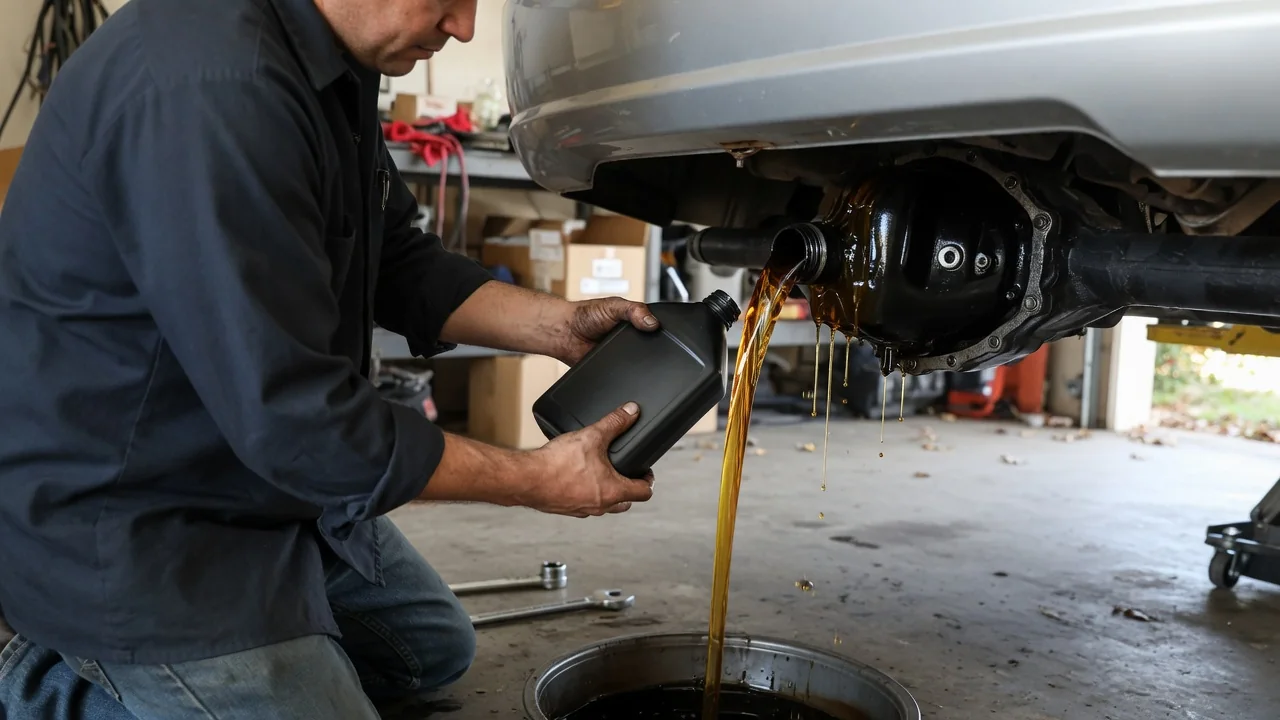
Anyone asking what is gear oil viscosity is really asking how easily a lubricant flows and how thick a film it leaves between loaded gear teeth. In a manual gearbox, transfer case, or drive axle, that single property influences shift feel, wear protection, noise, and efficiency. Understanding it makes the numbers on a bottle far easier to interpret for your own vehicle.
Viscosity rating
Viscosity is a fluid's resistance to flow, and gear oils are graded on a scale developed specifically for gear lubricants. A label such as 75W-90 carries two pieces of information: the number paired with the W describes how the oil behaves when cold, while the second number describes its thickness at normal operating temperature. A lower first number means the oil stays more fluid in cold conditions, and a higher second number means a thicker film once the gearbox or axle is fully warmed up.
One common source of confusion is that gear oil grades and engine oil grades use different numbering scales. A gear oil with a higher number on its label is not necessarily thicker than an engine oil with a lower one, so the two cannot be compared by number alone. Bottles may also show a single grade rather than a multigrade range, which indicates an oil rated at only one end of the temperature spectrum. Which grade your vehicle needs depends on the design of its transmission or differential.
Temperature
Every gear oil thins as it heats and thickens as it cools, and that shift matters at both extremes. On a cold morning, oil that is too thick resists being carried up by the rotating gears and splashed onto bearings, so components may run briefly with marginal lubrication. In a manual gearbox, thick cold oil also slows the synchronizers, which drivers often notice as stiff or notchy shifts during the first few miles before the fluid warms.
Heat creates the opposite challenge. A differential working hard under towing, sustained highway speeds, or steep grades can run hot enough to thin the oil considerably, reducing the film that separates the ring and pinion teeth. Multigrade gear oils are formulated to limit how much viscosity changes across this range, so one fluid can flow at startup and still protect under load. Climate and duty cycle vary widely, which is why some manufacturers list different grades for different ambient temperature ranges.
Specification
Viscosity is only one part of a gear oil specification. Manufacturers also call for a performance category, which describes the additive chemistry, particularly the extreme-pressure additives that protect teeth under heavy sliding contact. Hypoid gears in a drive axle slide across each other under high load and generally need strong extreme-pressure protection, while many manual transmissions contain synchronizer materials that can be sensitive to certain additive packages. Two oils with the same viscosity grade can therefore suit very different components.
Some units carry further requirements. Limited-slip differentials may need friction modifiers so the clutch packs engage smoothly, and certain gearboxes are designed around a manufacturer's own fluid standard rather than a generic grade. The owner's manual or service information for the exact vehicle lists both the viscosity grade and the performance requirement, sometimes separately for the transmission, transfer case, front axle, and rear axle. Matching both parts of the specification matters more than choosing a grade that simply seems thicker or thinner.
Everyday Use and Observations
In daily driving, correct viscosity is mostly noticed by its absence of symptoms. Shifts feel consistent, the axle stays quiet, and nothing draws attention. When the grade is wrong or the oil has degraded, the signs are more noticeable: a manual gearbox that balks when cold, a whine from the differential that changes with throttle, or a slight drag that affects coasting. Thicker oil than specified can also raise churning losses, since gears must push through more resistant fluid with every rotation.
Oil condition offers clues as well. Gear oil that looks unusually dark, smells burnt, appears milky from water contamination, or carries visible metal particles on a drain plug magnet no longer provides the film it was designed to deliver. Seepage at axle seals or the pinion flange lowers the fluid level, which reduces lubrication regardless of grade. None of these observations identifies a failed part on its own; noise and shift complaints have several possible causes that deserve proper inspection.
Limits and Next Steps
Viscosity cannot compensate for mechanical wear. Choosing a heavier grade to quiet a noisy differential or a lighter one to ease a worn synchronizer may mask a symptom briefly while leaving the underlying problem in place, and it can introduce new issues with cold flow or film strength. Likewise, a grade that works well in one vehicle offers no assurance in another, because clearances, gear geometry, bearing design, and operating temperatures differ between manufacturers and even between axles on the same truck.
The sensible next step is to confirm the grade and performance requirement in the vehicle's own documentation, then check that the fluid currently in the unit matches it and sits at the correct level. Service schedules differ by manufacturer and by use, with towing, off-road driving, and water crossings often calling for earlier attention. If shifting problems or driveline noise persist with the right fluid in good condition, a qualified technician can inspect the gearbox or axle directly rather than relying on the oil to solve it.