What Is Battery Sulfation? Causes, Effects, and Prevention
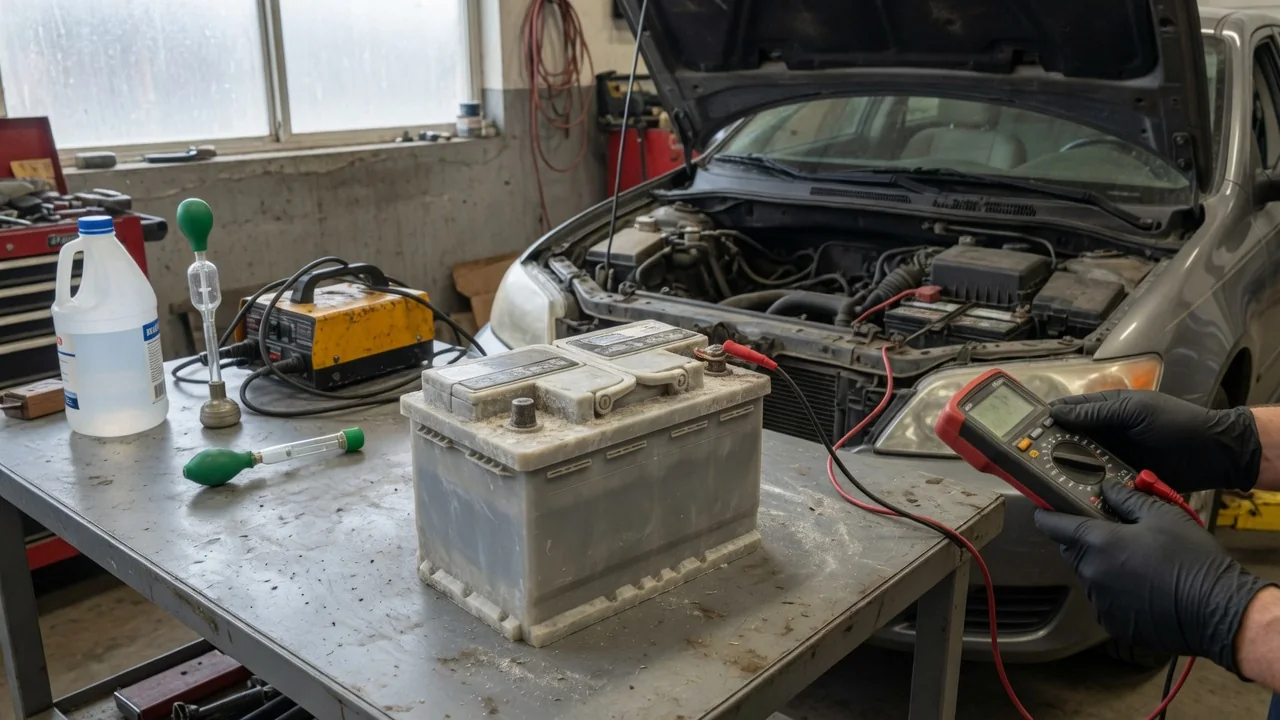
Battery sulfation is the buildup of lead sulfate crystals on the plates of a lead-acid battery. It is one of the most common reasons a car battery loses strength before its time. Some sulfate forms every time a battery discharges, so the process itself is normal. The trouble starts when that sulfate stays in place long enough to harden. Knowing how lead acid battery sulfation develops makes it easier to recognize the symptoms and slow the damage.
How Lead Sulfate Crystals Build Up
A conventional 12-volt car battery contains six cells. Each cell has positive plates of lead dioxide and negative plates of sponge lead, and both are immersed in or saturated with a sulfuric acid electrolyte. When the battery delivers current, both plate materials react with the acid and turn into lead sulfate, and the electrolyte becomes weaker and more watery. Charging reverses the reaction. The lead sulfate converts back into lead dioxide and sponge lead, and sulfuric acid returns to the electrolyte. In a healthy battery this cycle repeats many times with little lasting change.
Freshly formed lead sulfate consists of very fine, soft particles that convert back easily. If the battery sits partially or fully discharged, those small particles gradually recrystallize into larger, denser crystals. Large crystals have much less surface area relative to their volume and dissolve poorly during charging, so a normal charger struggles to break them down. Technicians often call the early stage soft or reversible sulfation and the advanced stage hard or permanent sulfation. The boundary between the two is gradual rather than sharp.
Several conditions speed up crystal growth. Long periods of storage without charging leave the plates coated in sulfate, and so do repeated short trips that never restore full charge. Parasitic electrical drains and a charging system that runs too low have the same effect. Heat increases self-discharge and chemical activity, and a deep discharge converts a larger share of the active material into sulfate. In flooded batteries, acid stratification can make the electrolyte stronger near the bottom of the cells, which encourages sulfation on the lower portions of the plates. Plate areas left exposed when the electrolyte level drops also tend to sulfate.
How Sulfation Affects Battery Performance
Lead sulfate conducts electricity poorly. Any area of plate locked up by hardened crystals can no longer store or release energy. The most direct result is lost capacity: the battery holds less total charge than it did when new. It runs down faster when the engine is off and recovers less from a given amount of driving. The crystals also raise internal resistance, so the battery cannot deliver high current as easily. This shows up as weaker cranking, especially in cold weather, when engine oil is thicker and the battery chemistry is already slower.
Sulfation also reduces charge acceptance. A sulfated battery may take longer to recharge, may get warmer while charging, and may never return to a true full state of charge. It can show a reasonable voltage at rest yet drop sharply as soon as a starter motor or load tester draws current. Owners commonly notice a slow crank after the car sits for a few days or a repeated need for jump starts. Another sign is a battery that tests fine after charging but fails again soon afterward. These symptoms point toward sulfation but are not unique to it, so they call for proper testing rather than assumption.
How to Prevent Battery Sulfation
The most effective prevention is keeping the battery as close to fully charged as practical. Sulfate that is converted back promptly never has time to harden. That makes recharging soon after any deep discharge more valuable than attempting a recovery later. Common examples are lights left on or long accessory use with the engine off. Short trips, especially with heavy electrical loads, can leave the battery chronically undercharged. An occasional longer drive or a periodic charge with an external charger helps make up the difference.
For vehicles that sit unused, an automatic maintainer designed for the battery type can hold it at full charge without overcharging. If no maintainer is available, you can disconnect the battery according to the vehicle manufacturer's instructions and recharge it at intervals to reduce drain. Some vehicles lose stored settings when the battery is disconnected. Storing a battery in a cool place slows self-discharge, but a battery stored discharged will sulfate at any temperature.
Routine checks support these habits. A charging system with inadequate output, or a parasitic draw that drains the battery overnight, will undo good charging practices. Both are worth having inspected when a battery repeatedly runs low. On serviceable flooded batteries, topping up with distilled water as the battery maker directs keeps the electrolyte above the plates and prevents exposed areas from drying and sulfating. Clean, tight terminals help ensure that charging current actually reaches the battery.
Practical Implications and Limits
How much sulfation can be reversed depends on how far it has progressed. Many smart chargers offer reconditioning or desulfation modes. Some flooded batteries can also receive a controlled equalization charge where the manufacturer permits it. These methods may recover some capacity from relatively recent sulfation, but results vary widely. No charging technique reliably restores a battery whose plates are heavily covered in hardened crystals. Equalization and high-voltage modes can damage sealed AGM or gel batteries when used against the maker's guidance, so the charger profile must match the battery construction.
Sulfation is also only one of several ways a lead-acid battery wears out. Positive grid corrosion, shedding of active material, internal shorts, and electrolyte loss can produce similar symptoms, and charging cannot fix any of them. A load test or conductance test gives a clearer picture than voltage alone, and so do specific gravity readings across the cells of a flooded battery. When a battery fails these tests after a full charge, replacing it is usually more dependable than repeated recovery attempts.
Vehicle design changes how these principles apply. Cars with start-stop systems, enhanced flooded or AGM batteries, or electronic battery management may regulate charging differently. They may also require a specific battery type or a registration procedure after replacement. The chemistry of sulfation stays the same, but the owner's manual and the battery manufacturer's instructions should guide charging, storage, and replacement decisions for any particular vehicle.