How Does a Lead-Acid Car Battery Store Energy?
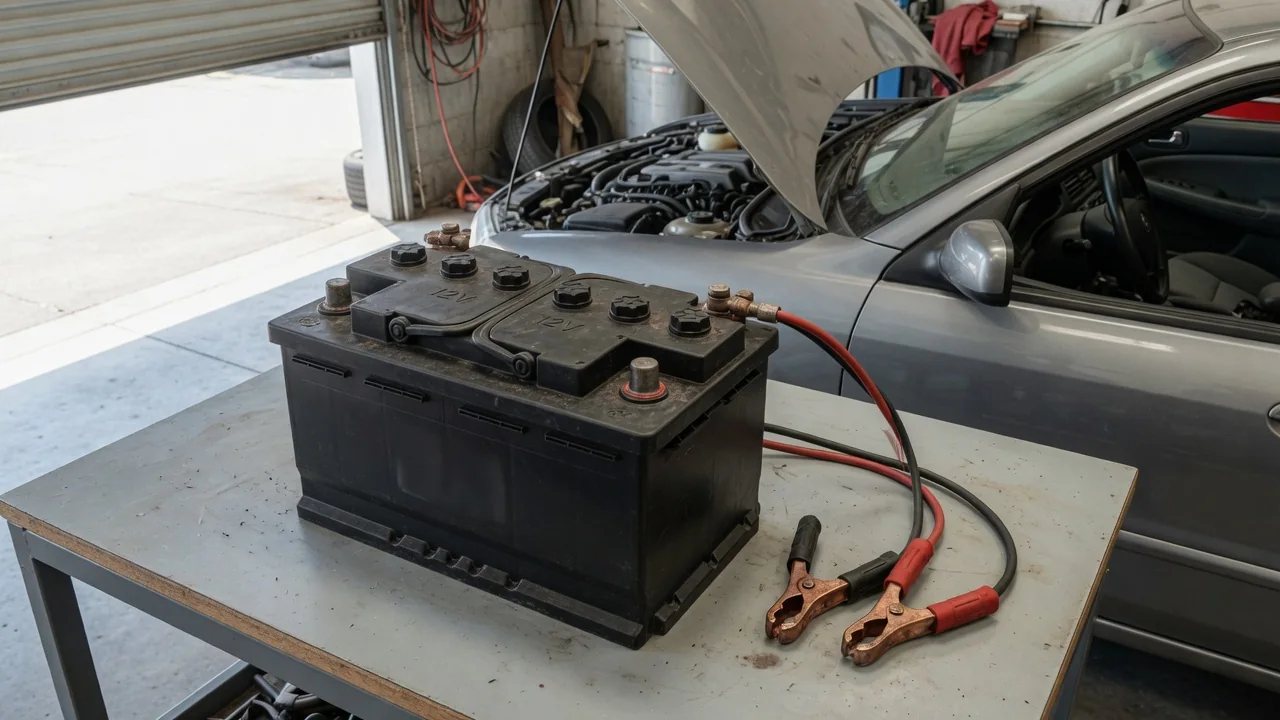
A lead-acid car battery does not hold electricity the way a tank holds fuel. It stores energy chemically, in the difference between two lead compounds sitting in a bath of dilute sulfuric acid. When you start the engine, those compounds react and release electrons. When the alternator or a charger pushes current back in, the reaction runs in reverse. Understanding lead acid car battery chemistry explains why batteries weaken, recover, and eventually wear out.
Plate reaction: where the energy actually lives
Inside the case, a typical 12-volt automotive battery is made of six cells connected in series. Each cell contains two sets of plates kept apart by porous separators. The positive plates are coated with lead dioxide, a dark brown material. The negative plates carry sponge lead, a porous form of metallic lead with a large surface area. The energy is stored in the chemical potential between these two materials. Lead dioxide strongly tends to gain electrons, and sponge lead readily gives them up. Because the plates are separated, that exchange can only happen when an external circuit, such as the starter motor or headlights, connects the terminals. Each cell produces roughly 2 volts, which is why six cells give a fully charged battery a resting voltage of about 12.6 volts.
During discharge, both plates react with the sulfuric acid around them. At the negative plate, lead combines with sulfate ions to form lead sulfate and releases electrons into the circuit. At the positive plate, lead dioxide accepts those electrons, combines with sulfate and hydrogen ions, and also becomes lead sulfate, producing water as a byproduct. As discharge continues, both plates drift toward the same material. The more alike they become, the smaller the electrical difference between them and the lower the voltage the cell can deliver. A fully discharged cell is not empty in the sense of missing something. Its active material has simply been converted into lead sulfate that no longer offers a useful energy difference.
Electrolyte: the acid that takes part in the reaction
The electrolyte is a mixture of sulfuric acid and water. It is not merely a conductor that lets ions travel between the plates; it is an active participant in the reaction. Sulfate from the acid is consumed by both plates during discharge and bound into lead sulfate. That means the acid gets weaker as the battery delivers energy, and the solution becomes closer to plain water. This is why the electrolyte's specific gravity, its density compared with water, is a traditional indicator of state of charge in flooded batteries with removable caps. Dense, acid-rich electrolyte corresponds to a charged battery, while thinner, more watery electrolyte points to a discharged one.
Not every battery holds its electrolyte the same way. In a conventional flooded battery, the liquid moves freely around the plates. In an absorbent glass mat (AGM) battery, the acid solution is soaked into fiberglass mats pressed between the plates, so there is little free liquid. Gel batteries thicken the electrolyte into a paste-like form. The underlying chemistry is the same in all of these designs: the acid supplies sulfate for the plate reactions and gives ions a path to move. What changes is how the electrolyte is contained, how gases produced during charging are handled, and how sensitive the battery is to charging voltage.
Charging: running the reaction in reverse
Charging forces the discharge reaction backward. When the alternator or an external charger applies a voltage higher than the battery's own, current flows into the positive terminal and out of the negative one. At the positive plate, lead sulfate is converted back into lead dioxide; at the negative plate, it returns to sponge lead. The sulfate released from both plates goes back into the electrolyte as sulfuric acid, so the solution becomes stronger again. In this way, electrical energy from the charging source is stored once more as chemical potential between the two plate materials.
The process is not perfectly efficient, and it slows as the battery approaches full charge. Once most of the lead sulfate has been converted, additional current increasingly goes into splitting water in the electrolyte into hydrogen and oxygen gas. This gassing is why flooded batteries slowly lose water over time and why charging areas should be ventilated and kept away from sparks. Sealed AGM and similar valve-regulated designs are built to recombine much of that gas back into water internally, but they still depend on charging voltage staying within the battery manufacturer's limits. Excessive voltage can overwhelm recombination and dry the battery out.
In a vehicle, the charging system regulates voltage to replace energy used during starting and to supply electrical loads while driving. How aggressively it charges, and whether it adjusts for temperature or battery condition, depends on the specific vehicle and its electrical system design. Some modern vehicles use battery sensors and variable charging strategies, so exact behavior should be confirmed in the owner's manual or service information for that model.
Practical implications and limits
Because energy is stored as a chemical change in the plates, a lead-acid battery stays healthiest when it is kept near full charge. Lead sulfate formed during normal discharge is fine-grained and converts back easily. If a battery sits partly or deeply discharged for long periods, those sulfate crystals can grow larger and harder, a condition called sulfation. Hardened sulfate resists recharging, which permanently reduces the active material available and therefore the battery's usable capacity. Frequent short trips with heavy electrical loads, long storage without a maintainer, and repeated deep discharges all push a battery in this direction.
Temperature also matters. Chemical reactions slow down in the cold, so a battery can deliver less current on a freezing morning even at a good state of charge, just when a cold engine is harder to crank. A discharged battery is also more vulnerable to freezing, because its electrolyte contains less acid and behaves more like water. Heat speeds up the reactions but also accelerates corrosion of the plate grids and water loss, which shortens service life over time.
Finally, a starting battery is designed to deliver a large burst of current for a short time, not to be drained repeatedly, and deep cycling wears it faster. Resting voltage and electrolyte density can indicate state of charge, yet neither alone proves a battery is healthy. A load test or a proper battery tester gives a clearer picture of whether the stored energy can actually be delivered. When a battery no longer holds or supplies enough energy, replacing it with the type and rating specified for the vehicle is the appropriate fix.