What Is an EFB Car Battery? Construction, Start-Stop Use and Replacement
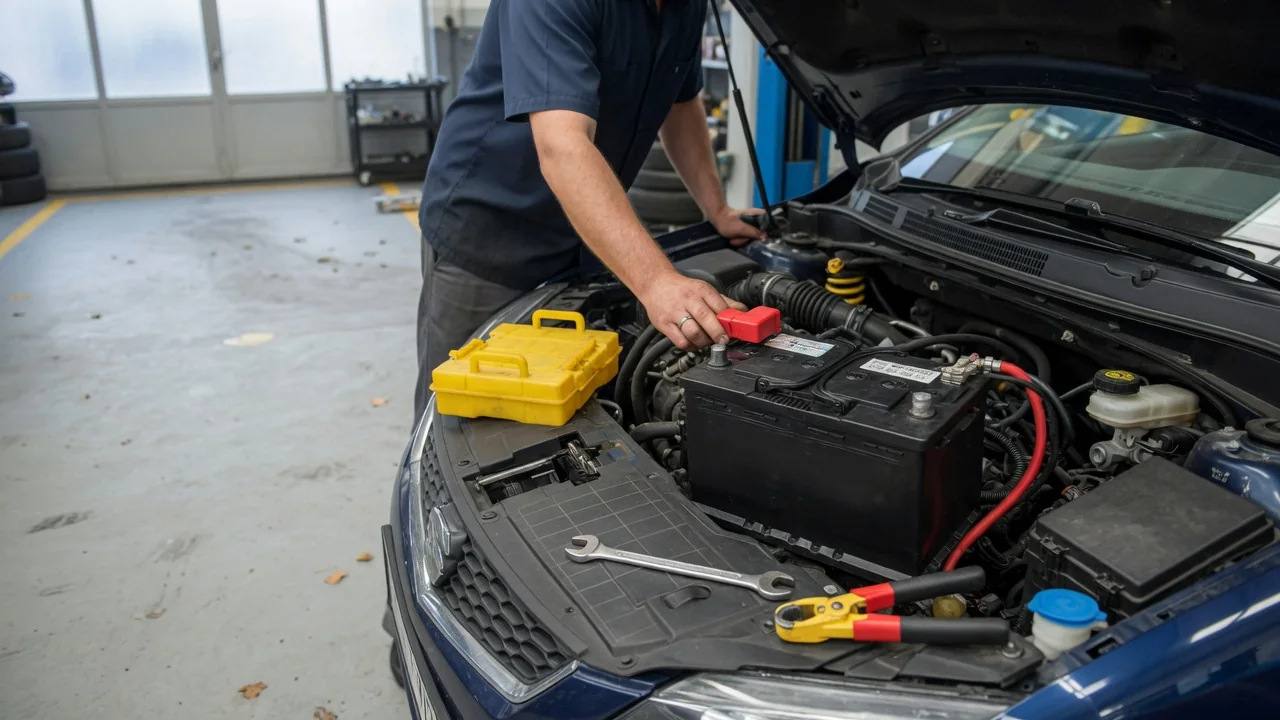
An EFB car battery, short for enhanced flooded battery, is a lead-acid starting battery built to handle more frequent and deeper cycling than a conventional flooded battery. Its capability sits between a standard flooded battery and an absorbent glass mat (AGM) battery, and it is commonly fitted to vehicles with start-stop systems. This article explains how an EFB is built, why start-stop driving calls for one, and what to consider when you replace it.
How an EFB Battery Is Constructed
Like any conventional flooded battery, an EFB uses lead plates immersed in a liquid electrolyte of sulfuric acid and water. Each cell contains alternating positive and negative plates with porous separators between them. Six cells connected in series produce the nominal 12-volt output. The chemistry is the same as in a standard battery. During discharge, lead dioxide on the positive plates and sponge lead on the negative plates react with the acid to form lead sulfate, and charging reverses that reaction. The difference in an EFB is that the internal components are designed to survive repeated cycling.
Manufacturers use several approaches, and the exact combination varies by brand. Many apply a polyester scrim or fleece layer to the positive plates, which helps hold the active material in place as the plates expand and contract. Carbon additives in the negative plate material are often used to improve charge acceptance, so the battery can absorb current more quickly when the alternator recharges it. Denser active material and more durable grid alloys are also typical. Some designs also try to reduce acid stratification, a condition in which heavier acid settles at the bottom of the cell when the battery is rarely fully charged.
The electrolyte is still a free liquid rather than being held in glass mat separators, so an EFB remains a flooded design. Most are sold as maintenance-free units with sealed or semi-sealed lids. They still vent gas through a venting system and are generally meant to be installed upright, as the manufacturer specifies.
Why Start-Stop Vehicles Use EFB Batteries
A start-stop system shuts the engine off when the vehicle comes to a halt, such as at a traffic light. It restarts the engine when the driver releases the brake or presses the clutch, depending on the system. While the engine is off, the battery alone powers the lighting, climate control fans, infotainment and control modules. It then has to deliver another engine start, often many times during a single urban trip. In a conventional vehicle, the battery mainly cranks the engine once and is then recharged, so start-stop driving produces far more charge and discharge cycles.
Start-stop operation also tends to keep the battery in a partial state of charge. The charging system may not have enough time between stops to restore full charge, and some vehicles deliberately limit alternator output to reduce fuel use. A standard flooded battery used this way is prone to sulfation, stratification and shedding of active material, which shortens its life. The construction changes in an EFB are aimed at tolerating this partial-state-of-charge cycling and at accepting charge quickly during short recharge windows.
EFB batteries are generally intended for vehicles with basic start-stop systems. Manufacturers commonly specify AGM batteries for vehicles with heavier electrical demands, regenerative braking strategies or more advanced energy management, because AGM batteries typically offer greater cycling capability. The vehicle manufacturer decides which type a particular car requires; the presence of start-stop alone does not settle it.
Replacing an EFB Battery
Start by matching the original specification. The owner's manual, the label on the existing battery, or a parts catalog listing for the specific vehicle will show the battery technology, group size and terminal layout. It will also list performance ratings such as cold cranking amps and reserve capacity or ampere-hour capacity. The standard approach is to replace an EFB with another EFB of equivalent ratings. Upgrading to an AGM battery is often acceptable where it fits physically and the manufacturer permits it. Downgrading to a conventional flooded battery is widely discouraged, because it is likely to wear out quickly and may affect how the start-stop system behaves.
On many modern vehicles, replacing the battery involves more than swapping the unit. Some cars have a battery monitoring sensor on the negative terminal and an energy management system that adjusts charging according to battery type, capacity and age. On these vehicles, the new battery may need to be registered or coded with a diagnostic tool so the system recognizes it. Whether this step is required, and how it is done, depends on the vehicle, so check the service manual or ask a qualified technician. Skipping a required registration can cause incorrect charging, which may shorten battery life.
Standard battery handling precautions still apply. Wear eye protection and disconnect and reconnect the terminals in the order the vehicle manufacturer specifies. Secure the hold-down and connect any vent tube properly. Return the old lead-acid battery for recycling rather than putting it in household waste.
Practical Implications and Limits
An EFB improves cycling durability, but it does not remove the factors that shorten battery life. Frequent short trips, long periods of parking, high under-hood temperatures and parasitic drains from accessories can still leave the battery chronically undercharged. Many start-stop systems monitor battery condition and temporarily stop shutting the engine off when charge is low or electrical demand is high. If the engine stops less often than usual, the battery may be worth checking. Other conditions, such as cabin climate settings or engine temperature, can also prevent automatic stops.
If a vehicle sits for long periods or is driven only briefly, an external battery maintainer can help keep the battery charged. Use a charger designed for modern lead-acid batteries, select a mode suited to the battery type if the charger offers one, and follow both the charger and vehicle instructions. Testing an EFB is also best done with equipment that supports the technology. Some older testers are calibrated for conventional flooded batteries and may give misleading results.
It also helps to keep expectations realistic. An enhanced flooded battery is a cost-effective middle option, not a universal upgrade for every car. Fitting one in a vehicle without start-stop will not harm it, but the benefit depends on how the car is used. An EFB is also not a substitute where the manufacturer specifies AGM. Service life varies widely with climate, driving pattern and electrical load, so no single replacement interval applies to every vehicle.