What Is an Oil Cooler on a Car? How It Works and Why It Leaks
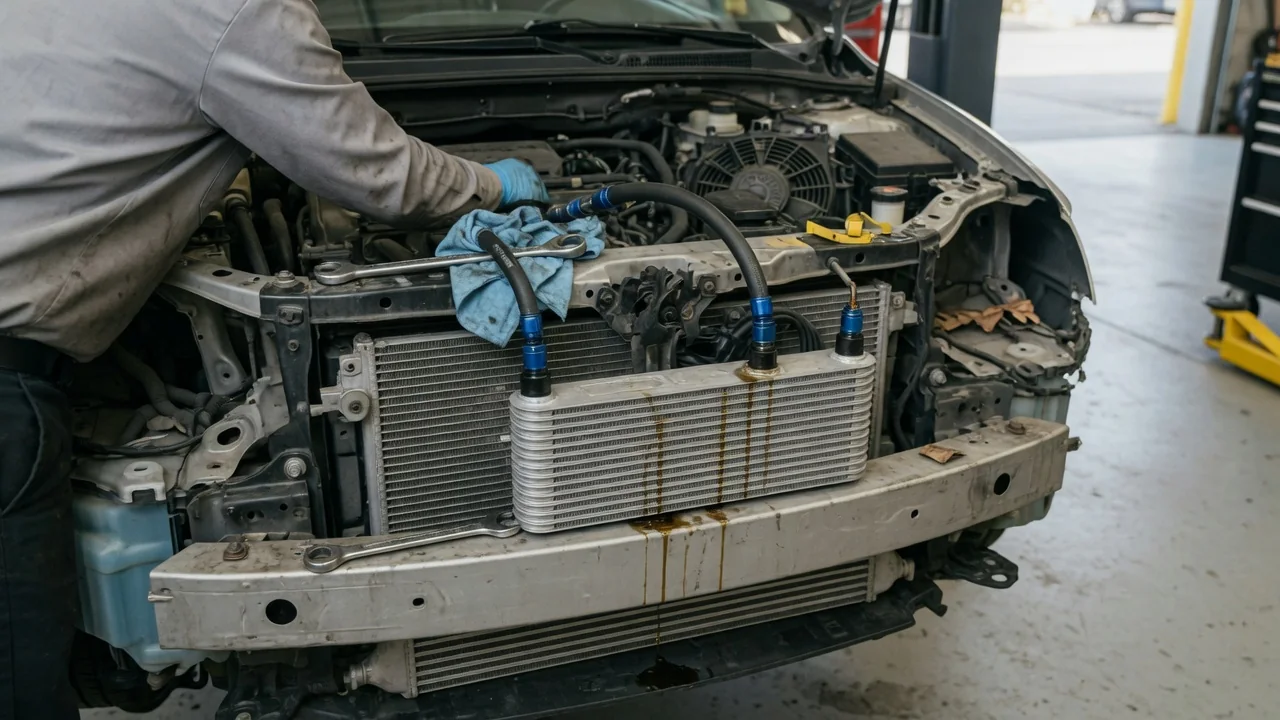
An oil cooler on a car is a small heat exchanger that removes heat from engine oil before the oil returns to the moving parts it protects. Not every vehicle has one. Many engines built for towing, high output, turbocharging, or sustained heavy loads use one to keep oil within a safe working range. This guide explains why oil gets hot, how an oil cooler moves heat away, and what a leak can mean.
Oil Heat: Why Engine Oil Needs Help Staying Cool
Engine oil does more than lubricate. It forms a protective film between bearings, cam lobes, piston rings, and cylinder walls. It also carries heat away from parts that coolant cannot reach directly, such as the crankshaft bearings, the underside of the pistons, and the center bearing of a turbocharger on turbocharged engines. Friction, combustion heat soaking through metal, and the work of pumping oil through tight clearances all raise its temperature. During light driving, airflow around the oil pan and the engine's main cooling system often keep that heat in check.
Trouble starts when oil stays too hot for too long. Heat thins oil, which can weaken the film in heavily loaded areas. Sustained high temperatures also speed up oxidation, which wears out additives and encourages varnish and sludge. Towing, long uphill grades, high-speed driving in hot weather, track use, and slow traffic with little airflow all tend to push oil temperatures up. An engine oil cooler adds heat-rejection capacity for those conditions so the oil stays closer to its intended viscosity. Oil that runs too cold is not ideal either. For that reason, many systems are designed to regulate oil temperature rather than simply drive it as low as possible.
Cooling Path: How an Oil Cooler Moves Heat Away
Oil coolers generally fall into two broad designs. An oil-to-air cooler looks like a small radiator. It is usually mounted near the main radiator or behind a grille opening, where outside air passes through its fins. Oil travels from the engine through hoses or metal lines to the cooler, releases heat into the passing air, and returns to the engine. An oil-to-coolant cooler, often called a liquid-to-liquid heat exchanger, is typically a compact stack of plates mounted on or built into the oil filter housing. Engine coolant flows through one set of passages and oil through another, separated by thin metal walls. Heat moves from the oil into the coolant and then leaves the vehicle through the main radiator.
In both designs, the oil pump provides the flow. Oil leaves the pump, passes through the filter and the cooler in an order that depends on the design, and then enters the galleries that feed the bearings and valvetrain. Many systems include a thermostat or bypass valve that sends oil around the cooler until it reaches operating temperature, which helps the engine warm up quickly. A coolant-type cooler can also help warm the oil after a cold start, because coolant often heats up faster than oil. Once the oil becomes hotter than the coolant, the direction of heat transfer reverses and the cooler starts removing heat.
The exact location, routing, and presence of a thermostat vary by vehicle. Some automatic transmissions also use a fluid cooler, sometimes built into a radiator tank. That is a separate circuit from the engine oil cooler, even though the parts can look similar. The owner's manual or service information for the specific vehicle identifies which coolers are fitted.
Leaks: How Oil Cooler Problems Show Up
An oil cooler adds hoses, lines, fittings, seals, and gaskets to the oil circuit, and each of these is a place where oil can escape. On air-cooled designs, common leak points include hose crimps, threaded fittings, and the cooler core itself, which sits in the airstream where road debris can strike it. Rubber lines can harden and crack with age and repeated heat cycles. Typical signs include drips under the front of the car, an oily film around the cooler or radiator area, a burning-oil smell if oil reaches hot exhaust parts, and an oil level that drops between changes.
Coolant-type coolers can leak externally through the gasket or O-rings where they mount to the engine. They can also fail internally. If the internal walls or seals break down, oil and coolant can mix. While the engine runs, oil pressure is often higher than cooling-system pressure, so oil may be pushed into the coolant. This can show up as a brown or greasy film in the coolant reservoir. Coolant entering the oil can make the oil look milky or foamy. Other faults, such as a failed head gasket, can produce similar symptoms, so these signs point toward a diagnosis rather than confirm one. Pressure testing and proper inspection are used to isolate the source.
A leak is more than a mess on the driveway. Losing oil can lead to low oil level and poor lubrication. Mixed fluids reduce the oil's ability to lubricate and the coolant's ability to prevent overheating and corrosion. A sudden failure, such as a ruptured cooler line, can empty the crankcase quickly. If the oil pressure warning light comes on, stopping the engine as soon as it is safe to do so limits the chance of further damage.
Practical Implications and Limits
For most owners, the oil cooler needs no adjustment or separate scheduled service. What matters is noticing problems early. Checking the oil level regularly, looking for wetness around cooler lines and the filter housing during oil changes, and watching for changes in coolant color or texture cover most of what an owner can do without tools. If an internal failure has contaminated the cooling system or lubrication system, repair usually involves more than swapping one part. The service information for the specific vehicle describes the required replacement and flushing procedure, and following it matters more than general rules of thumb.
An oil cooler also has clear limits. It cannot make up for the wrong oil grade, a low oil level, overdue oil changes, or a weak radiator or cooling fan. A coolant-type cooler in particular relies on the main cooling system to carry heat away. Adding an aftermarket cooler to a vehicle that was not designed for one is not automatically an improvement. It changes oil capacity, routing, and warm-up behavior, and a poor installation creates new leak points. Whether a car benefits from extra oil cooling depends on how it is used and on what the manufacturer specifies for that use. Where an oil temperature gauge is fitted, it gives more direct information than guessing from driving conditions.