What Is an Engine's Firing Order? Spark Sequence, Smoothness and Diagnosis
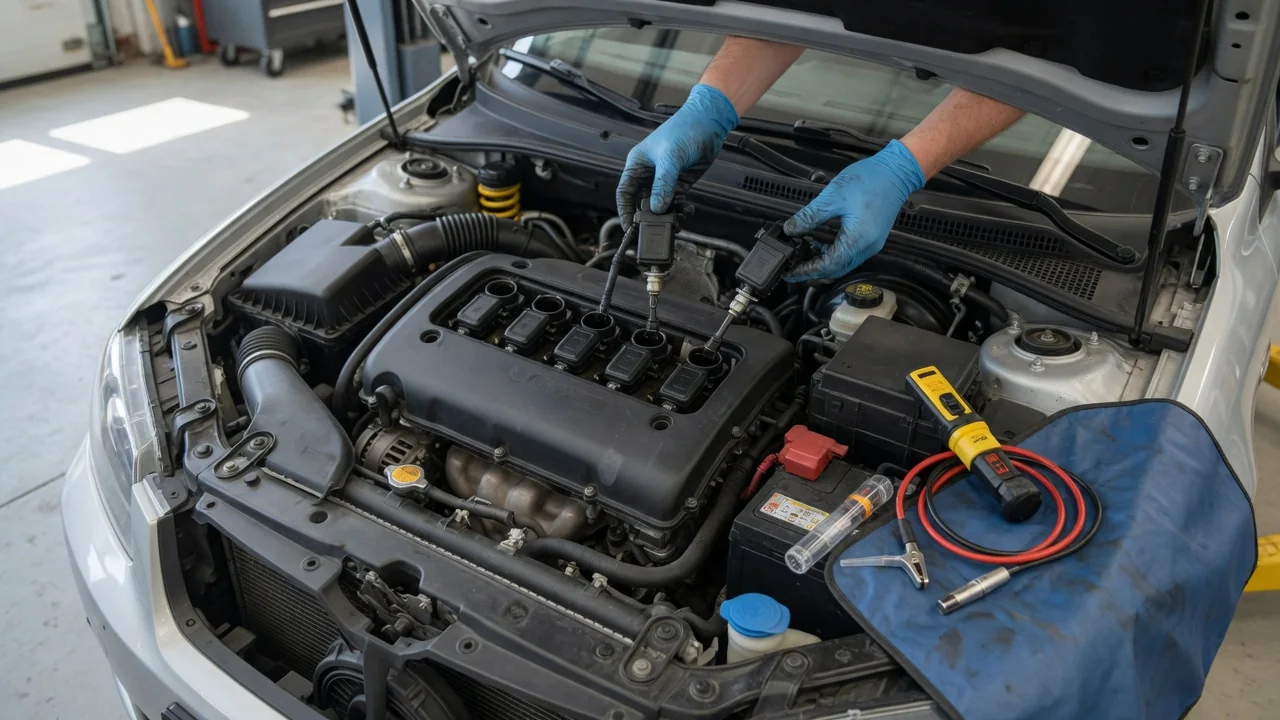
An engine's firing order is the sequence in which its cylinders ignite their air-fuel charge during each full operating cycle. The sequence is set by the shape of the crankshaft and the timing of the camshaft, and the ignition or injection system must follow it exactly. Understanding the firing order explains why multi-cylinder engines run smoothly, why crossed spark plug wires cause trouble, and how technicians trace a misfire to a specific cylinder.
Spark sequence
In a four-stroke engine, each cylinder completes its intake, compression, power and exhaust strokes over two full turns of the crankshaft, or 720 degrees of rotation. Every cylinder fires once in that span, so the engine needs a defined schedule for which cylinder receives its spark next. That schedule is the firing order, usually written as a string of cylinder numbers. Many inline-four engines use 1-3-4-2, for example, and many inline-six engines use 1-5-3-6-2-4. Other sequences exist, and the correct one for any given engine comes from its service information.
The order is determined mechanically. The angles of the crankshaft throws decide when each piston reaches top dead center, and the camshaft lobes decide which of those pistons is on its compression stroke rather than its exhaust stroke at that moment. The ignition system has to deliver the spark to the right cylinder at the right time. On older engines a rotating distributor routed high voltage to each plug wire in turn. On most modern engines an electronic control unit uses crankshaft and camshaft position sensors to trigger individual coils in the programmed sequence. Diesel engines have no spark plugs, but their fuel injection works the same way, delivering fuel to each cylinder in its firing order.
Cylinder numbering matters as much as the order itself. Manufacturers do not all number cylinders the same way, especially on V engines. One maker may number one bank consecutively, and another may alternate between banks. A firing order is meaningful only alongside the numbering convention used for that engine.
Smoothness
Engineers choose a firing order largely to spread power pulses evenly. On an even-firing engine, the 720 degrees of the cycle are divided equally among the cylinders. A four-cylinder engine fires every 180 degrees of crankshaft rotation, a six every 120 degrees, and an eight every 90 degrees. Evenly spaced pulses deliver torque to the crankshaft in a steadier stream. This reduces the speed fluctuations felt as roughness at idle and low engine speeds. More cylinders mean more frequent, overlapping pulses, which is one reason engines with higher cylinder counts tend to feel smoother.
The sequence also affects how loads travel through the engine. Firing adjacent cylinders back to back would concentrate stress on one section of the crankshaft and its main bearings. Designers therefore typically alternate between the ends of the engine or between banks, which helps manage torsional vibration in the crankshaft. Firing order also affects breathing. It shapes how intake runners draw air and how exhaust pulses interact in the manifold, which can influence how evenly each cylinder fills and how the exhaust sounds.
Firing order is not the whole story of smoothness. An engine's inherent balance depends mainly on its layout, crankshaft design and reciprocating masses, and some layouts need balance shafts or counterweights whatever order is chosen. Some engines are deliberately odd-firing, with uneven intervals that result from their bank angle or crankshaft design. Their uneven feel and sound is intentional, not a sign of a fault.
Diagnosis
When spark or fuel reaches a cylinder out of sequence, the engine runs poorly. Swapped spark plug wires on a distributor engine are a classic example. A cylinder receives its spark on the wrong stroke, so it fails to produce power. Typical signs include a rough or shaking idle, hesitation, reduced power, popping through the intake or exhaust, and a flashing or steady check engine light. With only two wires swapped, the engine may still start and run, which can make the error easy to overlook.
On vehicles with OBD-II, the engine computer watches crankshaft speed for the small slowdowns caused by a cylinder that does not fire. Misfire codes in the P0300 series report what it finds. P0300 indicates random or multiple misfires, while codes such as P0301 or P0304 point to a specific cylinder. Locating that cylinder on the engine requires the manufacturer's numbering convention, and making sense of several misfiring cylinders is often easier when they are viewed against the firing order.
A common troubleshooting step is to move a coil or plug from a misfiring cylinder to another cylinder and see whether the fault follows the part. If the misfire code moves, the part is suspect. If it stays, the cause likely lies elsewhere, such as fuel delivery, compression or an intake leak at that cylinder. Ignition, fuel and mechanical problems produce similar symptoms. A correct firing order therefore rules out one cause, but it does not show that the engine is healthy.
Practical implications and limits
For owners doing their own work, the firing order matters most whenever ignition components are disconnected. Replacing plug wires one at a time, and routing each new wire exactly where the old one sat, avoids most mix-ups. On engines with individual coils, connectors are often positioned so they reach only their own cylinder, but labeling each one before removal is still sensible. Installing a distributor requires setting cylinder 1 at top dead center on its compression stroke. If the engine is on its exhaust stroke instead, the rotor points to the wrong terminal and the engine may not start, even with every wire in place.
Where to find the information varies. On many engines the firing order and cylinder numbers are cast into the intake manifold or printed on an under-hood label, but this is not universal. The factory service manual or a reliable repair database is the authoritative source. Two engines with the same cylinder count or layout do not necessarily share a firing order, because crankshaft and camshaft designs differ.
An owner also has limited room to change the firing order. It is built into the crankshaft and camshaft, so rewiring cannot change it. Connecting wires in a different sequence only makes the ignition disagree with the mechanical cycle. A genuine change requires a camshaft ground for a different sequence plus matching ignition or engine-control changes, which is specialist engine-building work. In everyday ownership, the job is to keep the ignition and fuel systems matched to the order the engine was built with.