How Does a Hybrid Blend Motor and Engine Torque?
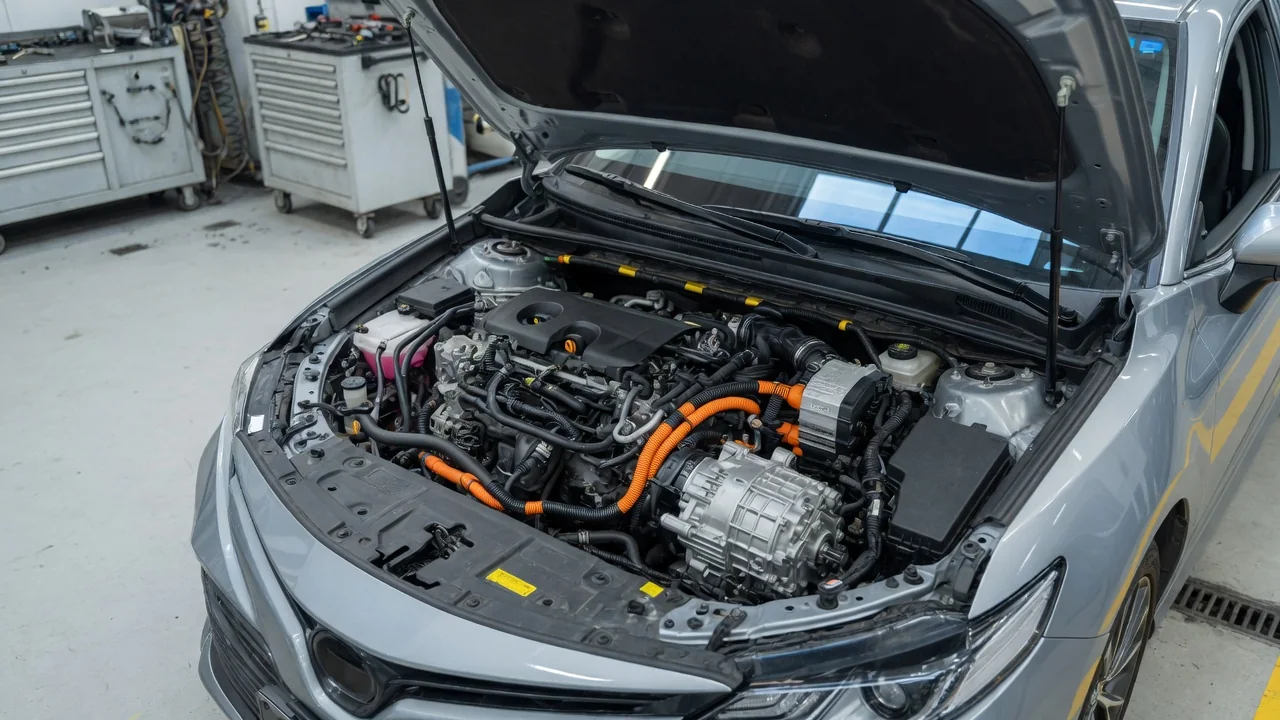
A hybrid powertrain has two sources of propulsion, but the driver has only one accelerator pedal. Hybrid torque blending is the control process that turns that single request into a coordinated split between the electric motor and the combustion engine. Knowing how it works helps explain why a hybrid can feel seamless one moment and slightly different the next. The general logic is similar across many designs, although the exact strategy depends on the architecture and the manufacturer's calibration.
Driver request
In most modern hybrids the accelerator pedal is not mechanically linked to the engine throttle. A pedal position sensor sends a signal to the hybrid control unit, which interprets it as a torque demand at the wheels rather than as a command to a specific power source. That interpretation usually takes vehicle speed, the selected drive mode, and the current gear or ratio state into account, so the same pedal position can produce different wheel torque targets in different situations. This abstraction is the foundation of torque blending: once the system knows how much total torque the driver wants, it can decide how to supply it.
The controller then compares that target with what each source can deliver at that instant. Typical inputs include battery state of charge, battery temperature and its permitted charge and discharge limits, engine temperature, motor and inverter temperature, and emissions-related needs such as warming the catalytic converter. The result is a torque split: a share assigned to the engine, a share to one or more motors, and in some cases a negative share used to recharge the battery. Because these constraints change constantly, the split is recalculated continuously, while the driver simply experiences acceleration that tracks pedal input.
Motor assist
Electric motors can produce strong torque from very low speeds, while a combustion engine generally delivers its best efficiency within a narrower operating range. Motor assist exploits this difference. When the driver asks for more torque than the engine can efficiently provide, the controller adds motor torque to fill the gap. This is common when pulling away from a stop, when the engine may be off or lightly loaded, and during sudden requests for passing power. Engine torque depends on airflow, boost pressure where a turbocharger is fitted, and combustion, all of which take time to build, whereas motor torque can follow a command almost immediately.
Assist also works in the other direction. If running the engine at a higher, more efficient load than the current demand requires makes sense, the motor can act as a generator, absorbing the surplus engine torque and storing it in the battery. This is often described as load point shifting. Net torque at the wheels still matches the driver's request; only the internal distribution changes. How the sources are physically combined depends on the layout. In a parallel hybrid, motor and engine torque are summed on a shared shaft or through the transmission. Power-split designs use a planetary gearset to combine them, and series-oriented systems use the engine mainly to drive a generator while a traction motor supplies wheel torque.
Assist is bounded by the electrical system. When the battery is depleted, hot, or very cold, the controller reduces the electric torque it allows, and the engine must carry more of the load.
Smooth transitions
Blending torque is straightforward on paper; making it imperceptible is harder. The main challenges are engine starts and stops, clutch engagement in designs that use one, and ratio or gear changes. When the engine starts while the vehicle is moving, a starter mechanism or the traction motor must spin it up, which can draw torque away from the driveline. The controller compensates by briefly adding motor torque so wheel torque stays steady, then gradually hands load to the engine once it is firing and its speed is matched to the driveline.
Ramp rates are another key tool. Instead of switching sources instantly, the controller typically changes each contribution along a planned rate, cross-fading as engine torque rises and motor torque falls. Because motor torque can be adjusted quickly and precisely, it often serves as the fast correction that masks the slower and less exact response of the engine. Software also manages driveline lash, the small free play in gears and joints, by easing torque through zero when the system moves from driving the wheels to regenerating or the reverse. Without that shaping, occupants could feel a clunk or surge.
A similar blending task happens under braking, where regenerative braking and the friction brakes share deceleration. The principle mirrors acceleration: total demand stays consistent while the contributing sources change behind the scenes.
Practical implications and limits
For owners, the most noticeable consequence is that performance and feel can vary with conditions the driver does not directly control. A hybrid may feel more eager with a warm, well-charged battery and less so after a long climb, after repeated hard acceleration, or in temperature extremes, when the system protects components by limiting electric output. This is generally intended behavior aimed at preserving battery and component life, not automatically a fault, although the specifics depend on the vehicle.
Because blending strategy is defined largely in software calibration, two hybrids with broadly similar hardware can behave quite differently. Drive modes commonly alter pedal mapping and how readily the engine starts, which is why an economy-oriented mode can feel softer. The owner's manual is the authoritative reference for what each mode does on a particular vehicle and which messages indicate reduced output.
There are also limits to what can be judged by feel. Engine starts at unexpected moments, a change in sound, or brief differences in response are usually part of the normal strategy. Persistent shudder, harsh engagement, warning lights, or a clear loss of power warrant professional diagnosis, since the cause could lie in the engine, motor, battery, sensors, or the software coordinating them. Manufacturers sometimes release control software updates to refine drivability, and a dealer or qualified technician can confirm whether one applies.