What an EFB Battery Is and How It Differs from Standard and AGM Batteries
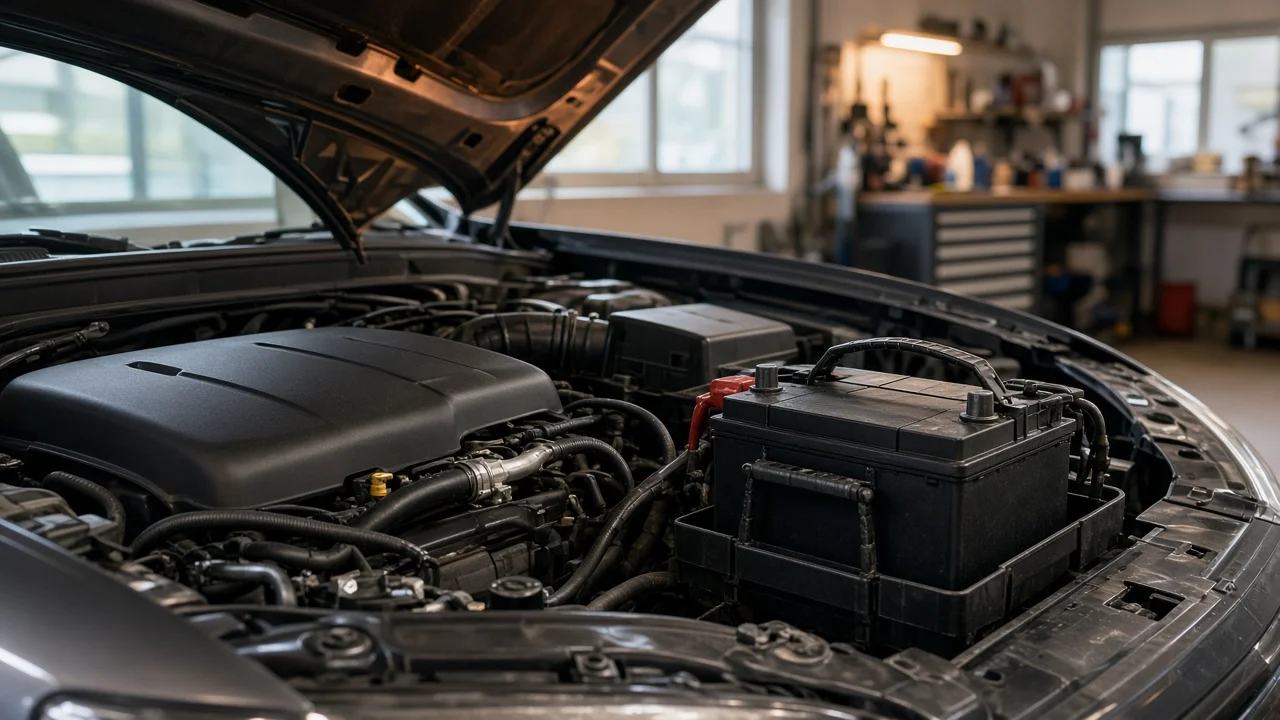
An EFB battery, short for Enhanced Flooded Battery, is a 12-volt lead-acid car battery built to handle the frequent starting and deep cycling of vehicles with automatic start-stop systems. It uses the same basic chemistry as a conventional flooded battery, with liquid electrolyte surrounding lead plates, but its internal construction is reinforced so it survives repeated discharge and recharge better and accepts charge faster. In practical terms, an EFB sits between a standard flooded battery and an AGM (Absorbent Glass Mat) battery in durability, start-stop capability and price. One qualification matters most. An EFB is not a universal upgrade for every car, and it is not a substitute for an AGM battery in a vehicle designed for AGM. Which battery type is correct depends on how the vehicle's charging and start-stop systems were engineered, and that varies by manufacturer, model year, powertrain and market.
Why EFB batteries exist
A conventional starter battery is designed mainly to deliver a large burst of current to crank the engine, after which the alternator quickly tops it back up. It is not meant to be drained repeatedly. Start-stop vehicles change that pattern. Every time the engine shuts off at a light, the battery alone powers the lights, climate fan, infotainment, control modules and other loads, then restarts the engine moments later. Over a typical commute this can mean many partial discharges per trip.
Under that kind of use, a standard flooded battery tends to lose capacity early. Its plates shed active material, and its electrolyte can stratify, with denser acid settling at the bottom of the cells. Automakers needed a battery that could tolerate this cycling without the higher cost of AGM, especially in entry-level start-stop systems. The EFB is the answer to that need.
How an EFB battery works
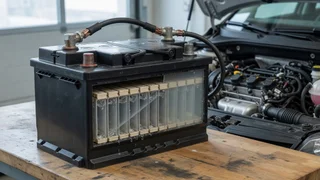
An EFB stores and releases energy the same way any lead-acid battery does: a chemical reaction between lead plates and a sulfuric acid electrolyte. The differences are in construction details that slow down wear and improve charging behavior. Exact designs vary between manufacturers, but the common enhancements include the following.
Carbon additives in the negative plates, which help the battery accept charge more quickly and reduce the buildup of hard sulfate crystals during partial-charge operation. A fleece or scrim layer, often made of polyester, applied to the positive plates to hold active material in place so it does not shed as quickly under repeated cycling. Denser or more robust plate and grid construction intended to withstand deeper and more frequent discharges. In some designs, features that help mix the electrolyte and reduce acid stratification.
The practical effect is that an EFB can spend more of its life in a partially charged state, as start-stop batteries often do, and still recover well when the alternator's charging output returns. That improved charge acceptance also matters in vehicles that use smart charging strategies, where the alternator charges more aggressively during deceleration and less during steady cruising to save fuel.
EFB vs. standard flooded vs. AGM
The easiest way to understand an EFB is to place it alongside the two battery types it is most often confused with. The comparison below describes general characteristics; specific products and ratings vary.
Feature | Standard flooded | EFB | AGM; Electrolyte | Free liquid acid | Free liquid acid | Acid absorbed in glass-fiber mats; Cycling durability | Lowest of the three | Improved over standard flooded | Highest of the three; Start-stop suitability | Not designed for start-stop | Designed for basic or entry-level start-stop | Designed for demanding start-stop, regenerative braking and high electrical loads; Charge acceptance | Basic | Improved | Generally strongest; Spill resistance | Vented, must stay upright | Vented, must stay upright | Sealed and spill-resistant; Typical mounting | Under the hood | Usually under the hood | Under the hood, trunk or cabin; Relative cost | Lowest | Moderate | Highest
A useful rule of thumb follows from this comparison. You can usually move up the ladder but not down. Replacing an EFB with an AGM of the correct size and rating is often acceptable, provided the vehicle's battery management settings are updated where required. Replacing an EFB with a standard flooded battery, or an AGM with an EFB, generally is not recommended, because the replacement may fail early and start-stop may stop working reliably.
Strengths and limitations
The case for an EFB is strongest when it matches what the vehicle was built for. Its main advantages are:
Better tolerance of frequent starts and partial discharges than a conventional flooded battery. Faster recharging, which helps keep start-stop functions available. Lower cost than an AGM battery in vehicles where EFB is the specified type. Flooded construction that is often considered tolerant of under-hood heat.
Its limitations are equally clear:
It does not match AGM durability under heavy cycling, regenerative braking or very high electrical demand. Like any flooded battery, it is vented and must be mounted upright, so it is generally not suitable for trunk or cabin locations designed for sealed batteries. Availability in US retail stores can be more limited than for standard flooded and AGM batteries, since many start-stop vehicles sold in the US are specified with AGM. It costs more than a standard flooded battery, which is unnecessary expense in a vehicle without start-stop.
In short, an EFB suits owners of vehicles that left the factory with one, and drivers who want a cost-sensitive battery for a basic start-stop system. It is not the right choice for a car that came with AGM, and it offers little benefit in an older vehicle without start-stop or significant electrical loads, where a quality standard battery is usually sufficient.
How to tell if your car has an EFB battery
Most EFB batteries are clearly labeled. Look on the top or side of the case for the letters EFB, or for wording such as Enhanced Flooded or Start-Stop. AGM batteries are typically labeled AGM, and a battery marked only with a group size and cold cranking amps is usually a standard flooded design.
If the label is missing or worn, check the owner's manual, the battery specification for your vehicle in a parts catalog, or ask a dealer using your VIN. The battery type is not something to guess from the case shape, because EFB and AGM units in the same size can look very similar. In the US, batteries are commonly identified by Battery Council International (BCI) group size, while many European-designed vehicles use DIN or EN size designations, so make sure the replacement matches both the size and the battery technology.
Replacing an EFB battery
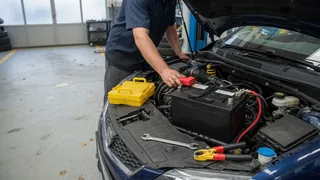
Replacing an EFB is similar to replacing any 12-volt battery, with a few start-stop-specific considerations. Exact procedures, including whether the battery must be registered and any tightening values for the hold-down and battery terminals, depend on the vehicle and should be checked against the manufacturer's service information.
1) Confirm the correct replacement: same technology (EFB, or AGM if the vehicle allows it), correct physical size, terminal layout and electrical ratings at or above the original specification. 2) Check whether your vehicle has a battery monitoring sensor on the negative cable. Many start-stop vehicles use one, and some require the new battery to be registered or coded with a scan tool so the charging system knows the battery is new and what type it is. 3) Note any radio codes, saved settings or memory requirements. Some owners use a memory saver, but follow the vehicle's guidance, as incorrect use can create risks. 4) With the ignition off, disconnect the negative terminal first, then the positive, and remove the hold-down. 5) Install the new battery upright, secure the hold-down, and reconnect positive first, then negative. Make sure the terminals are clean and tight, since loose or corroded connections cause voltage drop that can mimic a weak battery. 6) Perform battery registration if the vehicle requires it. If you do not have a compatible tool, a dealer or independent shop can do this step. 7) Start the engine and confirm there are no warning lights. Expect that start-stop may not activate immediately after a battery change while the system relearns the battery's condition.
Skipping registration on vehicles that require it is a common mistake. The charging system may continue to treat the new battery like an aged one, which can lead to undercharging or overcharging and shorten the new battery's life.
Charging and maintaining an EFB
Most EFB batteries are sold as maintenance-free, meaning they do not need routine topping up with water. If the vehicle sits unused for long periods, or is driven mostly on very short trips, a smart charger or maintainer can help keep the battery healthy. Use a charger that lists compatibility with flooded or EFB batteries; some offer a dedicated EFB or start-stop mode. Avoid outdated unregulated chargers that cannot control charging voltage.
Charging in a ventilated area remains important, because flooded batteries, including EFBs, can release gas during charging.
Signs an EFB may be weakening, and what to check
In start-stop vehicles, one of the first signs of a tired battery is often that the engine stops shutting off at idle. The vehicle's battery management system typically disables start-stop when it judges the battery's state of charge or health to be too low. That symptom does not prove the battery is bad, though, because start-stop can also be inhibited by cabin climate demand, engine temperature, seat belt or door status and other conditions.
Slow cranking or a hesitant restart after an auto-stop. Start-stop rarely or never activating under conditions where it used to. Battery or charging warning lights on the dashboard. Electrical accessories behaving erratically during an auto-stop.
Useful next checks include having the battery load-tested or tested with a conductance tester that supports EFB batteries, confirming that system voltage rises appropriately with the engine running to show the alternator's charging output is working, inspecting the battery terminals and ground connections for corrosion or looseness, and checking for excessive parasitic draw, which is current that continues to drain the battery after the car is shut off. If the battery tests good but problems persist, the cause may lie in the charging system, the battery sensor or the vehicle's software, and a shop with the right diagnostic equipment and the vehicle's wiring diagram is the appropriate next step. Any stored fault code should be treated as a pointer for diagnosis, not proof that a specific part has failed.
Bottom line
An EFB battery is a reinforced flooded lead-acid battery designed for the repeated cycling of start-stop driving. It outperforms a standard flooded battery in that role and costs less than AGM, but it does not match AGM in the most demanding applications. The right choice is the battery type your vehicle was designed for: replace an EFB with another EFB or, where permitted, an AGM, and make sure any required battery registration is completed.