What Is a Trim Clip Assortment for? Clip Types, Fit, and Retention
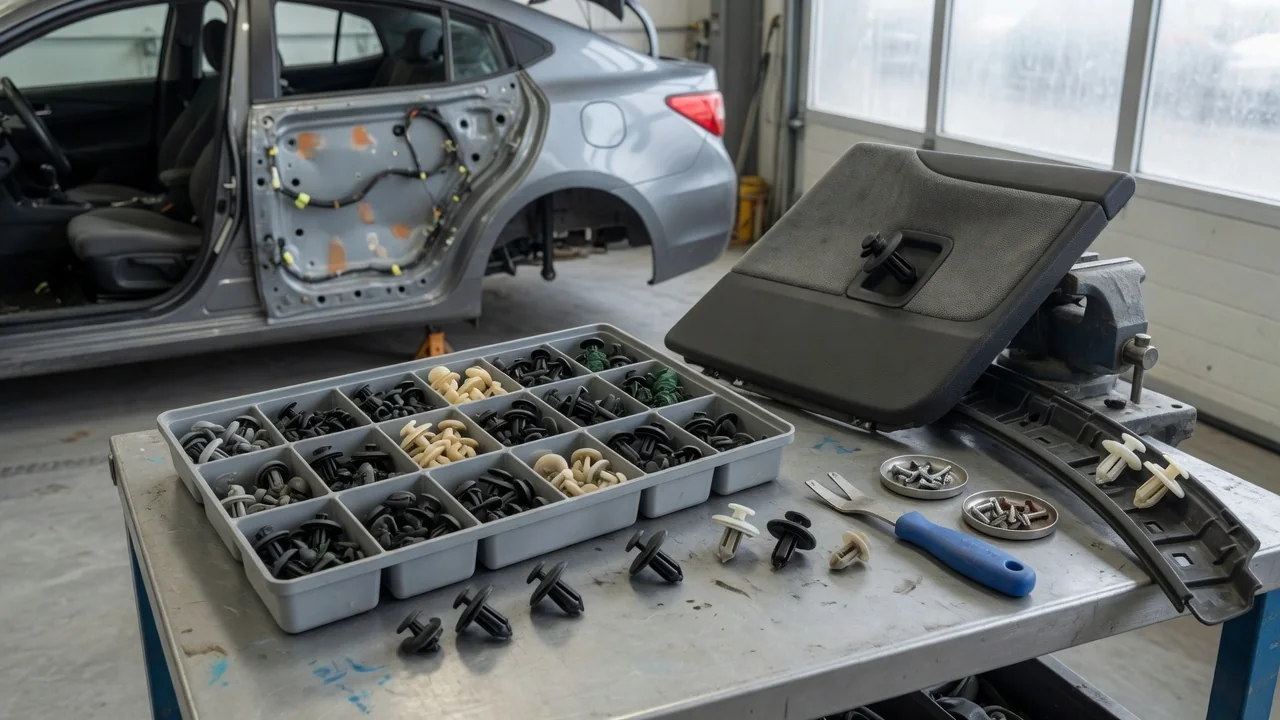
A trim clip assortment is a boxed collection of the plastic and metal fasteners that hold interior panels, bumper covers, fender liners, splash shields, and exterior moldings to a car's body. Its purpose is simple: when a clip breaks during removal or turns out to be missing, you can replace it on the spot instead of reinstalling a panel with gaps or waiting for a single part. Understanding clip types, fit, and retention helps you get real value from one.
Clip types
Most car trim clips repair kits group fasteners into compartments by style and size. The most common style is the push-type retainer, often called a fir-tree or Christmas-tree clip. It has a ribbed stem with flexible fins that fold as the stem passes through a hole and then spread behind the panel to resist pulling out. These are widely used for interior trim, carpet edges, insulation, and some exterior covers where the panel rarely needs to come off.
Two-piece push rivets are another staple. They consist of an outer body and a center pin. With the pin raised, the body slides into the hole; pressing the pin flush spreads the legs of the body behind the panel. Lifting the pin with a forked tool relaxes the legs so the rivet can be removed and often reused. Screw-type rivets work in a similar way, except the threaded center is turned rather than pushed. These styles are common on fender liners, splash shields, radiator covers, and bumper edges.
Assortments frequently include door panel clips as well. These typically have a broad head that slides into a slot on the back of the panel and a tapered stem that snaps into the door frame, and some carry a foam or rubber washer that seals and damps vibration. Depending on the kit, you may also find molding clips, metal spring nuts or U-clips, edge clips, and wiring or hose retainers. The mix varies between kits, so the label on the box is the best guide to what a particular assortment actually covers.
Fit
A clip fits correctly only when several dimensions match the application. The first is hole size and shape. Round holes take round stems, while square or rectangular holes need stems designed for them; a round clip in a square hole may spin or work loose. Hole diameter is usually the size printed on assortment compartments, and it should be measured at the hole the stem actually has to grip.
The second dimension is grip range, meaning the combined thickness of the materials the clip must clamp. A push rivet sized for a thin sheet-metal flange may not spread fully behind a thicker plastic bracket, while one made for a thick stack can sit loose on thin metal. Stem length matters for the same reason. Head diameter and shape then determine whether the clip covers the panel hole and sits flush, or whether it pulls through or looks out of place on a visible surface.
The most reliable way to choose a replacement is to compare it with an intact original from the same location, or to measure the hole and material thickness with calipers. When the original part number matters, the vehicle's service manual or parts catalog is the authoritative source, because clip dimensions vary by manufacturer and even by location on the same vehicle. A clip that has to be forced or hammered in, or one that drops through with little resistance, is a sign the size is wrong.
Panel retention
Retention is a clip's ability to keep a panel pressed in place and resist the forces trying to pull it away. Those forces include vibration, expansion and contraction with temperature changes, airflow at speed on exterior parts, water spray on liners and shields, and people pulling on door panels and armrests. A clip resists them through mechanical interference: fins that catch behind a hole edge, legs spread by a center pin, or a spring steel tab that bites into a stud or flange.
Panels are usually held by several clips working together, often combined with screws, hooks, or tabs molded into the panel itself. Each clip carries only part of the load, so when one breaks or goes missing, the neighboring clips take more strain and the panel may begin to rattle, gap at the edges, or creak. On door panels and splash shields, a missing or poorly sealing clip can also let water, road spray, or wind noise reach places they normally would not.
Plastic clips lose holding force over time. Fins can take a permanent set after repeated removal, heat cycling can make some plastics brittle, and prying at an angle tends to snap heads or leave the stem stuck in the hole. This is why many clips, particularly single-piece push retainers, are generally treated as one-use parts, and why fresh replacements usually restore a tighter, quieter fit than reused, fatigued originals.
Practical implications and limits
For home workshop jobs, the main value of an assortment is continuity. Removing a door card to reach a window regulator, pulling a fender liner to access a headlight, or dropping an undertray for an oil change can all break clips, and having replacements on hand means the panel goes back on complete. A plastic trim removal tool and a forked clip puller reduce breakage, and restocking the compartments you use most often helps avoid running short in the middle of a job.
An assortment also has clear limits. It covers common generic sizes, not every fastener a given vehicle uses, and some clips are shaped or color-matched for one specific location. Generic clips can differ from original parts in plastic quality and tolerances, which may affect long-term grip or sealing. Where trim sits near airbags, seat belt anchors, or wiring, follow the service manual's procedure and fastener requirements rather than substituting the closest-looking clip. Treat the kit as a practical stock for routine repairs, and source the specific part when no compartment is a true match.