What Is a Tire Carcass? Structure, Load Support, Flex, and Damage
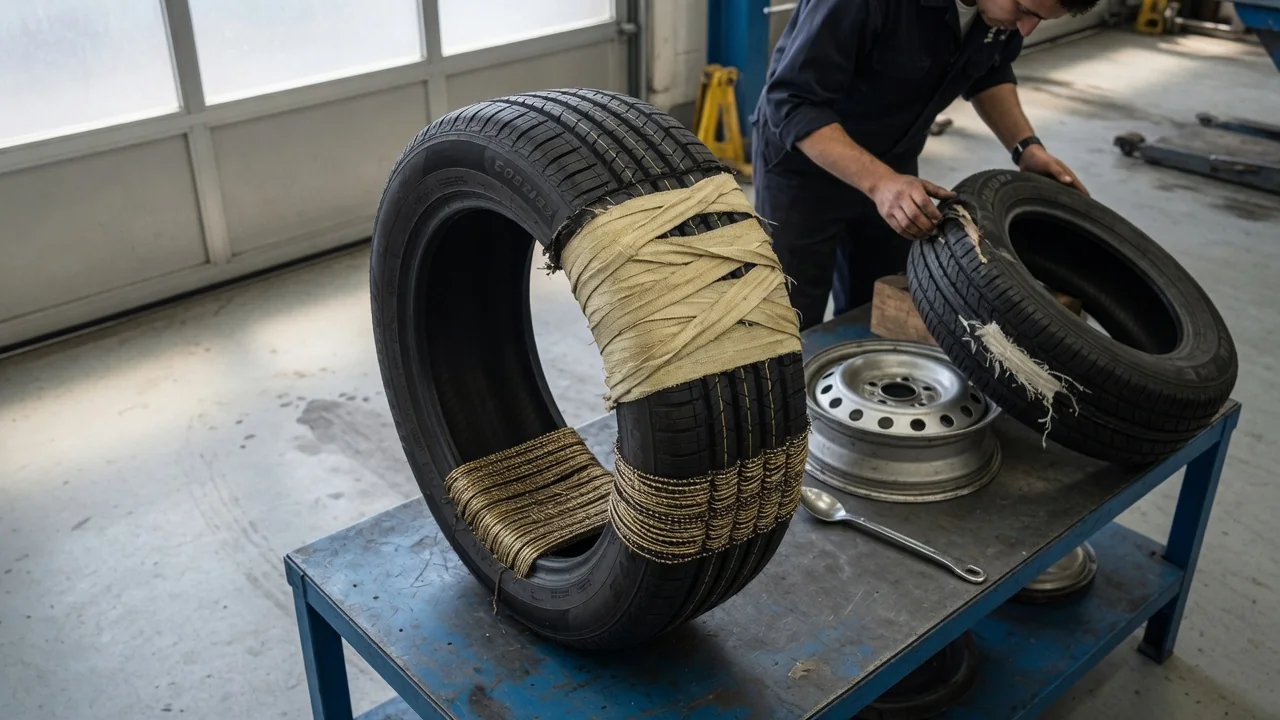
A tire carcass is the structural body of a tire. It is made of layers of fabric or steel cords coated in rubber that run from one bead to the other and give the tire its shape and strength. The tread, belts, and outer sidewall rubber are built on top of it. Knowing how car tire carcass structure works explains how a tire carries a heavy vehicle, why it flexes the way it does, and why certain kinds of damage mean the tire has to be replaced.
Load Support: How the Carcass Holds Up the Vehicle
The carcass is built from one or more body plies. Each ply is a sheet of parallel cords embedded in rubber. In a modern radial passenger tire, the cords run across the tire from bead to bead, roughly at a right angle to the direction of travel, which is where the word radial comes from. Textile cords such as polyester are common in passenger tires, while steel cord carcasses are typical of heavy commercial truck tires. At each edge, the ply wraps around the bead, a bundle of high-strength steel wire that anchors the carcass and seals the tire against the wheel rim. On the inside, an air-retaining inner liner lets a tubeless tire hold pressure. In radial tires, steel belts sit on top of the carcass under the tread to stabilize the tread surface. The belts are often treated as a separate component, although the word casing is sometimes used for the whole structure underneath the tread.
Air pressure does much of the work of carrying the load, but only because the carcass contains it. Inflation puts the ply cords under tension, much like the fabric of an inflated structure. When the vehicle's weight presses the tire against the road, the cords in the sidewall near the contact patch lose some of that tension, while cords around the rest of the tire stay tensioned. The load is then transferred through the cords to the beads and into the wheel. Because the carcass contains the pressure and distributes these forces, the strength of its cords and the quality of the bond between cord and rubber directly limit how much load the tire can safely carry.
This is why a tire's rated load capacity depends on both its construction and its inflation pressure. Tires designed for heavier loads, such as reinforced, extra-load, or light-truck types, use carcass constructions intended to tolerate higher pressures and greater forces. The load index on the sidewall summarizes that capacity under defined conditions. It is not a measure of carcass strength alone; it describes the tire as a complete system.
Flex: Why the Carcass Must Bend Without Breaking
A rolling tire is constantly deforming. Each section of the carcass flattens as it enters the contact patch and springs back as it leaves, once per wheel revolution, which adds up to an enormous number of flex cycles over a tire's life. The carcass has to be stiff enough to keep the tire stable and responsive, yet flexible enough to absorb bumps and keep the tread in contact with the road. How the plies are arranged largely sets that balance. In a radial design, the sidewalls can flex fairly independently while the belts keep the tread flat and steady. In older bias-ply construction, the plies cross each other at an angle, so the sidewall and tread move together more, which generally produces more internal friction and tread squirm.
Flexing also generates heat. Rubber does not return all of the energy used to deform it; part of that energy becomes heat, a property called hysteresis, and it is also a main source of rolling resistance. Under normal conditions, the tire sheds this heat as it runs. When a tire is underinflated or overloaded, the carcass deflects more with each revolution, and heat builds faster than it can escape. Sustained high temperatures weaken the rubber and the adhesion between rubber and cords. Overinflation causes the opposite problem: the carcass flexes less, the ride gets harsher, the contact patch can shrink, and the tire is less able to absorb a sharp impact.
Sidewall height affects how much room the carcass has to flex. Tires with a low aspect ratio have short sidewalls, which can sharpen steering response, but they leave less space between the road and the wheel rim. That gives the carcass less margin to absorb a hard hit before the tire is pinched against the rim.
Damage: What Harms the Carcass and How It Shows
Impact damage is one of the most common carcass injuries. When a tire hits a pothole, curb, or debris hard enough, the sidewall can be pinched between the object and the rim, and some ply cords break even if the outer rubber looks intact. With those cords gone, inflation pressure pushes the rubber outward and forms a bulge or bubble on the sidewall. A bulge means the structure has failed in that spot. The tire should be replaced, not repaired, because the reinforcement that contains the air pressure is no longer complete there.
Driving on a tire that is badly underinflated or flat damages the carcass from the inside. The sidewall flexes far beyond its design range, which creates heat and friction that can break down the inner liner and the ply structure. Signs can include rubber dust or crumbling inside the tire, or a creased or discolored band around the inner sidewall. These signs are usually visible only after the tire is removed from the wheel. Repeated overheating and fatigue can also cause separation, where layers of the tire begin to come apart internally.
Other threats include cuts deep enough to reach or expose the cords, bead damage from improper mounting, and punctures in the sidewall or shoulder. Common industry repair practice generally limits puncture repairs to the central tread area, because the flexing sidewall and shoulder zones cannot reliably hold a repair. Age, sunlight, and ozone exposure can also crack the rubber over time. Deep cracking may let moisture reach the internal cords, and in steel components this can lead to corrosion.
Practical Implications and Limits
For everyday driving, the most useful habit that protects the carcass is keeping the correct inflation pressure. The right figure is the vehicle manufacturer's recommended pressure, usually printed on a placard in the driver's door jamb or in the owner's manual. It is not the maximum pressure molded into the tire sidewall. Pressure is best checked when the tires are cold, and checked regularly, because tires slowly lose air even without a puncture. When buying replacement tires, choose a load index and speed rating that meet the vehicle maker's specification, so the carcass is suited to the weight and use it will see.
A visual check has real limits. Looking at the outside of a tire can catch bulges, deep cuts, exposed cords, and severe cracking, but much carcass damage stays hidden. After a hard impact, or after any distance driven on a very low or flat tire, have a tire professional remove the tire and inspect it from the inside. A new vibration, pull, or thumping sound that appears after such an event is also worth checking, since these can point to internal separation. On the other hand, a light surface scuff on the sidewall does not necessarily mean the structure is compromised. A professional assessment settles questions an owner cannot judge from outside.
This explanation covers general principles. Ply count, cord materials, bead design, and sidewall construction vary from one tire design and manufacturer to another, so the exact behavior of a given tire depends on its specific construction and on the vehicle it is mounted on. For guidance on a particular tire, consult the tire manufacturer's information and the vehicle's owner's manual. In commercial trucking, a sound carcass can sometimes be retreaded and used for further service, which shows how much of a tire's long-term value depends on its structure. Passenger car tires are rarely handled this way, so for most drivers, protecting the carcass simply means making the original tire last safely.