What Is a Subframe in a Car?
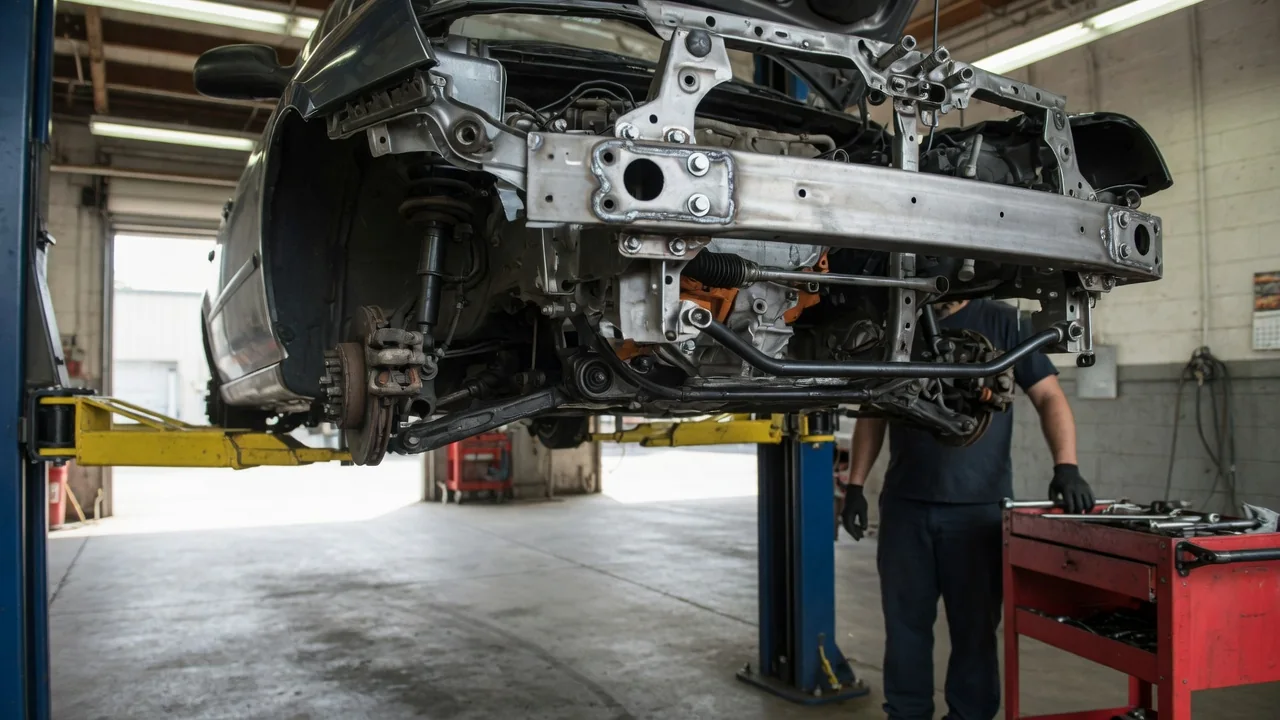
Anyone asking what is a subframe in a car is really asking how a modern unibody vehicle carries its heaviest working parts. A subframe is a separate steel or aluminum structure bolted beneath the body shell, supporting the engine, transmission, steering gear, or suspension. It spreads concentrated loads into the body and helps keep road and powertrain harshness away from the cabin.
Location
On most unibody cars, the front subframe sits low beneath the engine bay, spanning the width of the vehicle between the front wheels. Looking up from under the bumper, it usually appears as a stamped or tubular cradle, sometimes shaped like a rectangle or a letter K, passing under the engine and transmission. Lower control arms, the steering rack, and the stabilizer bar often attach directly to it, which is why some manufacturers call it an engine cradle or front crossmember.
Many vehicles also carry a rear subframe, located beneath the trunk floor or rear seat area. On cars with independent rear suspension, it holds the control arms and links, and on rear-wheel-drive or all-wheel-drive models it frequently supports the differential as well. Layouts differ considerably between makes. Some compact cars with a simple twist-beam rear axle have no rear subframe at all, while traditional body-on-frame trucks rely on a full-length ladder frame instead.
Mounts
A subframe attaches to the body at several points, typically four or more, using large bolts that thread into reinforced areas of the floor structure or frame rails. Some designs bolt the subframe rigidly, metal against metal, which keeps suspension geometry very precise and sharpens steering response. Others place rubber or hydraulic bushings between the subframe and body, allowing a small, controlled amount of movement. The choice reflects whether the manufacturer prioritized handling precision or ride refinement.
The subframe also serves as a mounting platform for other components. Engine and transmission mounts commonly rest on it, so the powertrain's weight and torque reaction pass through the subframe before reaching the body. Suspension pickup points are welded or machined into it at carefully controlled positions, because their location determines wheel alignment. Since the position of those points matters so much, a subframe that has shifted on its mounting bolts can change alignment angles even when no suspension part is bent.
Vibration
One major reason engineers use a subframe is isolation. An engine produces vibration as it runs, and tires transmit constant impacts from the road surface. If those forces fed straight into thin body panels, the cabin would hum and boom. Routing them first through a stiff subframe, and then through bushings into the body, gives two stages of filtering. The powertrain mounts absorb part of the energy, and the subframe bushings absorb more before it reaches occupants.
As those bushings age, the rubber can crack, soften, or separate from its metal sleeve, and the isolation weakens. Drivers may then notice a dull clunk when accelerating from a stop, braking firmly, or crossing a speed bump, along with more drone or shudder through the floor. These symptoms overlap with worn engine mounts, control arm bushings, and stabilizer links, so the noise alone does not identify the cause. A hands-on inspection is needed to separate one source from another.
Everyday Use and Observations
In normal driving a subframe needs no attention and does its job unnoticed. It does, however, sit low and exposed, so it is vulnerable to curb strikes, deep potholes, road debris, and corrosion in regions where road salt is used. Rust tends to gather around seams, drain holes, and mounting points where moisture is trapped. When the car is raised for an oil change or tire rotation, a glance at the subframe for heavy scale, dents, or fresh scrapes is worthwhile.
Changes in how the car drives can also point toward this area. A steering wheel that sits off-center after an impact, a pull to one side, uneven tire wear, or an alignment that will not hold within specification may indicate a shifted or distorted subframe. Vague steering or a rear end that feels as though it steers itself over bumps can suggest worn bushings. Lifting the car by the subframe is acceptable only where the owner's manual identifies it as an approved jacking point.
Limits and Next Steps
What an owner can judge from the driveway is limited. Surface rust looks alarming but may be cosmetic, while serious perforation can hide above a splash shield or inside a boxed section. A bent subframe is often impossible to see without measuring equipment, and shops typically confirm it by comparing alignment readings and reference dimensions against the manufacturer's data. Whether a given car uses rigid or bushed mounting, and which components the subframe carries, should be checked in vehicle-specific service information.
Because the subframe supports the powertrain and locates the wheels, work on it is best left to a qualified shop. Lowering or replacing one requires proper support of the engine, correct fastener replacement and tightening values, and usually a wheel alignment afterward. Anyone noticing persistent clunks, steering changes after an impact, or heavy corrosion underneath should arrange a professional inspection. Checking for open recalls is also sensible, since manufacturers have at times addressed subframe corrosion or fastener concerns through campaigns.