What Is a Seat Belt Pretensioner?
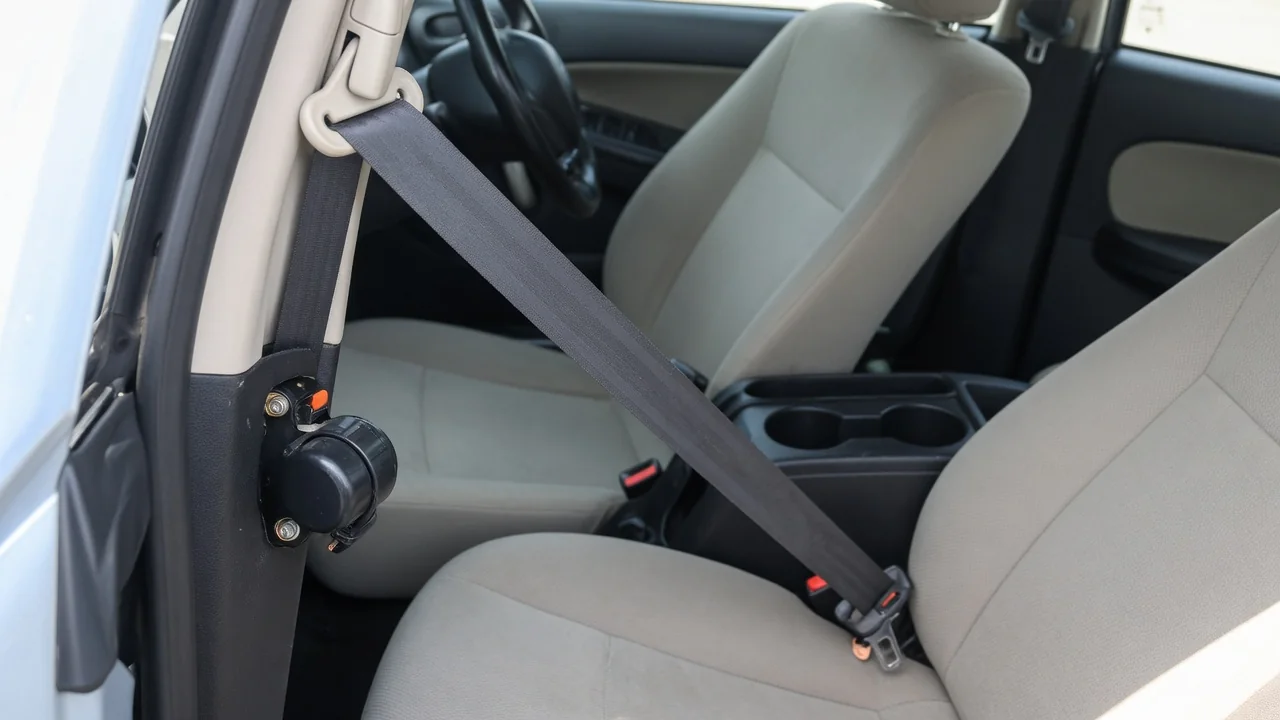
What is a seat belt pretensioner? It is a device built into the seat belt assembly that rapidly removes slack from the webbing when the vehicle's restraint system detects certain crash events. By drawing the belt snug against the occupant early in a collision, it helps the belt do its job sooner. How it behaves depends on the vehicle, the crash and the system design.
Trigger concept
A pretensioner does not react to ordinary braking or a sharp turn. It waits for a signal from the restraint control module, which monitors crash sensors measuring sudden deceleration or impact. When the module judges that an event meets its programmed criteria, it sends an electrical command to the pretensioner. In many designs that command ignites a small pyrotechnic charge, and the resulting gas pressure drives a mechanism that winds the retractor or pulls the buckle downward, taking up loose webbing in a fraction of a second.
Whether the device fires in a given collision is a decision made by the vehicle's software, not a guarantee. A low-speed parking bump may not meet the threshold, while a moderate frontal impact might. Some vehicles also consider side impacts, rollover sensing or whether the belt is buckled. Other designs use an electric motor that can tighten the belt reversibly before an anticipated impact, such as during emergency braking. Because these strategies differ between manufacturers and model years, the owner's manual is the best description of a particular vehicle.
Relation to airbag system
Pretensioners belong to the supplemental restraint system, the same network that controls the airbags. They typically share the control module, crash sensors, wiring and the warning lamp on the instrument panel. The two devices are meant to work in sequence: the belt tightens to position the occupant and manage early forward movement, and the airbag then cushions the head and chest. An occupant held properly against the seat generally meets an inflating airbag at a better distance than someone who has slid forward with a slack belt.
The two do not always deploy together, however. A module may fire the pretensioners without inflating any airbag, or deploy different combinations depending on impact direction and severity. Many belts also include a load limiter, which lets a controlled amount of webbing pay out after tightening to reduce pressure on the chest. Because of the shared circuitry, a fault in a pretensioner circuit usually lights the airbag warning lamp. A stored code points to a circuit worth testing; it does not prove the pretensioner itself has failed.
Replacement context
A pyrotechnic pretensioner is a single-use device. Once the charge has fired, the mechanism cannot be reset, and the belt may feel locked, unusually tight or unwilling to retract. After a collision in which the restraints deployed, manufacturers commonly call for replacing the affected belt assemblies, and some specify additional inspection or replacement of related components. Which parts are involved depends on whether the pretensioner sits in the retractor, the buckle or the lower anchor, and that layout differs from one vehicle to another.
Replacement is not casual driveway work. An unfired unit contains a live charge that can deploy if handled or tested incorrectly, so service information lays out specific precautions that trained technicians follow. Parts are usually matched to the seating position and vehicle, and the control module may need attention after a crash before the warning lamp will clear. Anyone buying a previously damaged vehicle should ask for documentation showing that deployed restraint components were replaced with correct parts rather than simply bypassed or left in place.
Everyday Use and Observations
In daily driving a pyrotechnic pretensioner is invisible. The belt pulls out, retracts and locks under hard braking exactly as a conventional belt does, because that familiar locking action comes from the retractor's inertia mechanism, not the pretensioner. Drivers of vehicles with motorized pre-crash belts may notice something different: a brief, firm tug during sudden braking or an evasive maneuver, followed by a release when conditions return to normal. That behavior is typically described in the owner's manual and is not a sign of trouble.
The most useful everyday check is the airbag warning lamp. It should illuminate briefly at startup as the system runs a self-test and then go out. A lamp that stays on, flashes or never lights suggests the system has found a problem, and pretensioners may not operate as designed until it is diagnosed. Good belt habits matter too: wearing the lap portion low across the hips, keeping the shoulder belt flat on the chest, and avoiding bulky clips or seat-back recline that add slack the device would have to remove.
Limits and Next Steps
A pretensioner improves how a belt performs; it cannot make any crash survivable or prevent every injury. It removes only a limited amount of slack, so it cannot compensate for a badly routed belt, an occupant leaning far out of position or a belt that is not buckled at all. Its effect also depends on crash type and severity, seating position and occupant size. Not every seat has one, either; rear seats and older vehicles may be equipped differently, which is another detail to confirm for the specific vehicle.
If the warning lamp is on, a belt will not retract or latch normally, or the vehicle has been in a collision, the sensible next step is a professional inspection with a scan tool capable of reading restraint system data. Fault codes in this system are often manufacturer-specific, so their meaning should be confirmed against information for that exact vehicle before any part is ordered. Checking for open safety recalls is also worthwhile, since restraint components are occasionally subject to them. Until the system is verified, treat the protection as uncertain.