What Is a Parking Stop and Why Does Clearance Matter?
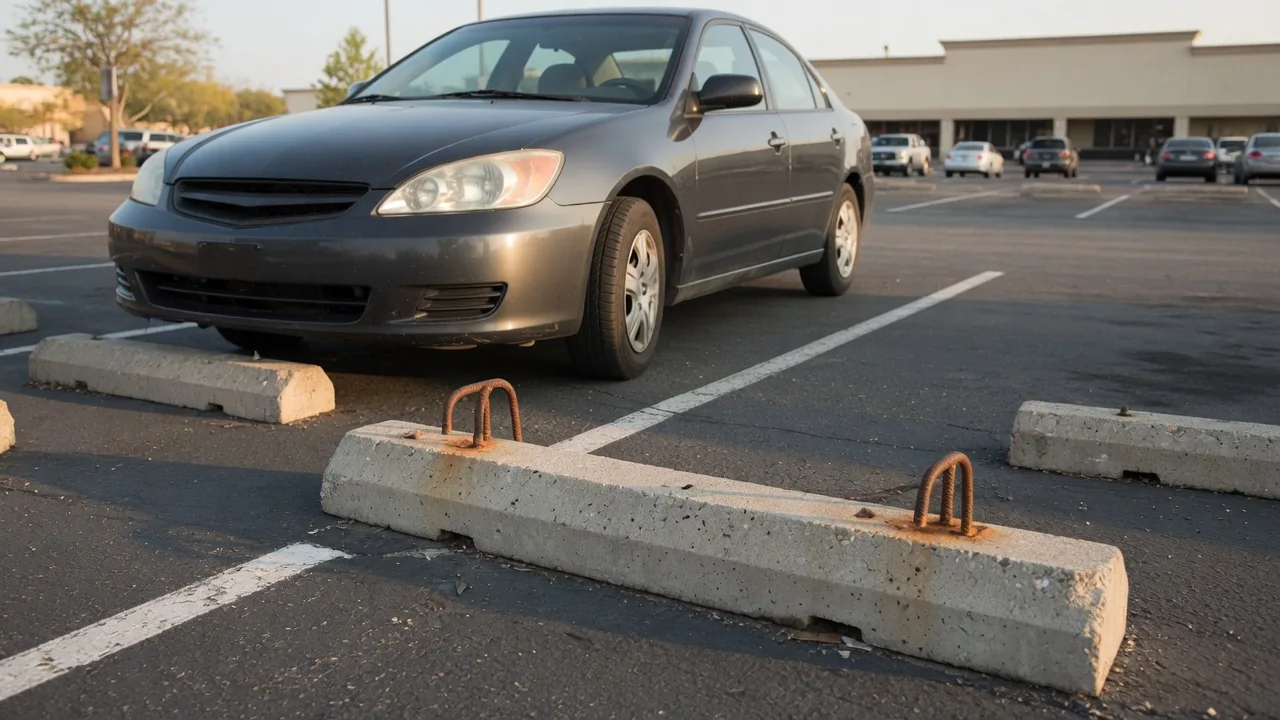
A parking stop, also called a wheel stop or curb stop, is the low concrete, rubber, or plastic block set at the head of a parking space to keep vehicles from rolling too far forward. Understanding what a parking stop is and why clearance matters helps drivers avoid scraped bumpers, cracked air dams, and damaged underbody panels during an otherwise routine maneuver.
Front overhang
Front overhang is the portion of the body that extends ahead of the front axle centerline. A parking stop is meant to meet the tires, but the bumper cover, lower valance, and any splitter reach the block before the wheels do. If the lowest point of that overhang sits closer to the ground than the top of the block, the bodywork strikes or rides over the stop before the tires ever touch it. A long nose combined with a low ride height makes this contact more likely.
Vehicle details vary widely. Sports cars, sedans with aerodynamic air dams, and vehicles on lowered suspension typically carry less clearance beneath the nose, while many trucks and crossovers sit higher and clear most blocks easily. Drivers can check this by crouching beside the front wheel and comparing the lowest edge of the bumper with a nearby stop. Flexible rubber air deflectors may bend and recover, but rigid painted covers, fog lamp housings, and undertrays tend to scrape, crack, or pull loose from their fasteners.
Tire contact
In the intended scenario, the front tires roll gently against the face of the stop, and the driver feels a soft but firm resistance through the car. That tire contact signals that the vehicle has reached the end of the space. Tread and sidewall tolerate a slow touch well, since rubber flexes against the block. Trouble begins at higher speed, because the tire can climb the stop, letting the vehicle drop over it and bringing suspension components and underbody panels down onto the block.
What a driver notices depends on tire and wheel dimensions. A tall sidewall cushions the touch, while a low-profile tire on a large wheel gives a sharper bump and leaves the rim closer to the block. Stops differ too: some are low and rounded, others taller with square edges, and older concrete ones may be chipped, shifted, or showing exposed anchoring pins. Waiting for tire contact as a stopping cue only works when the bodywork ahead of the wheels clears the block, which is not guaranteed on every vehicle.
Safer positioning
The simplest protection is stopping short. Many drivers of low cars halt with the nose just behind the block rather than pulling in until the tires touch, using the painted lines, a side mirror reference, or neighboring vehicles as a guide. Approaching at walking pace matters as much as distance, because a slow roll gives time to react to a scraping sound and limits the force if contact occurs. Backing into the space is another option, although rear bumper and exhaust clearance deserve the same attention.
Parking aids help but have blind spots. Front sensors and cameras, where fitted, may not register an object as low as a wheel stop, and coverage differs between manufacturers, so the owner's manual is the right reference for what a given system detects. Leaving matters as much as arriving. If the nose has passed over the block, a bumper lip can hook on it when reversing out, sometimes pulling the cover away from its mounts. Reversing slowly and pausing at any resistance reduces that risk.
Everyday Use and Observations
Daily conditions change clearance more than most people expect. A full load of passengers or cargo compresses the suspension, braking pitches the nose downward, and a space that slopes toward the stop tilts the bumper closer to the block. Snow, leaves, or standing water can hide a stop entirely, and in dim garages a gray block blends into gray pavement. Stops placed in front of a raised sidewalk add a second hazard, because the nose may clear the block yet meet the taller curb behind it.
Evidence of past contact is easy to spot once you know where to look. Scuffed paint or gouged plastic along the bottom edge of the bumper, a sagging splash shield, missing push clips, or a lower panel that flaps at highway speed all point toward a scrape. A grinding or dragging sound while pulling in or backing out is the most immediate clue. Some vehicles with adjustable air suspension offer a raised setting for such situations, though availability and operation depend on the model.
Limits and Next Steps
A visual check after contact only reveals so much. Scratches on a bumper cover are often purely cosmetic, but a hard hit may also affect parts hidden behind it, such as mounting brackets, sensors, grille shutters, or coolers positioned low in the nose, and their placement differs by vehicle. Fresh fluid spots beneath the car, a new warning light, a pull in the steering, or a vibration after climbing over a stop are reasons to quit guessing and have the vehicle examined.
General guidance cannot tell you how much room your particular vehicle has, since ride height, bumper design, and stop dimensions all vary, and parking stops are not built to one universal size. The practical next step is learning your own car's low points and treating unfamiliar lots with caution. If damage is suspected, a qualified technician can raise the vehicle on a lift and inspect the underside properly, which is far safer than crawling beneath a car on a jack. Loose panels are worth securing before they tear further.