What Is a Fuse Box in a Car?
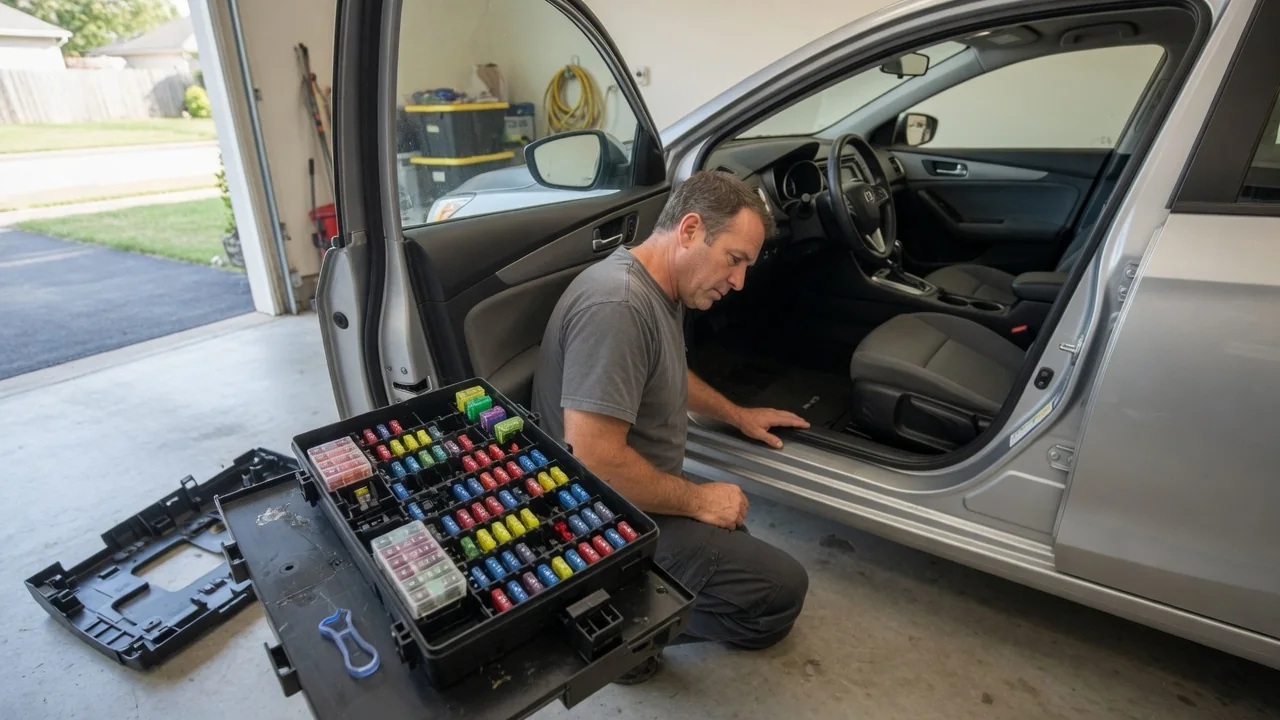
Drivers who ask what is a fuse box in a car are usually dealing with something that suddenly stopped working. The fuse box is a housing that groups the protective devices for the vehicle's electrical circuits, so a wiring fault in one system cannot overheat a harness or take down everything else. Understanding how it works makes small electrical problems far less mysterious.
Fuses and relays
A fuse is a deliberately weak link. Inside its plastic body sits a thin metal strip sized to carry a specific current, and if a circuit draws more than that, the strip melts and opens the circuit before the wiring can overheat. Each fuse is matched to the wire gauge and the load it protects, which is why a power outlet, a wiper motor, and a radio typically sit on separate fuses with different amperage ratings printed on top.
Relays share the same box but do a different job. A relay is an electrically operated switch that lets a small control current, from a dashboard switch or a control module, turn on a much larger current for a demanding load such as a cooling fan, fuel pump, or headlamps. Relays look like small cubes, noticeably bigger than the blade fuses around them. Many vehicles have more than one box, commonly one under the hood and another inside the cabin, though locations differ by manufacturer.
Diagram
The diagram is the map that makes the box usable. It is often molded or printed on the inside of the cover, and the owner's manual usually repeats it with fuller descriptions. Each position is labeled with a number, an abbreviation or symbol for the circuit, and the amperage that belongs there. Because abbreviations can be cryptic, the manual's legend is worth checking before assuming that a label refers to the component you have in mind.
Layouts are not interchangeable between vehicles, and they can change between model years, trim levels, and markets of the same model. A position that feeds heated seats on one version may be empty on another that lacks the option, so blank slots are normal. Blade fuse bodies are generally color-coded by rating, which gives a quick visual cross-check against the diagram, but the number stamped on the fuse and the value listed for that position are what count when the two seem to disagree.
Safe replacement
Replacing a blown fuse is one of the few electrical tasks many owners handle themselves, and the rule that matters most is matching the rating. The replacement should be the same type and the same amperage that the diagram specifies for that position. With the ignition off, the suspect fuse can be removed, often with a small plastic puller clipped inside the box, and inspected; a broken or burned strip visible through the body indicates it has opened.
Fitting a higher-rated fuse to stop repeated blowing defeats the protection. The wiring was sized for the original rating, so a larger fuse lets the wire itself become the weak link, and overheated insulation can damage a harness or start a fire. Bridging a fuse with foil or wire is worse for the same reason. A lower rating is not dangerous in that way, but it tends to blow under normal load and tells you nothing useful about the fault.
Everyday Use and Observations
In daily driving the fuse box does nothing visible, and most owners only think about it when one feature goes dead. The pattern of the failure is a helpful clue. When a single item such as the power outlet, interior lamps, or horn quits completely while everything else works, its fuse is a reasonable first check. When several unrelated features fail together, they may share a fuse or relay, or the cause may lie upstream in a ground, connector, or power feed.
Some observations point elsewhere. A component that works intermittently or weakly is rarely a fuse problem, because a fuse is either intact or open. A click from the box when a system switches on is often just a relay operating normally. Plugging in an accessory that draws more than the outlet circuit was designed for is a common, harmless explanation for one blown fuse. Keeping a few spares of the ratings your vehicle uses is practical, and some boxes include spare positions for that purpose.
Limits and Next Steps
A fuse that blows is evidence, not a diagnosis. One failure after an obvious overload may never recur, but a replacement that blows again right away or within days signals a short circuit, chafed wiring, a seized motor, or a failing component drawing excess current. At that point more fuses will not help, and tracing the fault with a wiring diagram and a meter is work for a qualified technician. The same applies if warning lights and stored fault codes accompany the problem, since a code narrows the search rather than condemning a part.
Signs of heat at the box itself deserve prompt attention. Melted plastic around a fuse slot, discolored terminals, a burning smell, or moisture and corrosion inside the housing suggest a poor connection or water intrusion that a new fuse cannot cure. Modern vehicles also complicate matters, since some integrate the box with a control module and use electronically managed circuits or high-current fuses that are bolted in place. For those designs, and for hybrid or electric high-voltage systems, the vehicle's service information should guide what is done.