What Is a Dual-Clutch Transmission?
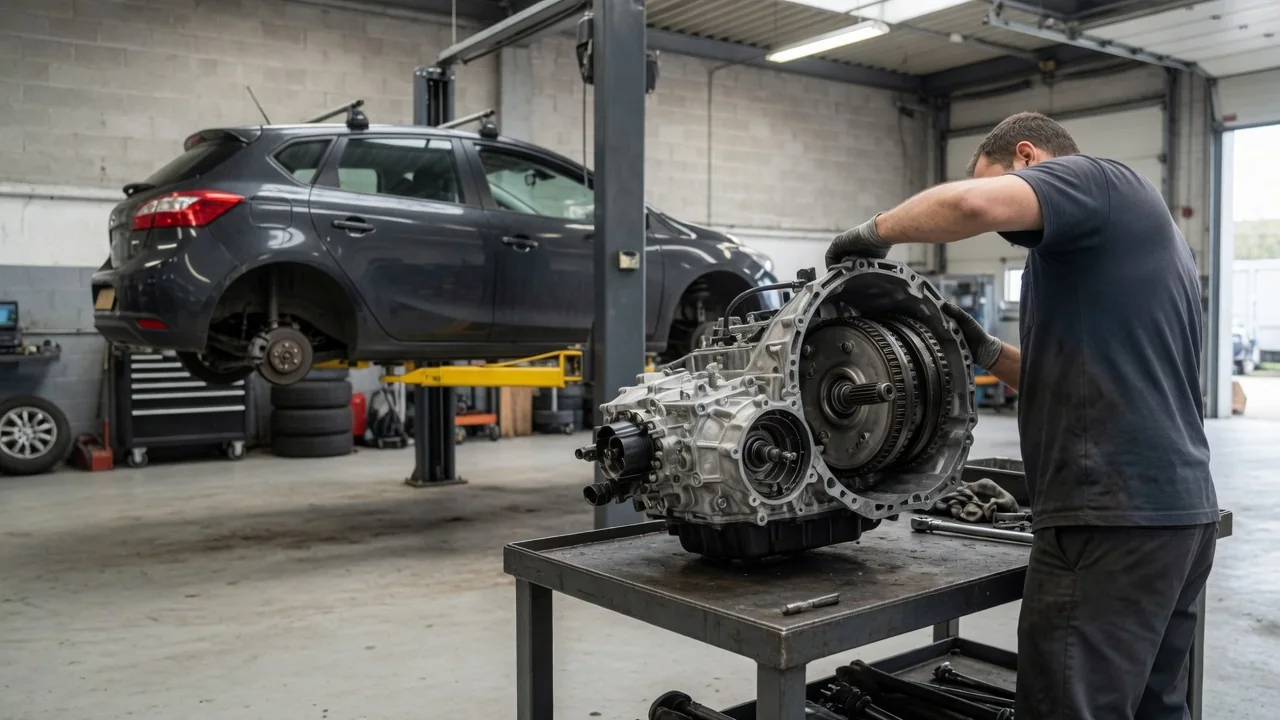
Drivers who ask what is a dual clutch transmission are usually trying to understand why a car shifts so quickly yet has no clutch pedal. The short answer is that it is an automated gearbox built like two manual transmissions sharing one housing, each with its own clutch. Computer-controlled actuators handle the clutch work and gear selection, so the driver simply steers, accelerates, and brakes.
Odd/even gears
The defining feature of a dual-clutch gearbox is how it divides the ratios between two input shafts. One shaft typically carries the odd gears, such as first, third, and fifth, while the other carries the even gears, such as second, fourth, and sixth. Each shaft connects to the engine through its own clutch. Reverse is assigned to one shaft or the other depending on the design, and the total number of forward gears differs from one manufacturer and model to the next.
This split lets the transmission prepare the next ratio before it is needed. While the car accelerates in third gear on the odd shaft, the control unit can already engage fourth on the even shaft, whose clutch is still open. The shift itself is then just a handoff: one clutch releases as the other closes, with very little interruption in power delivery. Drivers often notice this as a quick, crisp change where the tachometer needle drops almost instantly instead of sweeping down gradually.
Low-speed feel
At parking-lot speeds, a dual-clutch transmission behaves differently from a conventional automatic. A traditional automatic uses a torque converter, a fluid coupling that naturally lets the car creep forward smoothly. A dual-clutch unit has no such cushion in most designs, so the control software must slip a friction clutch to imitate that creep, much as a driver would feather the pedal in a manual car. The result can feel slightly hesitant or abrupt when pulling away gently from a stop.
Stop-and-go traffic tends to highlight this character. The gearbox may preselect second gear expecting acceleration, then need to return to first when the driver slows again, producing a brief pause or a mild shudder. Rolling back slightly on a hill before the clutch engages is also possible on vehicles without a hill-hold function. How noticeable these traits are depends heavily on the manufacturer's calibration, the clutch type, and software updates, so two cars with similar hardware can feel quite different.
Heat considerations
Because the clutches are friction devices, heat is the main stress they face. Every time a clutch slips, whether during a launch, a slow crawl, or holding the car on an incline with the accelerator, energy that is not moving the car turns into heat at the friction surfaces. Wet-clutch designs bathe the clutch packs in fluid that carries heat away, while dry-clutch designs rely on air and the surrounding metal mass, which generally gives them less tolerance for prolonged slipping.
Many vehicles monitor estimated clutch temperature and respond when it climbs. A driver might see a dashboard warning, feel the engagement become deliberately harsher to discourage slipping, or find the transmission temporarily limiting drive until things cool down. Heavy traffic on steep grades, repeated hard launches, and towing near the vehicle's limits are the situations most likely to trigger this. The exact warnings and protective strategies are model-specific, so the owner's manual is the right reference for what a given message means.
Everyday Use and Observations
In ordinary driving, most of the experience is positive and easy to recognize. Upshifts under moderate or firm acceleration arrive quickly with a continuous push forward, and downshifts for passing are usually prompt when the needed gear sits on the opposite shaft. Skipping several ratios at once, such as from sixth to second, can take a moment longer because the gearbox may need to change gears on both shafts. Many cars also offer paddle shifters or a manual gate for direct control.
A few habits help the hardware work as intended. Holding the car on a hill with the brake rather than balancing it on the accelerator avoids needless clutch slip. In slow traffic, leaving a small gap and then moving forward decisively is kinder than constant inching. Light mechanical clicks or whirring at low speed can be normal actuator and gear-selection sounds on some models, but they are worth noting if they change in volume or frequency over time.
Limits and Next Steps
A dual-clutch transmission is not automatically the best choice for every driver. Its strengths are efficiency and shift speed, since power flows through mechanical gears rather than a fluid coupling. Its compromises show up in low-speed refinement and in sensitivity to clutch wear and heat. Service needs also vary: some units require periodic fluid changes, some have separate fluids for the gears and the control hydraulics, and some need a clutch adaptation procedure after repairs. The maintenance schedule for the specific vehicle should guide those decisions.
When symptoms appear, such as persistent shudder, flaring engine speed during shifts, harsh engagement, or a warning light, a proper diagnosis matters more than assumptions. A stored fault code points a technician toward a circuit or condition to investigate; it does not by itself prove that a clutch, sensor, or control module has failed. Many transmission codes are manufacturer-specific and must be interpreted with vehicle-specific information. A qualified shop with the correct scan equipment can check software levels, adaptation values, and fluid condition before recommending parts.