What Is a Driveline Resonance? Speed, Frequency, and Service Basics
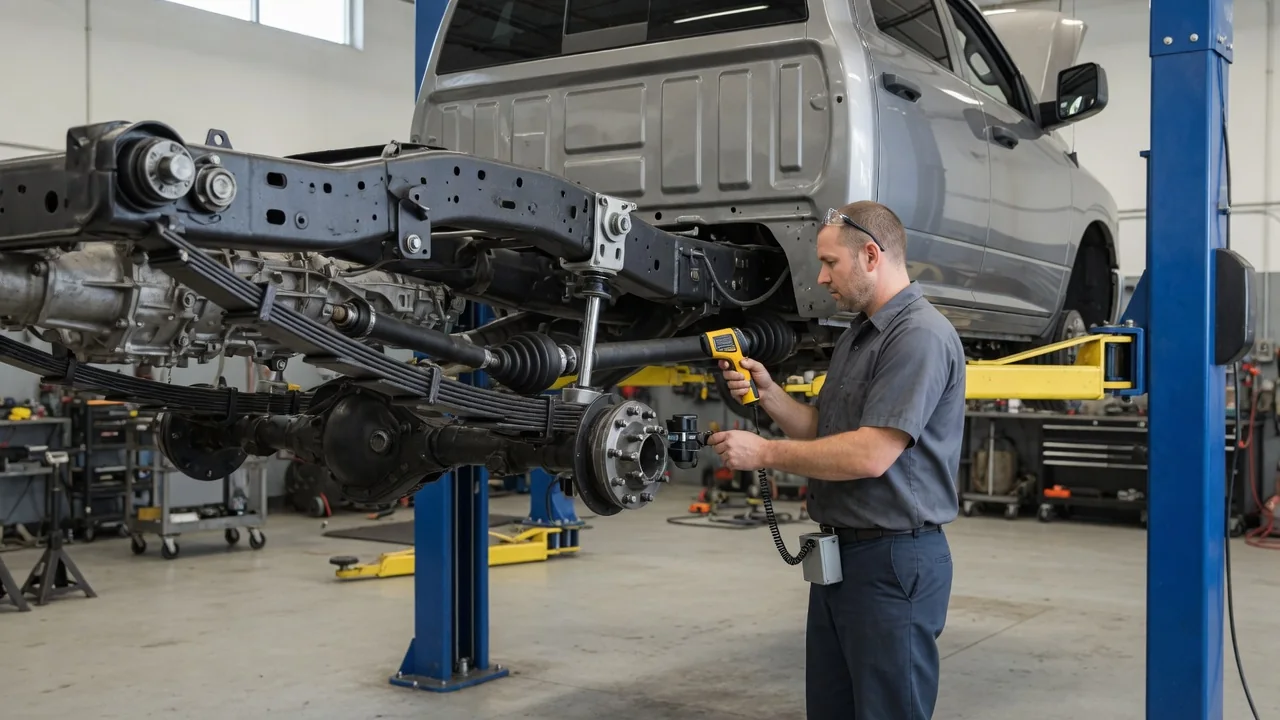
A driveline resonance is a vibration or noise that grows unusually strong when a rotating part of the powertrain spins at a speed whose vibration frequency matches a natural frequency of the driveline or the structure around it. Drivers usually notice it as a hum, boom, shudder, or buzz that appears in a narrow speed range and then fades. Understanding vehicle driveline resonance starts with how fast parts turn, what frequencies they produce, and what service can address.
Rotating speed: where the vibration energy comes from
The driveline includes everything that carries torque from the transmission to the wheels: the output shaft, driveshaft or propeller shaft, universal or constant-velocity joints, any center support bearing, the differential, the axle shafts, and finally the wheels and tires. Each of these turns at a speed tied to either engine speed or road speed. On a rear-wheel-drive or four-wheel-drive layout, the driveshaft speed follows road speed through the final drive ratio, so it changes with vehicle speed but not with the gear selected. Components ahead of the transmission output, such as the flywheel and clutch or torque converter, follow engine speed instead.
This distinction matters because a rotating part only excites vibration when something about it is uneven. A small mass imbalance, a slightly bent tube, runout at a flange, worn joint bearings, or a joint working at an unequal or excessive angle all turn steady rotation into a repeating push and pull. The faster the part spins, the more often that push arrives and, for imbalance, the stronger it becomes. Because torque load also changes how joints and mounts behave, the same road speed can feel different under acceleration, steady cruise, and coasting.
Frequency: why some speeds are worse than others
Every rotating disturbance has a frequency, which can be estimated by dividing the part's revolutions per minute by 60 to get revolutions per second, then multiplying by the number of disturbances per revolution. Engineers call that multiplier the order. An imbalanced driveshaft typically produces a first-order vibration, once per revolution. A conventional cross-type universal joint operating at an angle does not transmit perfectly uniform speed; its output speeds up and slows down twice per revolution, so joint angle problems tend to show up as second-order vibration. Engine firing pulses add their own orders that depend on cylinder count.
Separately, every structure has natural frequencies set by its stiffness and mass. A driveshaft has bending modes, the whole driveline has torsional modes as it twists between the engine and the tires, and the body, exhaust, and cabin air space have their own modes. Resonance occurs when a forcing frequency from the rotating parts lines up with one of these natural frequencies. At that point even a modest disturbance can be amplified considerably, which is why a car may be smooth at most speeds and then hum or shake through one band before calming down again as the frequencies move apart.
Mounts, bushings, center bearing supports, and dampers exist partly to shift natural frequencies away from common operating speeds or to absorb energy when they coincide. When those parts wear, stiffen with age, or are replaced with components of different stiffness, the frequency map of the vehicle changes, and a resonance that was once mild can become obvious.
Service: how driveline resonance is diagnosed and addressed
Diagnosis usually begins by deciding what the vibration follows. If it appears at the same road speed regardless of gear, and persists briefly when coasting in neutral, it points toward road-speed components such as the driveshaft, axle, wheels, or tires. If it tracks engine speed regardless of road speed, including when revving in park or neutral, the engine side, accessories, or exhaust are more likely sources. Noting whether the symptom changes with throttle, coast, or turning helps narrow the list further. Many shops use electronic vibration analyzers that read frequency directly and compare it with calculated component frequencies, which is far more reliable than judging by feel.
Once a likely source is identified, common checks include inspecting universal and constant-velocity joints for play or binding, examining the center support bearing and its rubber isolator, measuring driveshaft runout, verifying that balance weights are present, checking that slip yokes and multi-piece shafts are assembled in the correct phase, and inspecting engine, transmission, and exhaust mounts. On vehicles with adjustable suspension geometry or after ride-height changes, driveline operating angles and pinion angle are measured against the manufacturer's service information. Tire and wheel balance and runout are also worth confirming because they share road-speed frequencies with the axle.
Repairs then target the cause: replacing worn joints or bearings, rebalancing or replacing a damaged shaft, correcting angles with the method the manufacturer specifies, or renewing degraded mounts. In some cases a manufacturer issues revised parts or dampers for a known condition, so checking service bulletins for the specific vehicle is a sensible step.
Practical implications and limits
For owners, the most useful takeaway is that a vibration appearing only in a defined speed window is a clue rather than a verdict. Some degree of driveline resonance is inherent in any vehicle, and engineers tune the design so it stays below a noticeable level in normal use. A new or worsening symptom, however, often signals that something has changed: a part has worn, a modification has altered angles or mass, or a repair used components with different characteristics. Lift kits, lowering, larger or heavier tires, and aftermarket driveshafts are typical examples of changes that can move frequencies into a range the original design did not anticipate.
There are also limits to what general knowledge can tell you. The exact speeds, orders, and acceptable tolerances differ between vehicles and layouts, so only the manufacturer's service information and proper measurement can confirm a specific cause. Not every hum or shake is a resonance either; brake, tire, wheel bearing, and engine problems can produce similar sensations. Because worn driveline joints and supports can eventually fail and affect control of the vehicle, a persistent or growing vibration is best inspected promptly by a qualified technician rather than tolerated.