What Is a Coolant Expansion Tank?
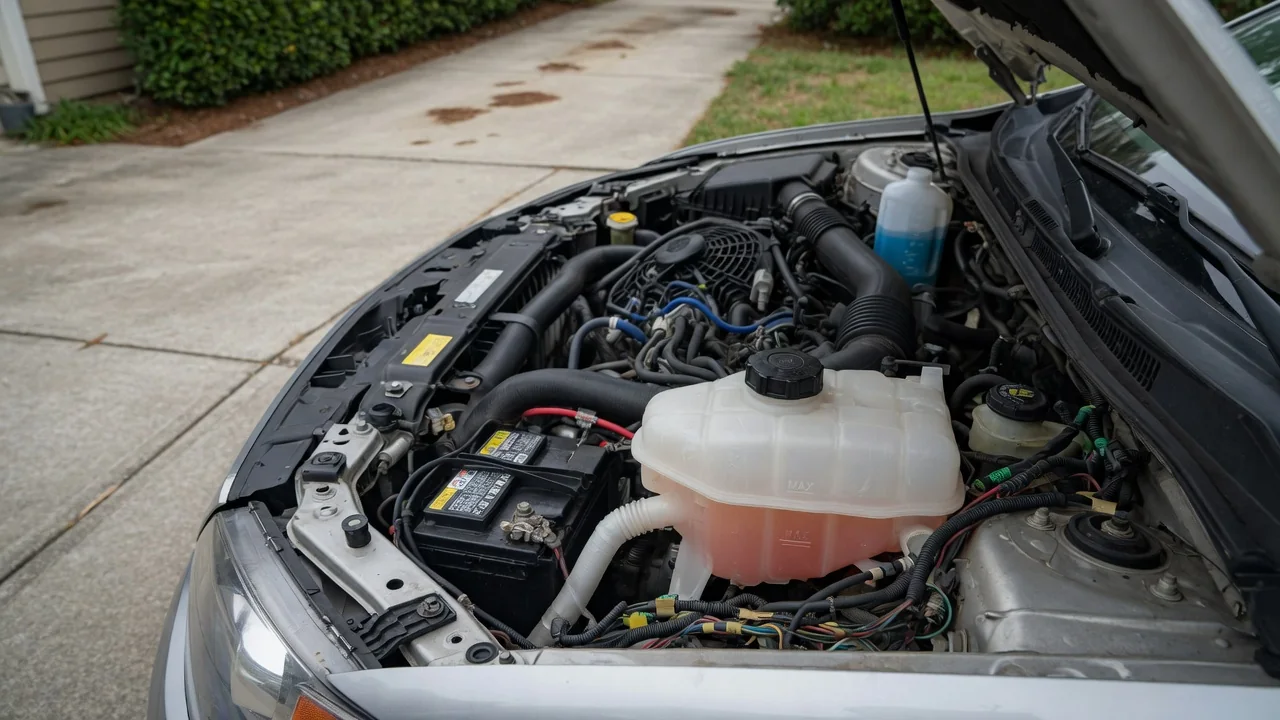
What is a coolant expansion tank? It is the reservoir, usually made of translucent plastic, that gives engine coolant somewhere to go as it heats up and grows in volume. Because coolant expands when hot and contracts as it cools, the cooling system needs spare room. This tank provides it while keeping the radiator and engine passages full of liquid rather than air.
Pressure and level
Coolant, a mix of water and antifreeze, takes up more space as its temperature climbs from a cold morning start to full operating temperature. In a sealed system that extra volume has to go somewhere, so the level in the expansion tank rises as the engine warms and falls again after shutdown. On many vehicles the tank is part of the pressurized circuit and carries the pressure cap itself; on others it is an unpressurized overflow bottle fed by a cap on the radiator.
Pressure matters because it raises the boiling point of the coolant, letting the engine run hot without the liquid turning to steam. The cap holds that pressure up to a set limit, then vents the excess, and it also lets coolant or air return as the system cools and pulls a slight vacuum. A driver can see the result as a level that sits higher when hot. Tank shape, cap location, and rated pressure differ by manufacturer, so the owner's manual is the reference.
Cold check
The markings molded into the side of the tank, often labeled minimum and maximum or cold and hot, are designed around the fact that volume changes with temperature. Checking the level when the engine is fully cold gives a consistent reading, because the coolant has contracted to its smallest volume. A level between the marks on a cold engine generally means the system has enough liquid to stay full once everything heats up and expands.
A cold check is also the safe one. Opening a cap on a hot, pressurized system can release scalding coolant and steam, so the cap should stay closed until the engine has cooled completely. Parking on level ground helps, since a slope tilts the liquid and skews the reading. Some tanks turn opaque with age or sit behind covers, and some vehicles rely on a level sensor and dashboard warning instead of visible marks, so the checking method varies.
Leak signs
Because normal expansion and contraction return the level to roughly the same cold mark each time, a level that keeps dropping between cold checks suggests coolant is leaving the system. External clues include a sweet smell after driving, colored puddles or drips beneath the front of the vehicle, and dried crusty residue in white, green, orange, or pink around hose joints, the cap, or the tank seams. The color depends on the coolant type the manufacturer specifies.
The tank itself can be a source. Plastic ages through repeated heat cycles and may develop hairline cracks that seep only when the system is hot and pressurized, leaving faint stains rather than obvious drips. A worn cap seal can let coolant escape as vapor with no puddle at all. A falling level with no visible trace deserves attention too, since coolant can be lost internally. Any of these signs is evidence to investigate, not proof of which component has failed.
Everyday Use and Observations
In ordinary driving the tank works without any input. After a highway run on a hot day the level may sit noticeably above the cold mark, then settle back overnight; that swing is the expansion the tank exists to absorb. In winter the cold level may look slightly lower than in summer simply because the liquid is colder and denser. Small seasonal differences like these are normal, while a steady downward trend over several weeks is not.
A quick glance during routine under-hood checks, such as when topping up washer fluid, is enough to build a sense of what is normal for a particular car. The coolant should look clean and consistently colored; an oily film, rust-brown tint, or sludge is worth mentioning to a technician. Tank location varies widely, from beside the radiator to against the firewall, and some hybrid and electric vehicles have more than one reservoir serving separate cooling loops for the battery or electronics.
Limits and Next Steps
The tank shows the level, but it cannot explain why a level changed. It will not reveal a weak water pump, a sticking thermostat, or a restricted radiator, and a correct level does not guarantee the coolant still protects against freezing and corrosion. Topping up restores volume without addressing a cause, and adding the wrong coolant type can create problems of its own, so the specification in the owner's manual should guide any top-up.
If the level drops repeatedly, the temperature gauge climbs, a coolant warning appears, or the heater blows cold when the engine is warm, the sensible next step is a professional inspection. A workshop can pressure-test the system and cap to find leaks that only appear under load. Should the engine begin to overheat while driving, stopping safely and letting it cool is wiser than continuing. Any stored fault codes need vehicle-specific interpretation, since they point toward a circuit or condition rather than a confirmed failed part.