What Is a Car's Compression Ratio Specification?
A car's compression ratio specification describes how tightly an engine squeezes the air and fuel inside each cylinder before combustion. Written as a figure such as 10:1, it compares the largest cylinder volume to the smallest. Understanding what a car's compression ratio specification is helps explain fuel recommendations, engine character, and why the number differs between vehicles.
Cylinder volumes
The ratio is built from two volumes. Swept volume is the space the piston displaces as it travels from the bottom of its stroke to the top, and it is what engine displacement figures describe. Clearance volume is the small space left above the piston at the top of its stroke, including the combustion chamber in the cylinder head, the compressed head gasket thickness, and any dish or dome in the piston crown. Compression ratio equals swept volume plus clearance volume, divided by clearance volume alone.
A simple illustration shows how the arithmetic works. If one cylinder sweeps 500 cubic centimeters and leaves 50 cubic centimeters of clearance, the total of 550 divided by 50 gives 11:1. Shrink the clearance space slightly and the ratio climbs; enlarge it and the ratio falls. That sensitivity is why a thicker head gasket, a resurfaced cylinder head, or different pistons can shift the figure away from the published value. None of these volumes are visible from outside the engine, so the specification comes from manufacturer documentation.
Engine design
Engineers choose the ratio as part of the whole combustion design rather than as an isolated number. Squeezing the charge harder extracts more work from each combustion event, which generally improves thermal efficiency, but it also raises cylinder temperature and pressure. Naturally aspirated gasoline engines often use relatively high ratios, while turbocharged or supercharged engines have traditionally used lower ones because the incoming air is already pressurized. Diesel engines run much higher ratios still, since they rely on compression heat alone to ignite the fuel.
The published figure is a static, geometric ratio, and real engines behave differently in operation. Valve timing determines when the intake valve closes and therefore how much of the stroke actually compresses the charge, so the effective or dynamic ratio can be noticeably lower. Some engines deliberately hold the intake valve open late in an Atkinson-style cycle, pairing a high geometric number with gentler real compression. Direct injection cools the charge and lets designers push higher, and a few engines can vary the ratio mechanically. These details differ by manufacturer and generation.
Fuel context
Compression ratio and fuel octane are closely linked in gasoline engines. Octane rating describes a fuel's resistance to igniting on its own under heat and pressure. When the mixture is squeezed harder, the unburned portion is more likely to self-ignite ahead of the flame front, producing knock, sometimes heard as a metallic pinging under load. Higher compression designs therefore tend to call for higher octane fuel, although chamber shape, cooling, injection strategy, and ignition timing all influence how much octane a particular engine truly needs.
The ratio alone does not tell you which grade to buy. Two engines with similar figures can carry different fuel recommendations, because one may tolerate regular through careful combustion design while another requires premium. Modern engines also use knock sensors that allow the control module to retard ignition timing when lower-octane fuel is detected, usually trading away some power and efficiency. The reliable guide is the fuel requirement in the owner's manual or on the fuel filler door, which reflects testing of that specific engine rather than a general rule.
Everyday Use and Observations
Drivers never see the compression ratio directly, but its effects show up in ordinary use. An engine with a high ratio often feels responsive at light throttle and returns good fuel economy for its size, while a lower-ratio boosted engine may feel soft until the turbocharger builds pressure. Persistent pinging on hills or during hard acceleration can suggest the fuel grade, carbon deposits, or ignition timing is not suiting the engine's compression. Heavy deposits on pistons and chambers reduce clearance volume slightly and can raise the effective ratio over time.
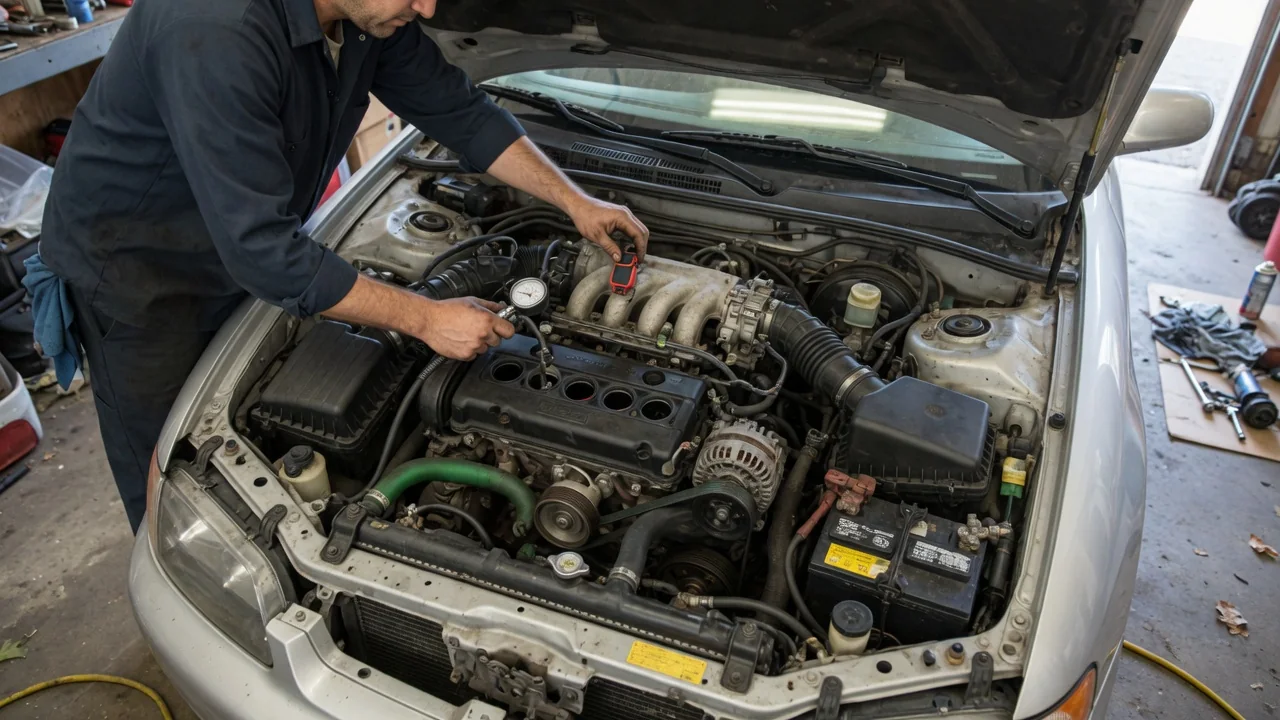
One common confusion is between the compression ratio specification and a compression test reading. The specification is a unitless design ratio that does not change unless parts are altered. A compression test measures cranking pressure in each cylinder with a gauge, and the result depends on ring sealing, valve condition, cranking speed, cam timing, and engine temperature. A workshop compares those pressure readings against the manufacturer's stated values and against each other, looking for one cylinder that falls well below the rest, rather than trying to calculate the ratio from pressure.
Limits and Next Steps
The number has clear limits as a diagnostic or comparison tool. It does not reveal engine health, predict power output on its own, or indicate that one car is better than another. Published values are nominal, and production tolerances, machining during a rebuild, or aftermarket pistons and gaskets can move the real figure. Anyone modifying an engine, particularly by adding forced induction or changing cylinder head work, should treat the ratio as something to be measured and calculated for that build rather than assumed from a brochure.
For a stock vehicle, the practical next step is to look up the figure in the owner's manual, the factory service information, or the manufacturer's technical specifications for the exact engine code, since the same model can be sold with several engines. If the concern is knock, rough running, or lost power, professional testing such as a compression or leak-down test gives evidence about sealing that the specification cannot. Any stored fault codes should be interpreted alongside those results, since a code points to a condition to investigate, not a confirmed failed part.